

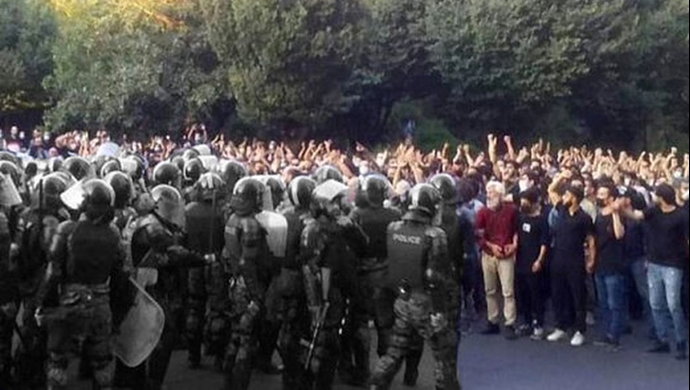

The disarray in Iran’s regime has become so evident that even media affiliated with the regime do not shy away from highlighting aspects of this chaos.
On November 13, Jahan-e Sanat news website wrote, “We have reached a point where Iranian livelihoods, whether at the family level, business level, or even on a macro scale, are on a path of structural collapse. A glance at discouraging economic news reveals that the 14th government is stuck in a quagmire, where every action, right or wrong, leads to sinking further.”
The structural integrity of affairs has unraveled. A vivid example of this quagmire is the crisis of power outages, fuel shortages at power plants, and the excuse of electricity cuts due to air pollution caused by heavy fuel oil consumption. The mullahs’ regime seeks to address budget deficits by increasing gasoline prices and facilitating conditions for price hikes through the tactic of selling imported gasoline. However, it cannot prevent the cascading effects of these price increases on other goods. This is just one of the issues confronting regime officials, causing them to live in constant fear of another uprising by the enraged people.
Jahan-e Sanat wrote, “The structural integrity of affairs has fallen apart, and today’s very difficult conditions will turn into dangerous conditions. Can the economic collapse be averted?”
The interwoven nature of Iran’s issues is further exposed in surveys by government-affiliated institutions, which show that only 5% of the society supports the regime, while the rest are dissatisfied, protesting, and demanding fundamental changes. They recognize that urgent action is needed, and it won’t be achieved with the current regime.
On November 13, the state-run Ham-Mihan wrote, “Iran’s issues can no longer be resolved on a case-by-case basis or with technical and minor adjustments. If a car has a flat tire, it is fixed. But when the condition of the car is so poor that it requires major overhauls, a comprehensive repair is the only solution.”
This fear and despair have entangled the regime’s officials in numerous other issues, ranging from gasoline prices and power outages in homes and industries to the release of greenhouse gases, which will soon confront the regime on the global stage, as well as factional and mafia conflicts among regime supporters and the unprecedented poverty and misery of the people.
Now that the regime has suffered major defeats in warmongering, exporting terrorism, and using proxy forces, it faces the risk of a repeat of protests like those of November 2019 and Autumn 2022, according to economist Hossein Raghfar. This economics professor, reviewing the uprisings and public protests, does not hide his concern for the regime’s future.
On November 13, Jamaran website quoted him as saying, “Before November 2019, more than 80 bread riots had occurred in the country. Riots that began in Mashhad in 1994… The November 2019 protests were more extensive and destructive, caused by structural discrimination and inequalities stemming from regime policies.”
Raghfar emphasizes that November 2019 was essentially an explosion of cumulative protests and humiliations; young people who see no bright future ahead of them are the same individuals who instill fear in the regime’s officials about the next uprising. Experts within the clerical regime view the 2022 protests as a continuation of the November 2019 demonstrations, with broader public participation standing against oppression and injustice.
And now, Iranian society awaits the final uprisings and transformative movements that will set ablaze the disintegrated structure of the regime in the fire of the righteous anger of the heroes of this land.