

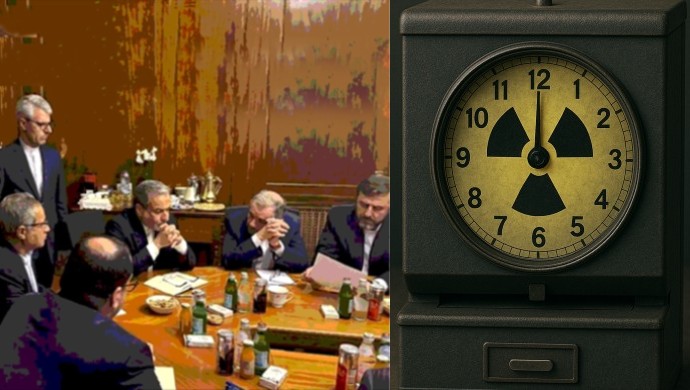

After negotiations between the Iranian regime and the United States did not take place on Tuesday, May 3, 2025, a new round of infighting began within the regime. On Sunday, May 4, Javan, the official newspaper of the Islamic Revolutionary Guard Corps (IRGC), described negotiations as a “trap” designed to ensnare the regime. In its editorial, with a sarcastic tone aimed at those advocating for talks, it wrote: “From the first day Donald Trump became the U.S. President, he initiated both agreement and threats simultaneously. Although the threats had a military undertone, most internal analysts believed that the U.S., through its maximum pressure campaign, was seeking social unrest and a confrontation between the people and the government. It is necessary to be vigilant about the trap they set, initially luring us into negotiations with leniency, and then, after price collapses, moving towards our red lines to initiate blaming the system…”
Kayhan, a newspaper closely associated with regime supreme leader Ali Khamenei, also wrote: “The Trump administration has imposed a new sanction on Iran every 13 hours. The issuance of 182 sanctions in just 100 days, while simultaneously sending diplomatic messages, is a clear sign of America’s contradictory yet explicit approach: maximum pressure, even under the guise of negotiation! Each of these sanctions is not merely an economic measure but an attempt to strike at the (system).”
The following day, May 5, Kayhan confronted proponents of negotiation with Trump’s statements about his goals for talks with the regime, writing: “The U.S. President stated that the goal of negotiations is the complete dismantlement of Iran’s nuclear program. He talks about negotiation and agreement while, in the last 100 days alone, he has imposed 182 new sanctions on Iran! What sane mind does not see this blatant contradiction?! He simultaneously invites to dialogue and, with the same hand, tightens the noose of sanctions around our necks!”
This internal regime conflict escalated as U.S. Secretary of State Marco Rubio had stated that the Iranian regime must cease developing long-range missiles, enriching uranium, and supporting terrorist groups. Concurrently, the French Foreign Minister warned the regime about the reimposition of the snapback mechanism, stating that with the imminent end of the JCPOA in a few weeks, if Europe’s security interests are not guaranteed, they will not hesitate to reimpose all the sanctions that were lifted ten years ago.
France’s warning came as Abbas Araghchi, the Iranian regime’s Foreign Minister, appealed to Europe for engagement with the clerical regime. In a message on the X network on May 3—devoid of the regime’s usual bravado—he wrote: “A credible and durable agreement is within reach. All it takes is firm political will and a fair attitude.”
In the new round of infighting, the regime’s Friday prayer leaders also tuned their instruments against the government, each in their own way deeming negotiations futile. Among them, Allah Nour Karimi Tabar, the Friday prayer leader in Ilam, said: “So far, we have seen nothing but betrayal from America in various fields. I have a recommendation for the Ministry of Foreign Affairs: if they want to enter this arena, their first action should be to retrieve our assets from foreign banks.” Ahmad Mahmoudi, the Friday prayer leader in Isfahan, also stated: “Our officials should be aware that our system will not retreat not just one step, but not even half a hand’s breadth!”
Meanwhile, advocates for negotiation within the regime, reacting to the taunts and sarcasm from their rivals, highlighted the impasse facing the entire system. The Setareh Sobh newspaper wrote on May 4: “The economic conditions in Iran have left no path but agreement. The people’s livelihood is in dire straits. There is potential for social protest. Iran is internationally isolated politically and frozen economically. If we do not accept the costs of an agreement, these issues will create even higher costs for us.”