

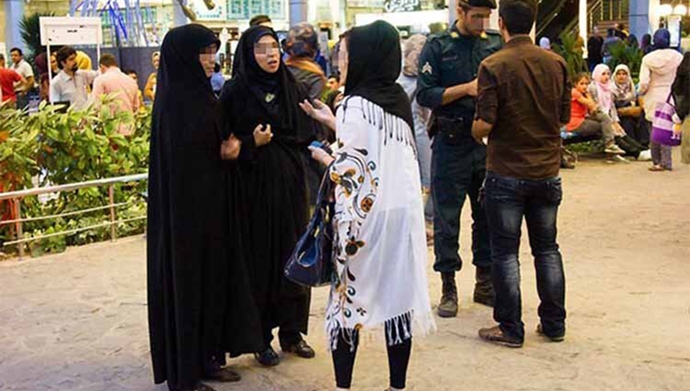

The inhumane law known as “Chastity and Hijab” was supposed to be delivered to the government by Mohammad Bagher Ghalibaf, the speaker of the Iranian regime’s Majlis (parliament), on December 13. However, the day came and went with no sign of the law being enforced, and the regime’s parliament announced a holiday on December 12. It is said that this sudden closure was an attempt to avoid dealing with the issue and its potential consequences. Earlier, in a press conference on November 27, Ghalibaf insisted that this law would definitely be delivered on December 13. He also revealed that “the delay in decision-making regarding this law was due to security considerations surrounding the anniversary of the 2022 protests.”
On April 3, Supreme Leader Ali Khamenei stated in a meeting with government officials: “Unveiling the hijab is both religiously and politically forbidden.” However, due to fears of social repercussions and serious doubts and opposition within the regime itself, the “Chastity and Hijab” law has been temporarily suspended.
The numerous contradictory statements expressed by both supporters and opponents of this law reveal the deadlock that the regime is facing on this issue.
The Friday prayer leaders, who are appointed by Khamenei, have loudly protested the delay in implementing this law. However, regime president Masoud Pezeshkian, in a televised interview, stated that this law is riddled with ambiguities from an implementation perspective. It is reported that during a meeting with Khamenei, Pezeshkian expressed his inability to enforce the law.
Ali Rabiei, Pezeshkian’s social advisor, wrote: “These days, whenever I speak to loyal individuals from various factions within the system, they all believe that the Chastity and Hijab law is unenforceable and will lead to civil disobedience.”
Regarding the delay in delivering this law, Alireza Salimi, a member of the Majlis presidium, told the state-run Khabar Online on December 14, “Following the government’s request and negotiations during the National Security Council meeting, based on a letter from the Secretariat of the Supreme National Security Council, the implementation of the hijab law was postponed until the government submits its proposed amendments.” Salimi noted that previously, the parliament speaker had also delayed the delivery of the law for three months based on a letter from the same secretariat.
On the other hand, many members of the parliament and the Guardian Council, who were the architects of this law, claim that the regime’s security depends on enforcing this controversial law. Fouad Izadi, one of the figures close to Khamenei, emphasized the necessity of implementing the law, stating, “If this law is not enforced, the Hezbollahi youth will no longer fight on the frontlines.”
Raja News, affiliated with Saeed Jalili, a political rival of Pezeshkian during the regime’s staged elections, described Pezeshkian’s request to halt this law as a “failure to manage the country,” stating, “Isn’t this inability to govern precisely what is referred to as a ‘crisis situation’? The fact that a law endorsed by the leader and passed by parliament is stopped at the request of the Supreme National Security Council sends a clear message to society: instead of implementing legal approvals, the government tries to shirk its responsibilities by invoking excuses like ‘expediency.’ Worse still, this suspension is portrayed as a favor to society.” Raja News added, “There is no doubt that halting laws and failing to enforce them delivers yet another blow to public trust in the government and the state’s governance structures.”
It is clear that both the faction that claims to have a “concern for hijab” and insists on implementing this law, and those who oppose it, share one common point: their problem is neither “legal” nor “religious,” but rather political and security-related.
Fearing an uprising after the fall of #Syria’s bloodthirsty dictator—a blow that has shaken the regime to its core—the Iranian regime has resorted to a humiliating “show of flexibility” regarding its inhumane and anti-Islamic mandatory hijab law. However, a partial retreat is not…
— Maryam Rajavi (@Maryam_Rajavi) December 15, 2024
Regarding the infighting among regime factions and the deadlock of the clerical regime over the contentious mandatory hijab law, Mrs. Maryam Rajavi, the president-elect of the National Council of Resistance of Iran, said that the regime has backed down from “inhumane and anti-Islamic” mandatory hijab law in fear of “an uprising after the fall of Syria’s bloodthirsty dictator—a blow that has shaken the regime to its core.”
“However, a partial retreat is not enough. The regime’s president must either bow to Iranian women and annul this law of velayat-e faqih or resign,” she added.