

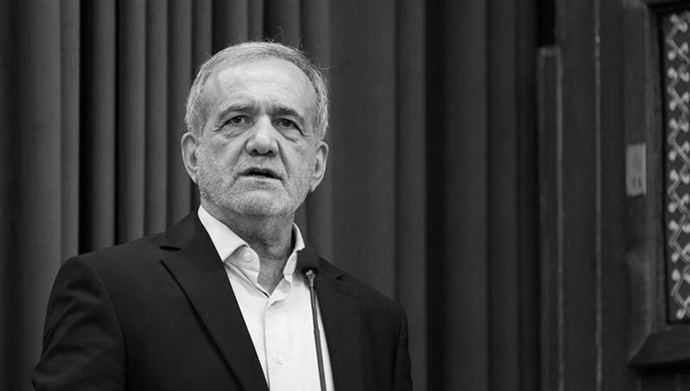

For a long time now, Iranian regime president Masoud Pezeshkian has been engaged in a repetitive game using the words “imbalance” and “austerity” when talking about the root of the excruciating livelihood problems and their solution. This is a disgusting deception and pouring salt on the agonizing wounds of people who are fed up with the most basic issues of life.
On Thursday, March 6, Pezeshkian, addressing a group of “elites,” said: “Water, electricity, gas, fuel, energy, and money are all in imbalance.” Then, regarding the result of these imbalances, he added that if it continues in this manner, “one day, we will fall flat on our faces.”
A few days prior, in a meeting with Iranian regime officials in western Tehran, he had said: “We have an imbalance in electricity, we have an imbalance in gas, we have an imbalance in water, we have an imbalance in money, we have an imbalance in land. Everywhere we look, it’s the same. School, high school… in all of these…”
The charade of playing with the word “imbalance” has become so excessive that even the regime’s own media has realized it. The state-run Iran newspaper wrote on February 16, “For the energy sector, or for the monetary and banking sector, or pension funds, the word bankruptcy is not used because it has a broad political and social burden. Using the word bankruptcy might have far more political costs than the bankruptcy itself; for example, pension funds. That’s why everyone prefers to use the word imbalance. Imbalance is both more stylish and beautiful, and it has no psychological, political, or social burden. It’s as if it’s just a simple management or economic problem, and this problem will be resolved soon, and there’s no need to worry. But is that really the case?”
More vulgar and disgusting than playing with the word “imbalance” is Pezeshkian’s playing with the word “austerity.”
To solve the gasoline problem, the regime president says: “If everyone walks one kilometer more each day and uses their personal car less, there will be savings in fuel consumption” (Hamshahri newspaper, March 1).
In the summer, Pezeshkian said to turn off the lights and open the windows, and in the winter, he recommends closing the doors and completely forgetting about heating. On the sidelines of a trip to Eslamshahr, he said: “Brothers, Friday prayer leaders and the congregation, tell them not to turn on 10 lights, not to use electricity and gas where it is not necessary. Instead of 10 rooms, heat one room…”
On February 27, Pezeshkian set a new record in playing with the word “austerity,” claiming that by turning off the lights and heating appliances, not only the fuel problem but also the livelihood problem would be solved. Pezeshkian said: “If we can save 10 percent, we can save several billion dollars, maybe 10-20 billion dollars, and we can give that to people’s livelihoods, to the livelihoods of employees, to our lives, to development, 10 percent, which I believe we can even save up to 50 percent in water, in electricity, in gas…”
These are all, of course, outrageous remarks that Pezeshkian has made. But this is just the surface of the matter. The reality is that deception and playing with words is a trend and arises from the nature of the regime; a regime that has stolen the revolution, freedom, values, culture, national wealth resources, and the fruits of the labor and work of Iran’s working people, and massacred the freedom-seeking children of the country.
Indeed, the real root of the problems is the oppressive regime and the usurpation of the right to sovereignty and the vote of the oppressed. The real solution is nothing but the uprising and overthrow of the oppressor; “be it Shah or Supreme Leader”!
This “political imbalance” is so obvious that regime sources also occasionally and, of course, in a completely clumsy manner and in the power struggle, admit it and write: “We have elections in the country, but we do not have the power to choose… The Guardian Council has taken away the power of choice from the people with its vetting supervision…” (Setareh Sobh newspaper, February 23).