

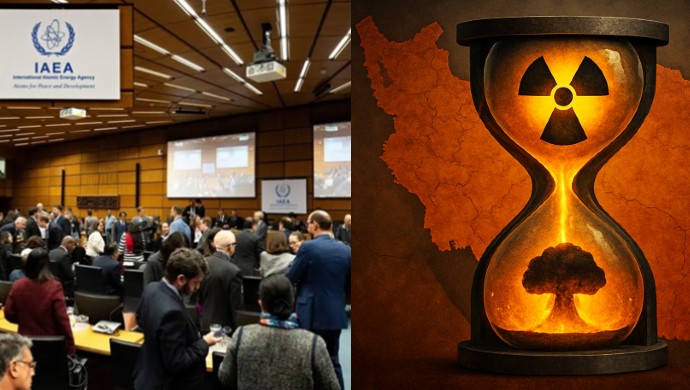

The international community’s patience with the Iranian regime’s nuclear deception has run out. In a significant diplomatic blow to Tehran, the International Atomic Energy Agency’s (IAEA) Board of Governors passed a decisive resolution on Thursday, November 20, demanding immediate and full cooperation from the regime regarding its clandestine nuclear activities. The resolution, sponsored by the United States, Germany, France, and the United Kingdom, is a direct result of Tehran’s policy of stonewalling and obstruction, which has left critical questions about its weapons-grade uranium stockpile unanswered for over five months.
Crucially, this resolution puts the regime’s compliance with the NPT Safeguards Agreement back on the permanent agenda of the Board of Governors. This procedural move pushes the clerical regime one step closer to a referral to the UN Security Council, a scenario it deeply fears.
A sharp rebuke to the regime’s obstructionism
The resolution issues a series of non-negotiable demands that leave no room for the regime’s typical tactics of delay and obfuscation. It explicitly states that Iran must, “without delay,” provide the agency with “precise information on nuclear material accountancy and safeguarded nuclear facilities.” This is a direct challenge to the secrecy surrounding its stockpile of 60% enriched uranium.
Furthermore, the resolution pressures the regime to grant inspectors the full access they require, particularly to the nuclear sites that were damaged during the military strikes in June 2025. For five months, the regime has blocked IAEA access to these facilities in a flagrant violation of its obligations under the Nuclear Non-Proliferation Treaty (NPT). To ensure sustained pressure, the resolution mandates the IAEA Director General to provide comprehensive reports on the regime’s compliance not only to the Board of Governors before each quarterly meeting but also simultaneously to the UN Security Council.
A failed strategy of nuclear blackmail
The regime’s defiant stance was a calculated gamble that has spectacularly backfired. Following the June strikes, Tehran believed it could leverage its unverified stockpile of highly enriched uranium to extract concessions from the international community. The IAEA has repeatedly stated that it has been unable to verify the status of Iran’s 440.9 kilograms of uranium enriched up to 60% purity—a short, technical step from the 90% needed for a weapon. This stockpile is enough material for as many as 10 nuclear bombs, a fact the IAEA calls “a matter of serious concern.”
Instead of intimidating the world, this strategy has only deepened the regime’s isolation. The resolution passed with a strong majority of 19 votes in favor.
Public bravado cannot hide internal panic
Publicly, the regime’s representatives responded with empty arrogance. The Iranian regime’s ambassador to the IAEA, Reza Najafi, dismissed the resolution’s authors as “deaf and visionless” and vaguely threatened that the resolution would have its own “consequences.”
However, this defiant posture crumbles when examining the regime’s own internal media, which reveals a deep-seated panic. Just hours before the vote, the state-run Sazandegi newspaper published an article admitting that the resolution would plunge the regime into the “nightmare” of facing the “Security Council” and an international consensus. The paper conceded that even the threat of the resolution had “changed the psychological and strategic balance between Iran and the West,” acknowledging that the West would use the situation to “rebuild multilateral pressures.” This admission exposes the profound weakness and fear behind the regime’s tough rhetoric.
A firm policy is the only way forward
This resolution is a crucial step, validating what the Iranian Resistance has warned about for decades: the mullahs’ regime is inherently untrustworthy and will never abandon its quest for nuclear weapons through dialogue alone. The regime’s bad faith was proven when it unilaterally terminated the September Cairo agreement with the IAEA shortly after UN snapback sanctions were reimposed.
The international community must build on this momentum. Appeasement has failed. The only language this regime understands is that of strength and resolve. The path forward requires the full enforcement of all UN Security Council resolutions and the intensification of a maximum pressure policy. Ultimately, the only lasting solution to the threat posed by the regime is to stand with the Iranian people and their organized resistance, who are striving to overthrow the mullahs’ rule and establish a democratic, secular, and non-nuclear republic in Iran.