

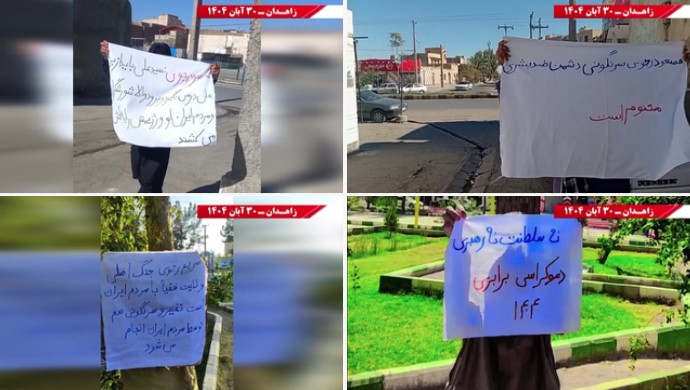

On Friday, November 21, 2025, PMOI Resistance Units in Zahedan resumed their weekly campaign of defiance. Challenging the regime’s repressive apparatus in the restive southeast, these units displayed placards and banners that articulated a clear political vision: the total overthrow of the mullahs’ rule and the establishment of a democratic republic that rejects all forms of dictatorship, whether clerical or monarchical.
The slogans displayed across Zahedan emphasized that the “tremors of overthrow have struck the clerical rule.” Central to their message was the rejection of the past and present tyrannies, with banners reading, “No to mullahs, no to shah, yes to freedom and a democratic republic” and “A dictator is a dictator; whether with a turban or a crown.” These activities underscore that despite the regime’s heavy-handed crackdowns, the Resistance Units remain the “torchbearers of uprising and revolution.”
A society ready to explode
The Resistance Units in Zahedan also drew powerful parallels between the current state of Iranian society and the events that sparked the Arab Spring. One prominent slogan warned Supreme Leader Ali Khamenei to “learn from Ben Ali and step down; otherwise, Iran’s rebels and people will burn his regime down.”
The self-immolation of Ahvazi youth Ahmad Baledi is a symbol of a society in Iran ready to explode pic.twitter.com/1JEZZ768fE
— People's Mojahedin Organization of Iran (PMOI/MEK) (@Mojahedineng) November 22, 2025
This warning references the tragic death of Ahmad Baledi, a 20-year-old student from Ahvaz. On November 2, 2025, municipal agents and security forces violently destroyed his family’s food kiosk—their sole source of income—despite the family holding a valid permit. When Ahmad threatened self-immolation in protest, a regime agent callously taunted him, saying, “Burn yourself, let’s see how you burn.” Ahmad set himself on fire and succumbed to his injuries on November 11.
The Resistance Units described Baledi’s death not as an isolated tragedy, but as “a symbol of a society in Iran ready to explode.” His death has ignited public fury across the country, exposing a system where the simple act of earning a living can become a capital offense.
Plundering the nation’s lifeblood
Beyond political repression, the banners in Zahedan addressed the catastrophic environmental mismanagement destroying the lives of Iranians. Slogans declared, “The solution to the water shortage is the eviction of military contractors and water thieves who are linked to the IRGC and the office of the Supreme Leader.”
We want to free our oppressed people and homeland. pic.twitter.com/UeDdNvDoxP
— People's Mojahedin Organization of Iran (PMOI/MEK) (@Mojahedineng) November 22, 2025
This outcry reflects the reality of Iran’s “water bankruptcy,” a crisis manufactured by the Islamic Revolutionary Guard Corps (IRGC). Experts note that the IRGC operates a “water mafia,” spearheading environmentally ruinous dam projects without ecological assessments to secure lucrative contracts. While the regime attempts to deflect blame with absurd claims—such as a member of the Assembly of Experts attributing drought to women not observing the hijab—statistics show a deliberate policy of plunder. Over 80% of renewable water is allocated to agriculture sectors that benefit regime affiliates, while ordinary citizens face rationing.
An uprising against executions
The regime’s primary response to these compounding crises has been a surge in lethal repression. In response, the Resistance Units declared: “Our response to executions is uprising.” They noted that the “fundamental issue of our time is the overthrow of the regime of executions and massacres.”
The fundamental issue of our time is the overthrow of the regime of executions and massacres. pic.twitter.com/lEUk4VY5Il
— People's Mojahedin Organization of Iran (PMOI/MEK) (@Mojahedineng) November 22, 2025
Since the beginning of 2025, the regime has executed at least 1,700 prisoners, nearly double the figure from the same period the previous year. This brutal wave of killing was formally condemned on November 19, 2025, by the Third Committee of the United Nations General Assembly. In its 72nd resolution on Iran, the UN expressed “grave concern” over the use of the death penalty to silence dissent.
As the Resistance Units in Zahedan concluded, “The overthrow of the inhuman regime is inevitable,” and “Tehran will rise, and the mullahs and IRGC will kneel before the people.”