

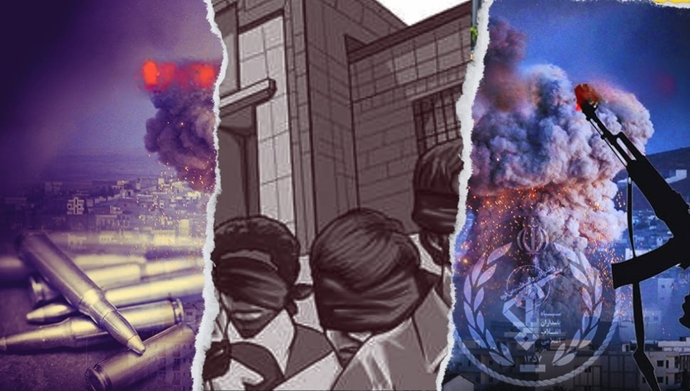

One of the prominent features of the foreign policy of Iran’s regime over the past four decades has been the systematic use of hostage-taking as a tool for blackmail and extracting concessions from Western countries. This unethical and inhumane policy, initiated in the early days of the regime, has recently evolved into more complex and extensive forms. Whether for financial gain or political extortion, hostage-taking has been a cornerstone of the regime’s foreign policy.
History of Hostage-Taking in the Mullahs’ Regime
The roots of hostage-taking in the clerical regime trace back to the early years following the 1979 Revolution. One of the most infamous examples was the takeover of the U.S. Embassy in Tehran in 1979, during which 52 American diplomats were held hostage for 444 days. This act, carried out with the approval and support of Ruhollah Khomeini, the founder of the mullahs’ regime, marked the beginning of hostage-taking as an official tool in the regime’s foreign policy.
Mohammad Ali Jafari, former commander of the Islamic Revolutionary Guard Corps (IRGC), explicitly admitted in 2019 that the hostage-taking was a planned move, with the regime Supreme Leader Ali Khamenei among its proponents. He also emphasized that without this act, the clerical regime would have collapsed within its first decade. These statements highlight how hostage-taking has been used not only as a means of pressure but also as a strategy for the regime’s survival since its inception.
Hostage-Taking: A Profitable Trade
The Iranian regime’s hostage-taking policy is not limited to political objectives; it has also become a significant financial resource for the regime. Numerous examples, ranging from negotiating for the release of hostages to receiving billions of dollars from Western countries, illustrate how the regime has turned hostage-taking into a lucrative business.
For instance, the release of French and American hostages in Lebanon in exchange for arms and spare parts from the U.S., as well as at least $300 million from frozen funds in France, are notable examples.
During the infamous “Iran-Contra” scandal, the regime secured the release of seven American hostages in exchange for TOW missiles and Hawk missile systems, which were transported to Tehran’s airport. Similarly, during nuclear negotiations, the regime leveraged hostage-taking to obtain over $6 billion in cash, along with military equipment and spare parts, while also securing the release of 25 of its operatives from the U.S. and Europe.
The regime’s long record of blackmail is extensive, but a recent example is the $6 billion payment by the Biden administration to facilitate the exchange of five dual-national hostages, which garnered significant international attention.
In 2015, IRGC officer Mohsen Rezaee admitted to a potential income strategy through hostage-taking:
“If a war breaks out between Iran and the U.S., we will take 1,000 Americans as captive in the first week, and each of them will cost several billion dollars to release. At that point, our economic problems might also be solved.”
Similarly, IRGC agent Hassan Abbasi said:
“How does the IRGC fund itself? The IRGC takes a spy… The government collects $1.7 billion and hands over the spy. Thus, the IRGC earns the billion or two billion dollars that the government wants to allocate to it.”
These remarks clearly illustrate that hostage-taking serves as a major financial resource for the regime, funding domestic repression and external terrorist activities.
Recent Examples of Hostage-Taking
After losing its strategic depth, the Iran’s regime has increasingly resorted to hostage-taking of foreign and dual nationals. The detention of Italian journalist Cecilia Sala in Tehran, following ten days of authorized and legitimate activities, is a recent example of this policy. Shortly before her arrest, an Iranian man in Italy was detained on charges of supplying drone components to the IRGC. The direct connection between these two events demonstrates how the regime continues to use hostage-taking as a tool for bargaining and blackmail.
Moreover, the arrest of two regime operatives in Italy and the U.S. on charges of supplying drone components used in attacks on U.S. military personnel in Jordan demonstrates that the regime exploits not only its own citizens but also knowledge-based companies to advance its military and terrorist objectives.
Motivations and Excuses for Hostage-Taking
Reviewing cases of hostage-taking reveals two primary motivations behind the regime’s actions:
- Financial Motivations:
The led regime uses hostage-taking to demand large sums of money for the release of captives, providing a significant portion of its budget. These funds are predominantly allocated to domestic suppression, supporting regional terrorist groups, and financing the IRGC. - Political Motivations:
Hostage-taking allows the regime to extract political concessions from Western countries and reduce international pressures. Exchanging hostages for detained terrorists in the West is another objective. The release of Assadollah Assadi, a regime diplomat arrested in Belgium, and Hamid Noury, implicated in the 1988 massacre in Sweden, exemplify this strategy.
Excuses for Hostage-Taking
To justify its profitable hostage-taking practices, the mullahs’ regime attributes a range of accusations to foreign and dual-national citizens, including:
– Drug trafficking
– Money laundering
– Illegal border crossing
– Photographing restricted areas
– Espionage for foreign states
– Illicit relationships
The Impact of Western Appeasement on Continued Hostage-Taking
One of the main enablers of the regime’s extensive hostage-taking policy is the appeasement of Western countries. This pragmatic approach emboldens the regime and exacerbates its behavior.
Engaging with a regime that institutionalizes hostage-taking only escalates this practice. Adopting firm and stringent policies not only enhances global security but also paves the way for freedom and democracy in Iran.
Solutions to Counter Hostage-Taking
To halt the regime’s systematic hostage-taking, the international community must take decisive actions:
- Designating the IRGC and Ministry of Intelligence as Terrorist Entities:
Listing these entities as terrorist organizations would curb the regime’s capacity for hostage-taking and terrorist activities. - Closing Regime Embassies and Missions:
The regime’s embassies act as hubs for espionage and planning terrorism. Shutting them down would disrupt these networks. - Imposing Targeted Sanctions:
Stricter sanctions against senior officials and institutions linked to hostage-taking would increase the costs of this policy for the regime. - International Collaboration:
Western nations must adopt a unified stance against hostage-taking and refrain from negotiating or engaging in deals with the regime.
In conclusion, hostage-taking in Iran is a systematic and planned phenomenon adopted by the regime. This policy will only end when the international community takes a firm stand against it.