


Recognizing the main conflict and its fronts in Iran is a crucial issue that society and political forces must understand. If we fail to discern the direction and tactics of this conflict during any shifts in power, we risk falling prey to the propaganda of diversionary and proxy wars, inadvertently or deliberately aiding the tyrannical regime of the mullahs and its goals.
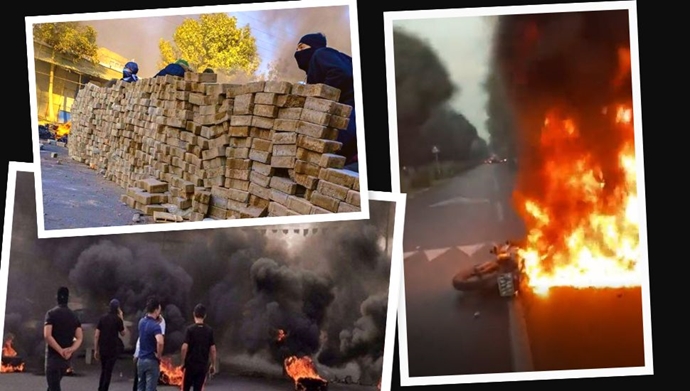
For more than four decades, the main conflict has been between the Iranian people and the regime, and it will continue until the regime’s downfall. On one side are the people and their blood-stained resistance movement, and on the other is the regime, with all its factions, supporters, lobbies, and hidden and visible elements, united in the common goal of preserving the system.
From four decades ago until today, the regime’s first and last priority has been the preservation of its own existence at any cost.
With his twisted mindset, regime founder Ruhollah Khomeini believed that fueling diversionary or proxy wars in the region’s Muslim countries was the only way to ensure his regime’s survival. His first target was Iraq, a neighboring Shia-majority country. By starting a devastating war under the banner of “exporting the revolution,” he diverted both domestic and global attention from the issues of regime change and resistance for eight years.
Sending schoolchildren in human waves over minefields, parading fake Imams Mahdi on white horses at the front lines, hanging keys to paradise around the necks of expendable soldiers, bombing cities, destroying homes, grieving mothers, and organizing coffin parades under the banner of “War, War Until Victory” were among the manifestations and outcomes of this so-called “exporting of the revolution.”
He justified and legitimized this devastating war with slogans like “Conquering Jerusalem through Karbala!” Even after losing the war with Iraq and being forced to accept a ceasefire, he continued planning, as he believed his survival depended on constant crisis-making.
At that time, with his sinister foresight, Khomeini knew that without engaging this newly revolutionized country in a foreign war, he would not be able to carry out mass executions inside Iran and massacre the children of the anti-monarchic revolution.
He fully understood that if he did not portray this self-made war as a “war between Islam and infidelity!” or a “holy defense!” akin to the Crusades in Europe, he would lose control, and the revolutionary forces would overthrow him.
His successor, Ali Khamenei, now faces an explosive society, and to counter the threat of overthrow, he needs to create crises in the region and beyond Iran’s borders.
Following Khomeini’s worn-out methods, he has no choice but to suppress the flames of the war with the Iranian people and their Resistance by starting a conflict between “Islam and infidelity.”
Slogans like “Liberating Karbala!” “Making ablution in the waters of the Tigris and Euphrates!” “Defending the Shrine of Zaynab!” and “Liberating Jerusalem!” are deceitful pretexts for this diversionary war. The fuel for this ominous war is the lives of Palestinian, Syrian, Iraqi, Yemeni, Lebanese, and, of course, Iranian children.
The danger of an unquenchable uprising engulfing Khamenei and his regime is so terrifying, imminent, and certain that they are willing to spend all of Iran’s wealth to produce missiles, drones, and nuclear bombs to escape it.
They have no qualms about setting the entire region on fire to delay their downfall.
Today, any mind not polluted by the dirty politics of appeasing religious despotism can easily recognize who is the main instigator of war and crisis in the Middle East, and which side is fanning the flames to prevent the fire from spreading to its own cloak and tent.
Iranian regime officials openly admit that had they not exported the crisis beyond Iran’s borders, they would not have survived the anger and fiery uprising of the Iranian people today.
On November 3, 2023, Mojtaba Zonnour, member of the regime’s parliament, said, “If the perseverance of this nation, if the sacrifice of the children of this nation in the holy defense and the defense of the shrines of the Ahl al-Bayt had not existed, know that if it weren’t for the blessings of the Islamic Revolution, today Iran would be Gaza. Martyr Hajj Qassem Soleimani, martyr Abu Mahdi al-Muhandis, and the martyrs defending the shrines blocked the satanic keys so that the defensive lines of the capital of the revolution and the tent of Ahl al-Bayt in the world would not be broken. Syria remained, Iraq remained, Hezbollah was born thanks to the revolution, Hashd al-Shaabi was created thanks to the revolution, Yemen was mobilized thanks to the revolution, Gaza, Lebanon, Syria, and Palestine remained by learning from the Islamic Revolution, and if it weren’t for this learning, nothing would remain today.”
It is clear that as long as this regime remains in power, it will not hesitate to ignite diversionary and proxy wars. However, after decades of waging war in the region, the regime’s warmongering strategy is firing back against it as many agree that Tehran is the head of the snake in the region.
As far as the advocates of appeasement are concerned, they prefer not to confront the head of the snake, unless they are left with no other choice.
There is only one key and irreplaceable solution to end this regime’s war-mongering: recognizing the Iranian people’s struggle and their democratic alternative, the National Council of Resistance of Iran, to overthrow the mullahs’ rule. Democratic change in Iran is undoubtedly within reach, possible, and certain with this option.