

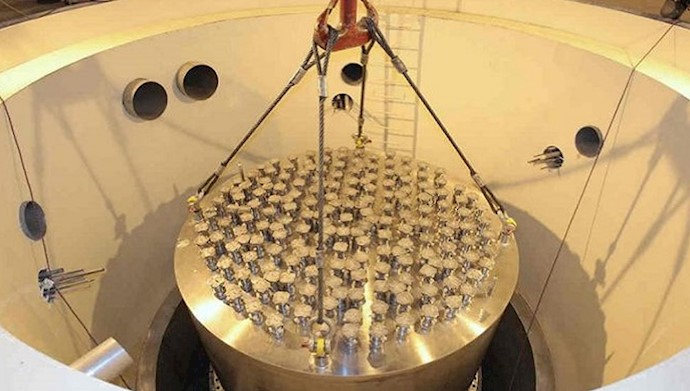

In recent developments, the Iranian regime’s nuclear program, shrouded in secrecy for decades, has once again surfaced as a critical threat. A statement released by the Defense and Strategic Research Committee of the National Council of Resistance of Iran (NCRI) on October 14, 2024, reveals that the regime’s Supreme Leader Ali Khamenei has ordered the Islamic Revolutionary Guard Corps (IRGC) to expedite the completion of a nuclear bomb.
From the outset, Khamenei’s 2010 fatwa, which claimed that developing and using nuclear weapons was forbidden under Islamic law, was deliberately crafted to deceive the international community and obscure Iran’s true nuclear ambitions.
Khamenei’s statement in 2010 declared, “We do not believe in nuclear weapons, and we will not seek them. According to our religious and ideological principles, the use of such weapons of mass destruction is prohibited.” This, it turns out, was intended to mislead international observers while covertly advancing nuclear capabilities.
The NCRI, which has been monitoring Iran’s nuclear ambitions for over three decades, consistently exposed secretive uranium enrichment facilities and other elements of the regime’s covert operations. In light of these revelations, it is now clear that Khamenei’s fatwa was a deceptive maneuver to conceal the true scope of Iran’s nuclear intentions.
The release of confidential IRGC documents highlights increasing pressure within the regime to revise its nuclear doctrine. Senior officials in Iran, including Hassan Khomeini, a prominent cleric and relative of the regime’s founder, have publicly called for heightened military deterrence, citing the need for “iron fists” in the face of regional threats. On October 5, Hassan Khomeini remarked that “military deterrence must rise to a higher level,” an indication that factions within the regime are pushing for a nuclear-armed Iran as the ultimate form of deterrence.
These internal calls were echoed in a letter signed by 39 members of Iran’s parliament on October 9, urging a shift in defense policy to include nuclear weapons. Some parliament members have openly suggested that Khamenei’s fatwa could be subject to change based on shifting geopolitical circumstances. For example, Mohammadreza Sabaghian, a member of parliament, stated, “Building a nuclear weapon is necessary for creating deterrence and ensuring national security.”
Khamenei has remained silent on these public debates, leaving many to speculate that the fatwa is no longer relevant and that the regime’s nuclear ambitions have shifted towards building a strategic arsenal to safeguard its future.
The NCRI has repeatedly warned the international community about the dangers of Iran’s nuclear program, emphasizing that time is running out to curb the regime’s ambitions. For over three decades, the Iranian Resistance has exposed Tehran’s nuclear activities through over 120 press conferences, including major revelations about uranium enrichment in Natanz and the heavy water project in Arak. Despite these efforts, the international community’s response has often been hesitant, providing Iran with the space to advance its nuclear program.
Now, with internal documents revealing the regime’s urgent push for nuclear weapons, the NCRI stresses the need to invoke the “snapback mechanism” of UN Security Council Resolution 2231, which would reimpose suspended sanctions and curb Iran’s nuclear activities. The NCRI also insists that only the overthrow of the current regime will permanently eliminate the nuclear threat it poses to both the Iranian people and the wider region.
Once again, I call upon the international community, particularly the European Union, to adopt a firm stance toward the Iranian regime—essential for achieving peace and stability both regionally and globally. Such a policy should encompass the following:
-Designating the clerical… pic.twitter.com/m48KyHq2d4— Maryam Rajavi (@Maryam_Rajavi) October 14, 2024
As tensions escalate, the global community must decide whether to take decisive action or risk further destabilization in a region already plagued by conflict. The Iranian Resistance, which has consistently opposed the regime’s nuclear aspirations, continues to advocate for international solidarity in preventing the Iranian regime from achieving its nuclear ambitions.