

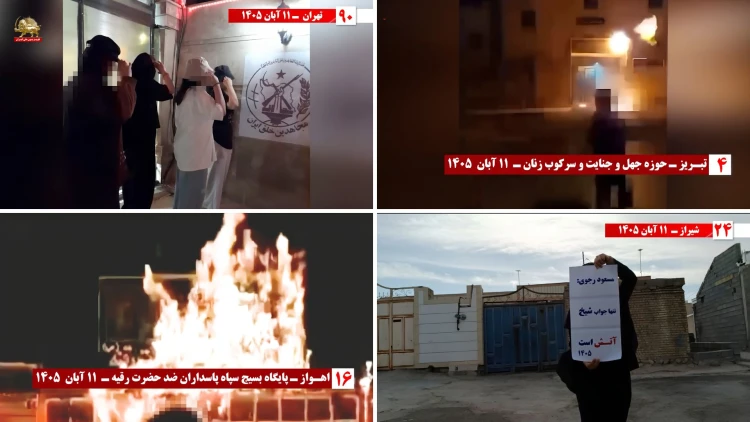

On November 2, 2026, Resistance Units affiliated with the People’s Mojahedin Organization of Iran (PMOI/MEK) carried out 30 operations against the Iranian regime’s centers and symbols of repression across the country, marking the upcoming seventh anniversary of the November 2019 uprising.
The operations targeted IRGC Basij bases, institutions associated with the regime’s repressive apparatus, and propaganda symbols featuring current and former regime leaders. They were part of a broader campaign of 90 activities across Tehran and 24 other cities, which also included anti-regime graffiti and banner installations.
November 2—Iran
PMOI/MEK Resistance Units mark the anniversary of the November 2019 uprising with 30 daring operations against regime targets across Iran. They sent the message that the flames of resistance and uprising are still alive and the regime can't stifle the voice of… pic.twitter.com/0iTK01BY4A— People's Mojahedin Organization of Iran (PMOI/MEK) (@Mojahedineng) November 5, 2026
The campaign commemorated the more than 1,500 protesters killed during the November 2019 uprising, sending the message that the regime’s bloody crackdown had failed to extinguish the Iranian people’s determination to achieve freedom.
Targeting the regime’s institutions of repression
A significant portion of the operations focused on facilities affiliated with the Islamic Revolutionary Guard Corps (IRGC) and its Basij paramilitary organization, which has played a central role in suppressing anti-regime protests.
In Tehran, Resistance Units set fire to the entrances of two IRGC Basij bases. Similar operations took place in Tabriz, while in Ahvaz, Resistance Units targeted another Basij base.
Tehran
Resistance Units set fire to entrance of IRGC Basij base. pic.twitter.com/eJN1m2VyFj— People's Mojahedin Organization of Iran (PMOI/MEK) (@Mojahedineng) November 5, 2026
In southeastern Iran, Resistance Units set fire to a Basij base sign in Iranshahr and another in Chabahar. In Dezful, southwest Iran, a Basij base signpost was targeted. In Rask, Resistance Units set fire to the entrance of an IRGC battalion headquarters.
Tabriz was also the scene of two operations targeting institutions associated with the regime’s promotion of religious fundamentalism. Resistance Units set fire to these facilities, challenging institutions that serve the regime’s ideological apparatus.
The geographical distribution of these operations, from Tehran and Tabriz to southeastern and southwestern Iran, highlighted the Resistance Units’ continued activities in different parts of the country.
The selection of Basij and IRGC facilities carried particular significance ahead of the November anniversary. These organizations were instrumental in the violent repression of the 2019 protests. By targeting their facilities and symbols, Resistance Units sought to challenge the atmosphere of intimidation that the regime has maintained through its security apparatus.
Challenging the regime’s leadership and propaganda symbols
Another major component of the campaign targeted propaganda images of the regime’s leadership, challenging its efforts to maintain an image of authority across Iran.
In Tabriz, Mashhad, Marand, Mahshahr, Kermanshah, Bojnurd, and Isfahan, Resistance Units set fire to posters and banners featuring former supreme leader Ali Khamenei.
Images of his successor, Mojtaba Khamenei, were also targeted. In Tabriz, Resistance Units burned a large poster featuring Mojtaba Khamenei, while similar operations took place in Mashhad, Abadan, and Sabzevar.
Ahvaz
Resistance Units target IRGC Basij base. pic.twitter.com/eonDbATCYF— People's Mojahedin Organization of Iran (PMOI/MEK) (@Mojahedineng) November 5, 2026
In Tehran, Resistance Units set fire to a poster featuring former regime president Ebrahim Raisi, notorious for his role in the 1988 massacre of political prisoners. Another operation in the capital targeted an image of Qasem Soleimani, the former commander of the IRGC Quds Force.
In Isfahan, Resistance Units also burned a billboard promoting the Ministry of Intelligence’s telephone number for reporting citizens, directly challenging a symbol of the regime’s surveillance and intelligence apparatus.
The November 2019 uprising: A turning point in Iran’s struggle for freedom
The November 2019 uprising began on November 15 after the regime abruptly announced gasoline price increases of 50 to 300 percent. Initially sparked by economic grievances, the protests rapidly spread to more than 190 cities and evolved into nationwide demonstrations calling for the overthrow of the clerical regime.
The regime responded with unprecedented violence. Security forces, including the IRGC and Basij, opened fire on demonstrators while the authorities imposed a near-total internet blackout to conceal the scale of the crackdown. At least 1,500 protesters were killed, and thousands more were arrested.
Tabriz
Resistance Units set fire to large poster featuring regime supreme leader Mojtaba Khamenei pic.twitter.com/tFKWsADE4Y— People's Mojahedin Organization of Iran (PMOI/MEK) (@Mojahedineng) November 5, 2026
Mahshahr, where security forces carried out one of the most notorious massacres of the uprising, became a symbol of the regime’s brutality. The November 2 operation targeting a large banner of Ali Khamenei in Mahshahr therefore carried particular historical significance.
Despite the killings and mass arrests, the uprising exposed the depth of public anger against the ruling establishment and demonstrated how economic protests could develop into a nationwide movement challenging the regime’s survival.
Keeping the spirit of uprising alive
Seven years after November 2019, the Resistance Units’ latest operations demonstrate the continuing relevance of that uprising to Iran’s struggle against clerical rule.
The 2019 crackdown was intended not only to end the protests but also to deter future generations from confronting the regime. The November 2 campaign challenged that objective by commemorating the victims through renewed acts of defiance across the country.
The Resistance Units’ activities link the memory of the fallen protesters to the ongoing resistance against the institutions and leadership responsible for repression.
The message of the anniversary campaign is that the November 2019 uprising was not an isolated event or a closed chapter of Iran’s history. Its legacy continues to inform the Resistance Units’ activities as they seek to challenge the regime’s climate of fear and prepare the political ground for the next nationwide uprising.