

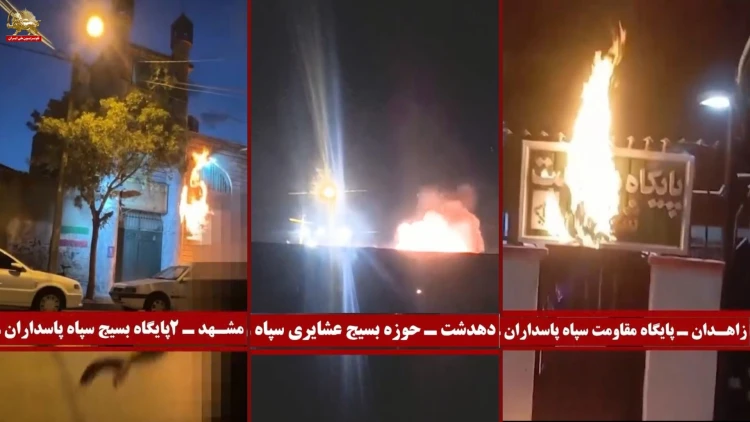

On September 29, PMOI/MEK Resistance Units carried out 40 operations across Iran to commemorate the victims of the September 30, 2022, Bloody Friday massacre in Zahedan.
The operations ranged from targeting entrances and signposts of IRGC Basij bases to setting fire to propaganda posters, banners, and billboards associated with the Iranian regime. They were reported in cities stretching from Zahedan, Iranshahr, Chabahar, and Bandar Abbas in the south and southeast to Tehran, Mashhad, Karaj, Qazvin, Isfahan, Kermanshah, and other parts of the country.
By staging the campaign across Iran, the Resistance Units turned the anniversary of an event rooted in Zahedan into a nationwide commemoration and challenge to the regime.
The massacre that became Bloody Friday
The September 30, 2022, massacre took place less than two weeks after the beginning of the nationwide uprising triggered by the death of Mahsa Zhina Amini.
September 29—Iran
PMOI/MEK Resistance Units honor the memory of the martyrs of the 2022 Zahedan Bloody Friday with 40 daring operations targeting the regime's apparatus and symbols of repression and tyranny. pic.twitter.com/hgynhrbPws— People's Mojahedin Organization of Iran (PMOI/MEK) (@Mojahedineng) October 4, 2026
People in Zahedan gathered after Friday prayers amid outrage over the rape of a 15-year-old Baluch girl by a local police commander. Demonstrators assembled outside Zahedan’s 16th police precinct demanding that those responsible be arrested and tried.
Security forces subsequently opened fire on protesters and worshippers. More than 100 people, including children, were killed and hundreds were injured.
The massacre became one of the defining episodes of the 2022 uprising and remained a rallying point for protests in Sistan and Baluchestan long after mass demonstrations had subsided elsewhere.
From remembrance to action across Iran
The September 29 operations focused heavily on institutions and symbols associated with the regime’s security and repressive apparatus.
Zahedan
Resistance Units set fire to the entrance of an IRGC Basij base pic.twitter.com/LuDEpvSQy8— People's Mojahedin Organization of Iran (PMOI/MEK) (@Mojahedineng) October 4, 2026
Resistance Units targeted IRGC Basij bases or their entrances and signposts in Dehdasht, Mashhad, Zahedan, Iranshahr, Ahvaz, Javanrud, and Chabahar. Other actions targeted billboards described as promoting intelligence or IRGC surveillance activities, including operations in Bandar Abbas and Zahedan.
Another large part of the campaign focused on regime propaganda. Resistance Units set fire to posters and banners depicting regime founder Ruhollah Khomeini, former supreme leader Ali Khamenei, current supreme leader Mojtaba Khamenei, and former Quds Force commander Qasem Soleimani. Such operations were reported in Tehran, Mashhad, Karaj, Isfahan, Qazvin, Saveh, Azadshahr, Qom, Ilam, Kermanshah, Birjand, Dezful, Shahriar, and Zahedan.
The geographic spread was central to the campaign’s message. An anniversary associated specifically with the killing of protesters in Zahedan was marked through actions in numerous provinces, connecting the memory of the massacre with continued opposition activity across the country.
Zahedan’s continuing place in the resistance
Bloody Friday has remained part of the political memory of Zahedan in the years since 2022. Friday demonstrations continued in the city in 2023 despite security measures and internet restrictions. Resistance Units have also repeatedly marked the massacre through public displays and other activities.
Zahedan
Resistance Units torch signpost of an IRGC Basij base pic.twitter.com/YPAw5oRs9k— People's Mojahedin Organization of Iran (PMOI/MEK) (@Mojahedineng) October 4, 2026
Just days before the latest anniversary, on September 25, 2026, Resistance Units displayed placards in Zahedan commemorating those killed on Bloody Friday. According to the PMOI, the messages connected remembrance of the victims with calls to continue resistance across Iran.
This continuity gives the September 29 operations a broader significance within the PMOI’s narrative: Bloody Friday is not solely an atrocity to be remembered, but part of an unfinished struggle that began during the 2022 uprising.
Four years after the 2022 uprising, the anniversary operations show how the Resistance Units preserve its memory while linking it to ongoing organized resistance.
The continued activities of the Iranian Resistance inside Iran preserve the demands and memory of the uprising despite years of repression. The latest operations keep the flame of the 2022 uprising alive and prepare the political and organizational ground for the next nationwide uprising aimed at overthrowing the clerical regime.