

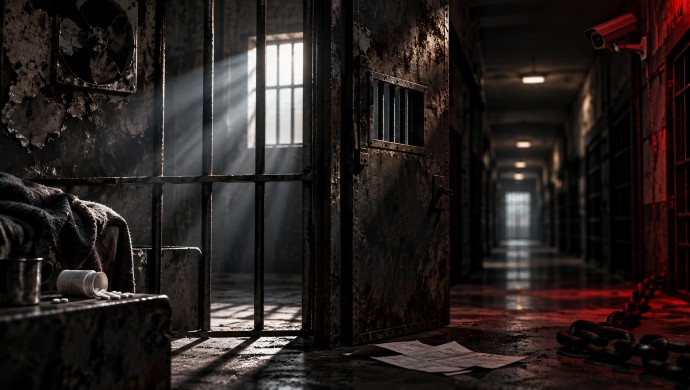

The Iranian regime has intensified pressure on prisoners across the country, imposing harsher conditions, restrictions and punitive measures, with political prisoners facing particular pressure.
In a September 11 statement, the National Council of Resistance of Iran (NCRI) reported worsening conditions in prisons in Qom, Urmia, Tehran and Mashhad, ranging from disease and inadequate food to raids, restrictions on visits and confiscation of prisoners’ belongings. A day earlier, the NCRI warned about the sudden transfer of political prisoner Parisa Kamali from Yazd to Bandar Abbas Prison.
The measures come against the backdrop of continued pressure on political prisoners who have challenged the regime from behind bars, including Kamali and death-row prisoner Mohammad Javad Vafaei Sani.
Pressure spreads across Iran’s prisons
The reports point to a pattern that extends across several prisons. At Qom Central Prison, inmates are facing severe environmental pollution, infestations of bedbugs, lice and vermin, and hundreds of cases of skin and infectious diseases. Influenza and COVID-19 have also spread while already meager food rations have been further reduced.
At Urmia Central Prison, authorities have increased restrictions on political prisoners and confiscated refrigerators and televisions that inmates had bought with their own money.
Female prisoners at Evin have meanwhile faced shorter family visits. Prisoners have also endured temperatures above 40 degrees Celsius, broken cooling systems, bedbug infestations and restrictions on fresh air and sports facilities. In August, guards raided Ward 7, beating political prisoners and destroying or confiscating their belongings.
These measures show how even basic living conditions and everyday necessities can become instruments of pressure against prisoners.
Parisa Kamali: exile after continued defiance
One of the clearest examples is Parisa Kamali. Around midnight on September 8, prison authorities removed the 40-year-old political prisoner from her ward without prior notice and transferred her from Yazd to Bandar Abbas Prison.
Kamali was arrested in Isfahan in 2024. The Revolutionary Court of Ardakan sentenced her to six years in prison and two years of internal exile in Sarbaz County on charges including membership in the People’s Mojahedin Organization of Iran (PMOI/MEK), acting against national security and destruction of public property.
Her transfer follows earlier pressure. In May, Yazd Prison authorities denied her medication and refused to transfer her to hospital after she issued a message commemorating those killed in the January uprising. She has subsequently continued issuing messages from prison against executions and in support of resistance.
Mohammad Javad Vafaei Sani: pressure under the shadow of execution
The pressure is even more ominous in the case of Mohammad Javad Vafaei Sani, a boxing champion and coach imprisoned in Mashhad’s Vakilabad Prison.
On September 3, prison authorities raided his ward, confiscated his limited sports equipment and denied him access to newspapers. Authorities had previously refused to allow him to attend his father’s funeral.
Vafaei Sani, 30, has been imprisoned since 2020 and subjected to severe physical and psychological torture. After two previous death sentences were overturned, he was sentenced to death for a third time in September 2024. The Supreme Court upheld that sentence on October 4, 2025. His request for a retrial was later rejected and his case was forwarded to the department responsible for implementing sentences.
Despite the threat of execution, Vafaei Sani has continued sending political messages from prison, most recently declaring that difficult prison conditions provide no justification for remaining silent.
Repression reflects fear of another uprising
The increasing pressure inside Iran’s prisons also fits into a wider pattern of repression following the nationwide uprising of January 2026.
The regime’s increasing reliance on executions, harsh sentences and intimidation is intended to reimpose fear on a society that demonstrated its willingness to challenge the ruling establishment during the uprising.
The authorities’ pressure against political prisoners points not to confidence but to fear that resistance inside prison is connected to wider defiance outside it.
The international community must protect defenseless prisoners
Prisoners have few means to protect themselves when authorities control their access to medicine, food, family, information and, in death-row cases, life itself. This places a particular responsibility on the international community.
The Iranian Resistance calls on the United Nations, the Human Rights Council, the UN High Commissioner for Human Rights and other human rights organizations to condemn the regime’s treatment of prisoners and dispatch an international fact-finding mission to Iranian prisons to meet detainees, especially political prisoners.