

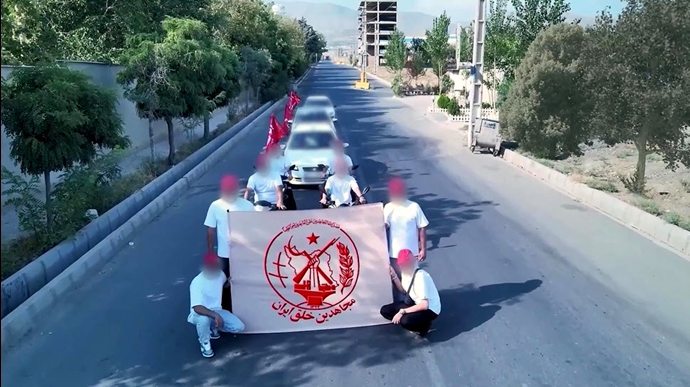

Ahead of the 61st anniversary of the founding of the People’s Mojahedin Organization of Iran (PMOI/MEK), Resistance Units have marked the occasion with activities across Iran, including a march by a Resistance Unit in Karaj and 30 slogan-writing activities in cities across the country.
The activities, reported on September 3, took place in Tehran, Karaj, Mashhad, Qom, Shiraz, Rasht, Ahvaz, Kermanshah, Bandar Abbas, Hamedan, Zanjan, Ilam, Sanandaj, Sabzevar, Saveh, Ivan Sarab, Bukan, Minab, and Islamabad-e Gharb. They come ahead of September 6, the anniversary of the PMOI’s founding in 1965.
Sixty-one years of “neither Shah nor Sheikh”
The slogans displayed by the Resistance Units connected the anniversary directly to the PMOI’s political history and its rejection of both the former monarchy and the ruling clerical establishment.
Among the messages were: “The PMOI means 61 years of ‘neither Shah nor mullahs,’” “61 years of struggle,” “Death to the oppressor, be it the Shah or the Supreme Leader,” and “Neither monarchy nor mullahs’ rule—democracy and equality.”
Video#ResistanceUnits Parade in Karaj: A Challenge to the Execution Machine and Proof of Resistance Readiness – September 3, 2026 #Iran #WeSupportMEK #StopExecutionsInIran pic.twitter.com/mG6e9FVXQi
— Iran Freedom (@4FreedominIran) September 4, 2026
Other slogans pointed to the political objective of that struggle: “A democratic republic free of mullahs and Shah” and “The democratic revolution of the Iranian people will put an end to religious dictatorship.” Resistance Units also displayed messages honoring PMOI founder Mohammad Hanifnejad and supporting Massoud and Maryam Rajavi.
A struggle that began under the Shah
The anniversary refers back to September 6, 1965, when Mohammad Hanifnejad, Saeid Mohsen, and Ali Asghar Badizadegan founded the organization under the Shah’s rule.
The organization emerged in a period when the Shah had suppressed organized opposition through SAVAK. Its founders concluded that the struggle for freedom required a permanent, organized movement and treated political struggle as a discipline that had to be studied and learned.
That history also gives meaning to another slogan used in the latest activities: “The great achievement of the organization’s founders was establishing an organization with honesty and sacrifice as its guiding principles.”
Defiance amid arrests and executions
The anniversary activities are also significant because of the risks faced by people associated with the PMOI and Resistance Units.
In July, the regime’s State Security Force had acknowledged arresting 6,500 people since the beginning of the recent conflict, including 567 people it said were connected to the PMOI. In the past year, the regime has executed 11 PMOI members and several PMOI supporters are on death row.
The most recent execution was Mehdi Khanaki, a 26-year-old PMOI member and law graduate who had participated in the January 2026 uprising, was arrested in Karaj on February 10. He was subsequently sentenced to death by the Karaj Revolutionary Court and executed on July 22.
On August 8, the National Council of Resistance of Iran also published the names of 11 PMOI supporters arrested in May, June, and July whose whereabouts or status it said remained unknown.
Against this backdrop, openly displaying the PMOI emblem, writing political slogans, or taking part in a Resistance Unit march carries particular significance. The latest activities turn the organization’s 61st anniversary from a historical commemoration into a statement of continued resistance inside Iran.