

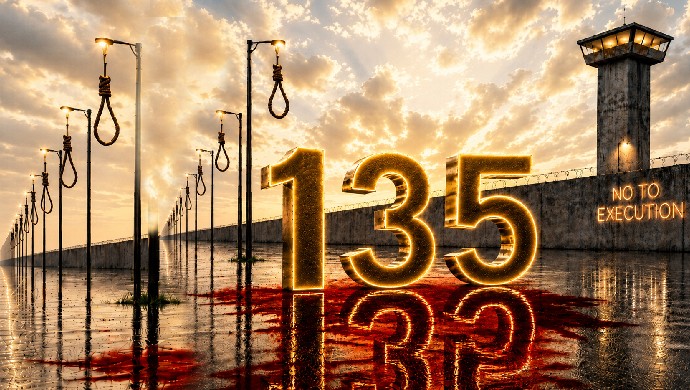

Prisoners across 61 facilities in Iran held the 135th week of the “No to Executions Tuesdays” campaign on August 25, 2026, continuing their weekly hunger strikes against the death penalty. With the addition of Nour Prison in Mazandaran province this week, the campaign, now in its third year, has grown from isolated acts of defiance into one of the most widespread and sustained organized protests inside Iran’s prison system.
The prisoners participating in the campaign continue their strikes despite severe security pressures, threats, and restrictions on communications. In their weekly statement, the striking inmates emphasized that their growing numbers reflect a widening consensus among detainees.
“The continuous expansion of the number of participating prisons shows that the demand to stop executions has found a broader scope among prisoners,” the campaign’s statement read.
Escalating execution machine and judicial complicity
The prisoners’ statement highlighted a rapid acceleration in executions, noting that 378 individuals have been executed since the start of the Persian year in March 2026. The total number of executions since Masoud Pezeshkian’s government took office has surpassed 4,000.
The statement also drew attention to recent structural changes within the Iranian regime’s judiciary, warning that these shifts are designed to fast-track death sentences at the behest of the regime’s intelligence apparatus.
“The authoritarian ruling government has made changes in the judiciary under the command of the ‘Velayat-e Faqih’ [Supreme Leader] in the past week,” the prisoners wrote. “These changes have been made with the suggestion and direct interference of security institutions and pose a serious threat to prisoners and those sentenced to death; because there is no independent institution to review and process their cases and these individuals are even deprived of the right to a chosen lawyer.”
Suppressing dissent: Targeting protesters and political prisoners
Between December 2025 and January 2026, a massive round of nationwide uprisings brought the Iranian regime to the brink of collapse, surviving only through the massacre of thousands of protesters. Following the death of Ali Khamenei in February 2026 and the installation of his son, Mojtaba, in March, the regime has increasingly relied on the gallows to prevent further revolts fueled by the country’s worsening economic crisis.
According to the campaign’s statement, the regime executed two political prisoners from the December-January protests last week: Ghaem Hosseini in Isfahan Prison and Majid Adineh in Central Karaj Prison.
Simultaneously, death sentences have been confirmed or issued for several other political prisoners. The statement identified Arghavan Fallahi in the women’s ward of Evin Prison, Rasoul Rezaei in Mashhad’s Vakilabad Prison, and Mohammadreza Majidi-Asl. Majidi-Asl was recently subjected to a sudden transfer from Greater Tehran Prison to Ghezel Hesar Prison. The striking prisoners noted that Ghezel Hesar is “the center of executions in Tehran province and one of the regime’s slaughterhouses,” and warned that his transfer indicates an imminent risk of execution following an opaque and unfair judicial process.
“In these days, the economic conditions of the people are getting worse day by day due to the inefficiency, anti-people policies, and crisis-making nature of the government. On the other hand, instead of solving the crisis, the government does nothing but suppress society,” the statement read. “They do not stop executions—especially the execution of protesting youth and political prisoners—to prevent protests, and every day we witness the execution of one of these dear ones.”
Call to action: Uniting prisons and society
In closing their statement, the prisoners expressed gratitude to the various social segments inside Iran who have echoed their calls to end capital punishment. They specifically linked their prison resistance to the ongoing civil demonstrations by retirees, workers, and teachers in Iran’s streets.
“We sincerely thank the retirees and all those who make the voice of ‘No to Execution’ heard by everyone in gatherings and in the streets and alleys. The teachers’ call for ‘No to Execution’ must be supported by workers and other social forces,” the prisoners stated. “In every classroom, children must be taught that authenticity always belongs to the right to life, not death and execution.”
The prisoners participating in the 135th week of the “No to Executions Tuesdays” hunger strike are located in 61 prisons.