

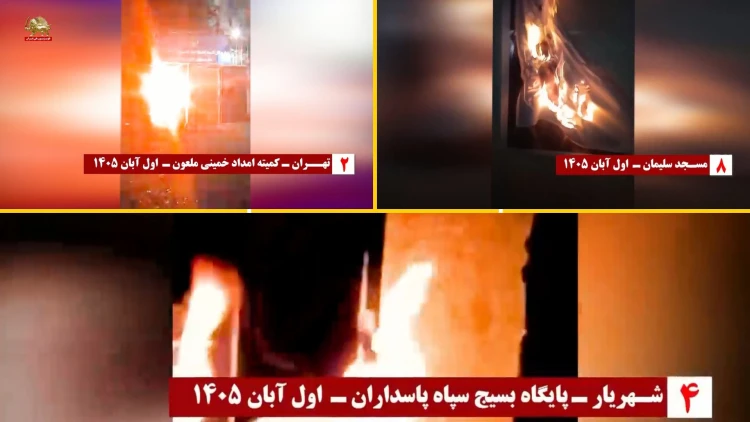

On October 23, 2026, Resistance Units affiliated with the People’s Mojahedin Organization of Iran (PMOI/MEK) carried out 10 operations across Tehran and six other cities in response to a violent crackdown on vendors at Tehran’s central fruit and vegetable market. The operations targeted institutions affiliated with the regime, IRGC Basij bases, and propaganda symbols featuring the regime’s leadership.
October 23—Iran
PMOI/MEK Resistance Units carry out 10 daring operations in response to regime authorities attacking and destroying the stalls of vendors in Tehran's Tarebar Square. pic.twitter.com/gGsPZ3frFm— People's Mojahedin Organization of Iran (PMOI/MEK) (@Mojahedineng) October 25, 2026
The operations followed an incident in which municipal authorities used heavy machinery to destroy merchandise belonging to struggling vendors, triggering angry confrontations. By responding to this incident, the Resistance Units sought to demonstrate that the authorities’ mistreatment of ordinary Iranians would not go unanswered.
Destruction of livelihoods at Tehran’s produce market
On October 18, municipal agents entered Tehran’s central fruit and vegetable market and used a loader to remove and destroy produce belonging to vendors. Videos circulating on social media showed angry confrontations between traders and municipal personnel as the authorities disposed of their merchandise.
One vendor protested that a shipment worth 50 million to 60 million tomans had been destroyed after its owner had stayed awake throughout the night attempting to sell it. He questioned what law allowed officials to destroy the products of farmers who had worked for months to bring their goods to market.
For farmers and small traders already struggling with economic hardship, the destruction of merchandise represents far more than the loss of a day’s earnings. It can mean losing the money invested in cultivation, transportation, and other expenses, leaving families without the income they depend on.
The incident illustrated the vulnerability of ordinary citizens confronting authorities who can destroy their livelihoods with little apparent accountability.
Resistance Units target regime institutions and propaganda across Iran
The October 23 operations extended well beyond the capital, targeting institutions and symbols associated with the regime’s apparatus of repression.
In Tehran, Resistance Units carried out an operation against a center of ideological indoctrination and repression. In another operation, they set fire to a headquarter of Khomeini Relief Committee, which is complicit in looting the people’s wealth. A third operation targeted an IRGC Basij base in the capital.
Tehran
Resistance Units set fire to headquarters of Khomeini Foundation pic.twitter.com/1bni83vJ3e— People's Mojahedin Organization of Iran (PMOI/MEK) (@Mojahedineng) October 25, 2026
In nearby Shahriar, Resistance Units set fire to another IRGC Basij base, extending the campaign against the regime’s paramilitary apparatus.
The operations also targeted propaganda symbols featuring the regime’s leadership. In Tabriz, Resistance Units burned a banner depicting former regime supreme leader Ali Khamenei and his successor, Mojtaba Khamenei. In a separate operation in the same city, they set fire to another banner featuring Mojtaba Khamenei.
In Mashhad, Resistance Units burned a poster of Ali Khamenei, while in Masjed Soleyman, they set fire to a banner featuring the former supreme leader. In Iranshahr, Resistance Units burned a banner depicting Mojtaba Khamenei.
In Nazarabad, near Karaj, Resistance Units targeted a sign directing people to an intelligence-gathering office affiliated with the IRGC Basij, setting it on fire.
Tabriz
Resistance Units set fire to banner featuring regime supreme leader Mojtaba Khamenei and former supreme leader Ali Khamenei pic.twitter.com/K8ygYkfKGN— People's Mojahedin Organization of Iran (PMOI/MEK) (@Mojahedineng) October 25, 2026
Together, the ten operations targeted both physical institutions associated with state power and the propaganda symbols used to project the regime’s authority. Their geographical spread also demonstrated that the response to the Tehran market incident was not confined to the location where the vendors had been mistreated.
Standing up for those who face repression
The significance of the operations lies in their connection to the suffering of ordinary Iranians. The vendors at Tehran’s produce market were attempting to earn a living when municipal agents destroyed merchandise that represented their investment and labor.
By directing their operations against regime institutions, Basij facilities, and propaganda symbols, the Resistance Units demonstrate solidarity with those facing repression.
For people who lack the economic resources or practical means to challenge abuses by powerful authorities, such actions show that their grievances have not been forgotten.
The central message of the operations was that the regime’s mistreatment of vulnerable Iranians would not pass unnoticed or without opposition.