

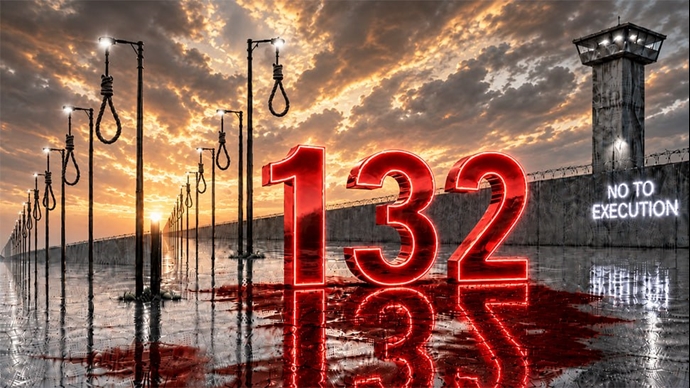

Prisoners across 59 facilities in Iran marked the 132nd week of the “No to Executions Tuesdays” campaign on August 4, 2026, holding hunger strikes to protest the regime’s escalating use of the death penalty. The latest expansion of the campaign coincides with a massive surge in executions following the nationwide uprisings of December 2025 and January 2026, and the subsequent installation of Mojtaba Khamenei as the regime’s Supreme Leader.
In their weekly statement, the striking prisoners highlighted a sharp spike in hangings aimed at terrorizing an explosive society. Since late July, the regime has executed 35 individuals, including a woman and a juvenile offender. Between July 28 and August 4 alone, 28 people were hanged, among them three protesters arrested during the December and January uprisings. The judiciary recently carried out the public hangings of Amirhossein Safari and Abolfazl Sepahi, as well as the execution of 19-year-old Arvin Kheirkhahan in Shahrud.
“Mojtaba Khamenei, the unseen autocratic leader, is following his father’s will, summoning the God of the 1980s, and bringing execution cranes to the streets to take the lives of Amirhossein Safari and Abolfazl Sepahi in public, and hanging 19-year-old Arvin Kheirkhahan… to continue the December-January massacre in this manner and prevent any form of protest for revolutionary and fundamental change,” the prisoners wrote in their statement. They challenged the regime’s narrative, adding, “If these protesting youths were criminals and murderers and are hanged in public, why were their trials not held openly, and why are they secretly tortured and tried?!”
The prisoners’ statement also addressed the regime’s use of recent military conflicts with the US and Israel as a smokescreen to militarize Iranian cities and suppress dissent. Armored units and security checkpoints have been deployed in main thoroughfares.
“It [the regime] has no fear of war and views foreign threats as a blessing, much like the eight-year war with Iraq,” the prisoners noted. “The entire fear of the various ruling factions, despite great differences, is of an internal uprising taking root. They know well that through their missile cities, they can buy as much time as possible against the US and Israel to guarantee their survival.”
The striking inmates explicitly rejected foreign intervention, stating, “No foreign country or power, despite the Iranian government’s warmongering, brings peace, democracy, equality, and human rights to Iran and the region. As opponents of execution, we are naturally also opposed to war and foreign intervention.”
Despite the regime’s execution machinery, political prisoners have demonstrated that organized resistance can force authorities to retreat. The statement highlighted a major victory in Ghezel Hesar Prison over the past two weeks, where 1,500 inmates from Unit 2 launched a 16-day hunger strike after six death-row prisoners were transferred to solitary confinement ahead of their scheduled executions. The collective action forced a high-level regime delegation to halt the immediate executions and commit to a case review for all death-row inmates in the unit within six months.
“In the past two weeks, 1,500 prisoners in Unit 2 of Ghezel Hesar Prison, with iron will, went on a hunger strike for more than two weeks and did not stop until prison agents and the prosecutor’s office agreed to commit to halting the execution of sentences,” the statement read. “We, the prisoners of the campaign, have seen our resolve to continue the campaign grow stronger with the intensification of executions.”
As the regime’s prosecutor escalates threats against activists merely for expressing opposition to executions, the striking prisoners called on the international community to take concrete action.
“We expect parties, organizations, political, human rights, and civil currents that oppose executions to act in defense of the ‘right to life’ and say ‘No to Execution’ without ifs or buts,” the statement urged. “Our power lies in our solidarity, and by resisting and organizing, we will shatter the barrier of tyranny and execution.”
The prisoners participating in the 132nd week of the hunger strike are located in Evin Prison (women’s and men’s wards), Ghezel Hesar Prison (units 2, 3, and 4), Karaj Central Prison, Fardis Karaj Prison, Greater Tehran Prison, Qarchak Prison, Khorin Varamin Prison, Chobindar Qazvin Prison, Ahar Prison, Arak Prison, Langarud Qom Prison, Khorramabad Prison, Borujerd Prison, Yasuj Prison, Asadabad Isfahan Prison, Dastgerd Isfahan Prison, Sheiban Ahvaz Prison, Sepidar Ahvaz Prison (women’s and men’s wards), Nezam Shiraz Prison, Adelabad Shiraz Prison (women’s and men’s wards), Firuzabad Fars Prison, Dehdasht Prison, Zahedan Prison (women’s and men’s wards), Borazjan Prison, Ramhormoz Prison, Behbahan Prison, Bam Prison, Yazd Prison (women’s and men’s wards), Kahnuj Prison, Tabas Prison, Birjand Central Prison, Mashhad Prison, Gorgan Prison, Sabzevar Prison, Gonbad-e Kavus Prison, Qaemshahr Prison, Rasht Prison (men’s and women’s wards), Rudsar Prison, Haviq Talesh Prison, Azbaram Lahijan Prison, Dizel Abad Kermanshah Prison, Ardabil Prison, Tabriz Prison, Urmia Prison, Salmas Prison, Khoy Prison, Naqadeh Prison, Miandoab Prison, Mahabad Prison, Bukan Prison, Saqqez Prison, Baneh Prison, Marivan Prison, Sanandaj Prison, Kamyaran Prison, Ilam Prison, Kerman Prison, Borujen Prison, and Neyshabur Prison.