

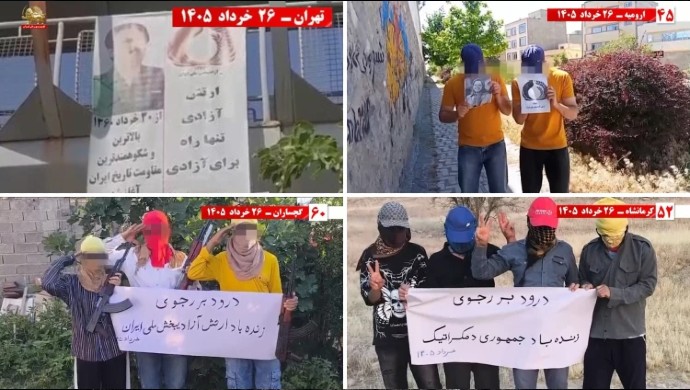

On June 16, 2026, ahead of a monumental international gathering of the Iranian Resistance, PMOI/MEK Resistance Units launched a widespread campaign across Iran. Spanning major cities from the north to the south, these activists took to the streets to commemorate the 45th anniversary of the June 20, 1981, uprising and to declare their unwavering solidarity with the upcoming Free Iran rally in France.
In highly organized displays of defiance, Resistance Units carried out visible activities in Astara, Tehran, Mashhad, Tabriz, Isfahan, Shiraz, Ahvaz, and Urmia. In Tehran and Isfahan, groups of PMOI Resistance Units bravely marched in the streets holding placards that read “Commemorating June 20th.”
June 16—Iran
PMOI/MEK Resistance Units continue their activities in commemoration of the 45th anniversary of the June 20, 1981, uprising and in solidarity and support for the upcoming rally of the Iranian Resistance.#100kFreeIranRally pic.twitter.com/zUFdme7XQP— People's Mojahedin Organization of Iran (PMOI/MEK) (@Mojahedineng) June 17, 2026
Activists hung large placards from pedestrian bridges, including a prominent display in Tehran featuring the photo of Massoud Rajavi alongside the emblem of the National Liberation Army (NLA) with the message: “June 20, 1981, marked the dawn of the most magnificent and monumental resistance in the history of Iran.” The overarching message of these campaigns emphasized a rejection of all dictatorships.
In Mashhad, a large banner read, “Down with the oppressor, be it the shah or the supreme leader,” while in Tabriz, a photo of Massoud Rajavi was installed with the text, “The rule of the mullahs must come to an end.” Resistance Units in Urmia held photos of Maryam Rajavi, and activists in Tehran left flower wreaths to honor the “Day of Martyrs and Political Prisoners.”
The historical roots of the resistance
The bravery seen on the streets today honors a decisive and irreversible turning point in Iran’s contemporary history. On June 20, 1981, the despotic clerical regime fully unmasked its true nature by opening fire on a peaceful, massive demonstration in Tehran. Hundreds were killed in the streets, and thousands more were arrested and sent to firing squads. This brutal crackdown destroyed the democratic achievements gained following the 1979 revolution.
Mashhad
"The National Liberation Army is the ultimate guarantor of enduring peace, freedom, and independence for Iran." pic.twitter.com/UmcJG6sm5C— People's Mojahedin Organization of Iran (PMOI/MEK) (@Mojahedineng) June 17, 2026
However, June 20 also birthed a highly organized opposition. The Iranian Resistance recognized that the regime posed a profound threat to the nation and that compromise would only empower brutal suppression. This realization led to the founding of the National Council of Resistance of Iran (NCRI), establishing the overthrow of the regime and the creation of a democratic republic as the only path to freedom.
A fragile regime relying on executions
Today, the Resistance Units are operating in an environment where the state is deeply terrified of popular outrage. Following the massive nationwide uprising in January 2026 that brought the ruling clerics to the brink of overthrow, the regime finds itself unprecedentedly weak.
To prevent another revolt, the state has resorted to a horrific surge in executions. Exploiting recent wartime conditions, the regime systematically executed political prisoners, recently hanging eight PMOI members and over 20 young people involved in the January uprising.
Tehran
PMOI Resistance Units march with placards that read "Commemorating June 20th." pic.twitter.com/d8aCELphbu— People's Mojahedin Organization of Iran (PMOI/MEK) (@Mojahedineng) June 17, 2026
Despite this crackdown, the Resistance Units have repeatedly proven their operational capacity. During the January uprising, they executed 630 operations to defend unarmed protesters, and on February 23, 2026, 250 PMOI fighters launched a daring assault on Khamenei’s heavily guarded headquarters.
To guide this democratic transition, the NCRI announced a provisional government on February 28, 2026, grounded in Mrs. Maryam Rajavi’s Ten-Point Plan for a pluralistic republic.
The Paris rally as the true voice of Iran
The actions of the Resistance Units inside Iran serve as the beating heart of an upcoming monumental gathering. On June 20, 2026, more than 100,000 supporters of the Iranian Resistance, freedom-loving Iranians, and global political figures will gather at Place Vauban in Paris.
One of the largest Iranian rallies ever held in Europe, this event echoes the exact demands of the Resistance Units on the streets of Tehran and Mashhad: condemning the escalating wave of political executions and demanding a democratic, secular republic. Bound by the central slogan, “No to Shah, No to Mullahs,” the Paris rally rejects any return to past dictatorships. Ultimately, the synchronized efforts of activists inside Iran and the massive global gathering in Paris prove that the resistance movement born out of the bloodshed of 1981 remains the only legitimate force capable of realizing the dream of a free Iran.