

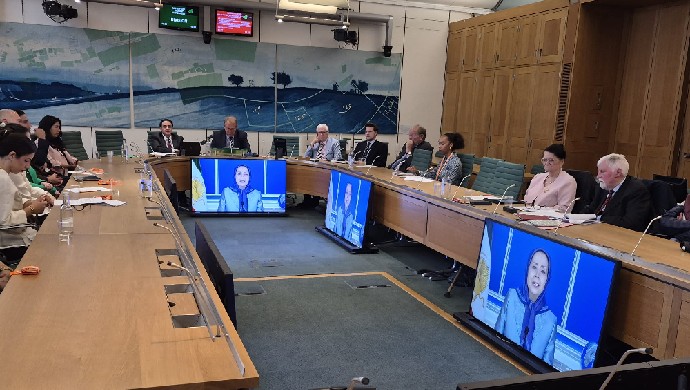

On June 10, 2026, international dignitaries, British cross-party lawmakers, and Anglo-Iranian activists convened at the UK Parliament for a pivotal conference titled “Peace and Freedom with a Democratic Republic.”
Set against the backdrop of a brutal execution spree by the Iranian regime following the nationwide uprising of December 2025 to January 2026, the event underscored the urgent need for a decisive international policy. Participants demanded the immediate terrorist proscription of the Islamic Revolutionary Guard Corps (IRGC) and expressed unwavering support for the organized Iranian Resistance.
The conference highlighted that amid shifting regional dynamics, the establishment of a secular, democratic republic remains exclusively in the hands of the Iranian people, rather than through foreign intervention or appeasement.
Delivering a keynote message to the summit, Maryam Rajavi, President-elect of the National Council of Resistance of Iran (NCRI), outlined the prospects for fundamental change. She emphasized that Iran currently “stands at a critical moment between fear and hope.” The regime, she noted, is desperately attempting to stave off its collapse through executions, detentions, and internet blackouts following the massive January 2026 uprisings. Pointing to the recent execution of 30 political prisoners—including PMOI members and young protesters—she highlighted the clerics’ mounting desperation.
Conference at the UK Parliament: Peace and freedom with a democratic republic
The prospect of change gives hope to the people of Iran#FreeIran10PointPlanhttps://t.co/lAkN9DnrDx pic.twitter.com/G3hzHVajHV— Maryam Rajavi (@Maryam_Rajavi) June 10, 2026
Yet, she affirmed, the Resistance Units remain “the living hope for change in Iran,” actively challenging the apparatus of suppression despite severe repression.
Mrs. Rajavi strongly warned against the remnants of the Shah’s dictatorship, whose glorification of the notorious SAVAK secret police acts as “the biggest gift to the clerical regime” by diverting the true struggle. Reaffirming the Iranian people’s rallying cry of “No to the Shah, No to the Mullahs,” she stressed that “there is no viable solution to the regime’s nuclear weapons program except its overthrow.” She urged the UK to recognize the NCRI’s provisional government and designate the IRGC as a terrorist organization, concluding only the people can bring real change.
Escalating Executions and Human Rights Abuses
The UK parliamentary conference convened on the heels of a horrific execution spree in Iran, demonstrating the regime’s reliance on terror to maintain its grip on power. Following the widespread protests of December 2025 and January 2026—during which the regime killed thousands of citizens calling for regime change—Tehran has increasingly targeted political dissidents. In the past month alone, the regime executed at least eight PMOI members. Numerous protesters from the recent nationwide uprising have also been sent to the gallows.
Addressing this brutal crackdown, Toby Perkins MP cautioned that the regime’s current involvement in regional conflicts is a deliberate strategy to distract from its domestic legitimacy crisis. He stressed that Tehran “requires a constant state of war to maintain impunity and justify its political executions,” calling the surge in hangings a calculated effort to intimidate citizens from joining the Resistance Units.
Mental health researcher and human rights advocate Narges Rahmanfard illuminated the stark contrast between the regime’s projected strength and its actual vulnerability. She categorized the executions of PMOI Resistance Unit members as reflecting “fear rather than confidence.”
There is no viable solution to the regime's nuclear weapons program in Iran except its overthrow.
The Middle East and the Persian Gulf will never find peace and stability until this regime is overthrown.
The global threat of terrorism will never end until its primary source,… pic.twitter.com/icXn0ufmfp
— Maryam Rajavi (@Maryam_Rajavi) June 10, 2026
Adding a legal perspective, Professor Sarah Chandler KC, former president of the Federation of European Bar Associations, delivered a scathing indictment of the regime’s judicial atrocities. She condemned the surge in political executions and the systematic imprisonment of advocates on fabricated national security charges, demanding that the international community support a transition that establishes an independent judiciary and fair trials.
The Illusion of Appeasement and Foreign Intervention
Recent years have seen dramatic geopolitical shifts, including foreign airstrikes on Iranian nuclear sites in June 2025 and military action targeting regime leadership in early 2026. However, speakers at the conference firmly rejected the premise that aerial bombing or foreign military intervention will bring about democratic regime change. They equally condemned the failed policies of diplomatic concessions and engagement with Masoud Pezeshkian’s administration.
Harrow Councilor Matthew Goodwin-Freeman stressed that regime change will not come from foreign airstrikes, but “must originate from the brave citizens of Iran who risk their lives demanding justice.” He declared that “the time for words is over,” urging global support for a peaceful transition to a government deriving its legitimacy from the people’s will.
Struan Stevenson, former MEP from Scotland, categorically rejected both military intervention and the “endless negotiations” of appeasement. He praised the PMOI Resistance Units as “one of the most remarkable movements of civil resistance today,” noting that they continuously expose the regime’s weakness despite facing torture and death.
Neda Zabeti, representing the Anglo-Iranian Youth Association, noted that military confrontation merely gives the regime excuses to tighten its grip, while concessions only “embolden repression.” Emphasizing that the regime acts from a profound “fear of the democratic aspirations of the Iranian nation,” she stated that “lasting democracy can only be achieved through the Iranian people and their organized resistance.”
Malcolm Fowler, a prominent British lawyer with over five decades of experience, vehemently criticized historical policies of appeasement. He insisted that Western nations must “play hardball,” making any diplomatic encounters or trade entirely conditional upon human rights compliance and international norms.
Rejecting Dictatorships: No to the Shah, No to the Mullahs
A prominent and unifying theme throughout the summit was the unequivocal rejection of both the current theocracy and the deposed monarchical dictatorship. Several speakers voiced deep alarm at the harassment campaigns by supporters of the Shah’s son, Reza Pahlavi, and their shocking display of SAVAK symbols in Europe.
Bob Blackman MP condemned monarchist supporters who “openly glorify the return of the Shah’s notorious secret police” and threaten journalists. Pointing out that the PMOI and NCRI remain the central targets of the regime because Tehran’s “greatest fear is obviously the next uprising,” Blackman sharply contrasted Maryam Rajavi’s democratic platform with the actions of the deposed Shah’s remnants.
Jim Shannon MP voiced similar concerns, labeling the SAVAK as synonymous with torture. Demanding immediate action rather than delays, he urged the UK government to recognize that the Iranian people will “not exchange one form of authoritarianism for another.”
Councilor Robert Ward of Croydon drew upon his personal experiences living in pre-revolutionary Iran to debunk historical revisionism, recalling the grim reality of the SAVAK secret police where “people would occasionally disappear.” He stated he was “utterly baffled” by the desire to return to such oppression after suffering under the mullahs.
Naghme Rajabi, President of the Association of Iranian Professionals—who lost family members to regime executions—delivered a blistering critique of Reza Pahlavi. She stated that chasing fantasies on “fake oppositions” sidelines the organized resistance and benefits only the mullahs, urging the UK to support a secular republic over the false choices of a return to the past.
The Path Forward: Resistance Units and the Ten-Point Plan
With both foreign intervention and appeasement dismissed as unviable, the conference presented a unified vision for Iran’s future: Maryam Rajavi’s Ten-Point Plan and the formal recognition of the NCRI’s provisional government.
Ladan Alizadeh, a leading pharmacologist and independent researcher, highlighted the critical role of the organized Resistance Units operating at extreme risk inside the country. She outlined three essential steps to weaken the regime: holding it accountable for human rights violations, proscribing the IRGC as a terrorist organization, and officially recognizing the existing democratic alternative, proving that Iranian society actively rejects the status quo and wants “no return to the past, and no continuation of the present.”
Lord Hamilton of Epsom, a former Minister of State, provided a geopolitical analysis of the regime’s economic vulnerabilities. He explicitly rejected the notion that transferring power to groups like the Revolutionary Guard or relying on the Ayatollah’s son constitutes meaningful change, stating “there’s not much difference for people who want democracy and freedom in Iran.” He expressed deep admiration for the resistance campaign, hoping their relentless fight against the “brutality of the regime” will eventually see democracy fully restored.
The summit concluded with a resolute consensus: the international community must immediately formally engage with the NCRI’s provisional government, close the regime’s embassies, and recognize the Iranian people’s legitimate right to bring an end to the dictatorship and establish a secular, democratic republic.