


On April 8, 2026, a 15-day ceasefire temporarily halted a devastating 39-day regional war. While the conflict dealt severe blows to the Iranian regime, it has become unequivocally clear that external military intervention is not a viable strategy for liberating Iran.
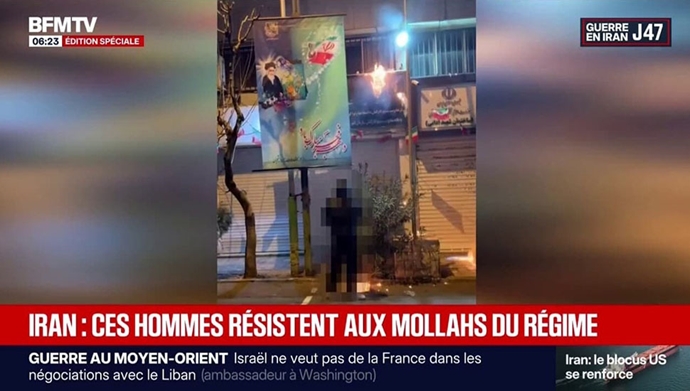
The real war is being waged inside Iran, between the arisen population and a decaying religious tyranny. Highlighting this internal battlefield, France’s BFM TV recently broadcast a special segment revealing the highly organized, clandestine activities of the PMOI Resistance Units fighting on the ground.
Inside the BFM TV report on the shadow war
The BFM TV broadcast captures the intensity of this domestic resistance. Footage shows nighttime operations where posters of regime figures are set ablaze in seconds. BFM TV noted that on the specific night covered, this was just one of about 30 coordinated actions orchestrated across the country. The videos, filmed and distributed by the Iranian resistance, also show symbolic buildings of power being torched.
According to the report, this shadow war is waged by small, clandestine cells firmly opposed to the regime. Highlighting their deep integration into Iranian society, one Resistance Unit member told BFM TV: “Our members can be university professors as well as youth from villages. They lead their normal lives by day and become the regime’s nightmare by night.”
https://twitter.com/BFMTV/status/2044272896697065777?s=20
The broadcast details how these units operate in pairs and conduct discreet training in isolated locations, including shooting practice hidden from the regime’s view.
Expanding ranks in the face of unprecedented brutality
The regime has exploited the fog of war to quietly accelerate its domestic crackdown. Following the death of regime supreme leader Ali Khamenei on February 28, the installation of his son, Mojtaba, on March 9 effectively transformed the regime into a medieval-style hereditary monarchy. To preserve this crumbling power base, the new leadership intensified executions, hanging 10 political prisoners in just one week, including six PMOI members.
The Resistance Units are relentlessly tracked by the regime’s forces. According to BFM TV, nearly 2,000 members of these units have recently been killed or disappeared. Yet, the network remains unbroken. As one member stated in the broadcast: “It’s an impenetrable network. The more the regime’s men arrest us, the more we return with greater impact. In this repression, any mistake means torture or execution.”
This indomitable courage is echoed by captured PMOI members inside Iran’s prisons. Executed heroes like Mohammad Taghavi, who boldly told his executioners he would rejoin the PMOI if released, represent a generation that no longer fears death or torture.
The true path to a democratic republic
To confront such a heavily entrenched apparatus of suppression requires an organized force willing to brave the odds. Just days before the regional war erupted, 250 PMOI fighters launched a daring operation against the Motahari Complex in Tehran—Khamenei’s heavily fortified headquarters. Though around 100 fighters were martyred or captured in the February 23 operation, it fundamentally shattered the regime’s aura of invincibility.
The selflessness of the organized resistance stands in stark contrast to the remnants of the shah regime, who demand foreign powers bomb Iran into ruins. The ultimate endgame for Iran is a democratic revolution led by its people and the Iranian Resistance member, who are willing to risk it all to bring freedom and democracy to their country.