

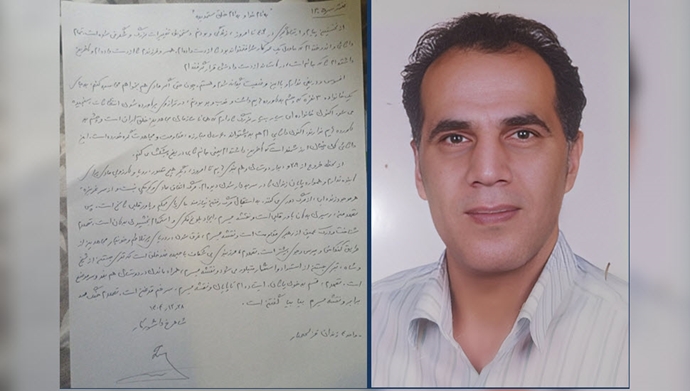

On March 30, 2026, the Iranian regime executed 59-year-old Ali Akbar (Shahrokh) Daneshvarkar, a dedicated member of the People’s Mojahedin Organization of Iran (PMOI/MEK). While the regime’s state media attempted to portray him as a “terrorist” to justify his hanging, Daneshvarkar life and writings—some of which were smuggled out of prison just days before his execution—reveal a man of profound moral clarity, driven by an unwavering commitment to a free Iran.
From civil engineer to political prisoner
Born in Tehran in September 1966, Daneshvarkar was a trained civil engineer. However, under a regime that marginalizes its citizens, he was dismissed from his profession and forced to work as a motorcycle courier to make ends meet. On January 3, 2024, security forces arrested him at his home in Tehran. He was subjected to months of brutal interrogation in the notorious Ward 209 of Evin Prison. In May 2024, he was formally informed of his heavily politicized charges, which included “armed rebellion” (baghi), “collusion against the security of the miserable clerical regime,” “membership in the PMOI,” and destroying regime property.
Losing everything but gaining a “larger family”
On March 19, 2026, just 11 days before he was taken to the gallows, Daneshvarkar penned a poignant letter from Unit 4 of Ghezel Hesar Prison. He began the letter with, “In the name of God and the oppressed people.” In it, he candidly described the immense personal toll of his activism: “From the first message and contact [with PMOI] to today, my life and existence have undergone immense and profound changes. I have lost all my assets and savings… I have lost my wife and child, and I am on the verge of losing my last possession, my life.”
Despite this unimaginable loss, he expressed zero remorse: “I have no regrets… instead of a three-person family that looked to what I could provide… I now have a very, very large family, which is the People’s Mojahedin Organization of Iran… Now I have the backing of 60 years of struggle, resistance, and sacrifice. This is so valuable that I offer my last possession, my life, without hesitation.”
Embracing the ultimate sacrifice for the cause of freedom
Daneshvarkar wrote that after leaving the isolation of Ward 209 and joining his fellow political prisoners, he let go of all personal earthly desires, knowing the regime’s judicial system had predetermined his fate: “I no longer have any material dreams or desires for the future, and I have always seen the end of prison as the gallows.”
In a deeply philosophical passage, he addressed the natural human fear of death: “Death is not a normal or small event, and by instinct, every living creature avoids it. Going to welcome death requires a firm foothold and a strong heartfelt belief. So, my commitment is reaching that heartfelt belief.”
A legacy of absolute defiance against tyranny
In his final words, Daneshvarkar made it clear what kind of Iran he was dying for—a democratic republic free from both the current ruling clerics and the deposed monarchy. “My commitment is a clear boundary with the anti-popular front, manifested in rejecting both the mullahs and the Shah, rejecting tyranny and exploitation,” he wrote.
He ended his testament with a rallying cry for the next generation of Iranian protesters, promising never to yield to his captors: “My commitment is to swear by the blood of my fallen comrades to stand until the end, and never bowing down.” The Iranian regime may have ended Daneshvarkar’s life, but his smuggled words prove they completely failed to break his spirit.