

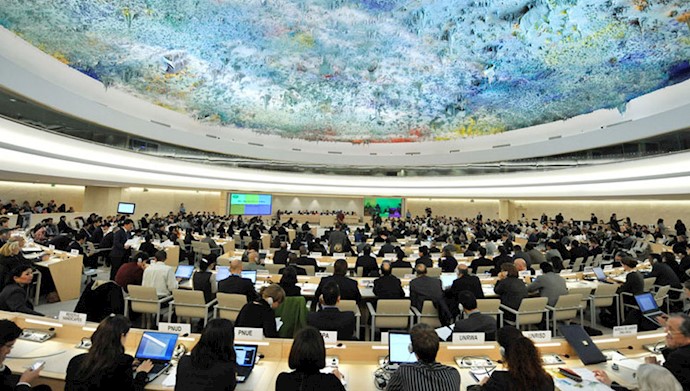

In a major global blow to the clerical regime, the United Nations General Assembly’s Third Committee adopted a resolution on November 19, 2025, condemning the gross and systematic violation of human rights in Iran. The 72nd such resolution passed with a decisive 79 votes in favor and only 28 against, signaling the international community’s growing alarm over the regime’s brutality. While the resolution addresses the current wave of repression, its true historic significance lies in its unprecedented decision to link the regime’s present-day crimes to the unpunished 1988 massacre of 30,000 political prisoners.
Alarm over “frightening” surge in executions
The UN resolution expresses grave concern over the “alarming and significant increase in executions” in Iran, condemning the regime’s use of the death penalty as a tool for “political repression and silencing opponents and protesters.” It specifically notes the rising number of executions targeting women and minors. This condemnation is not abstract; it reflects a horrifying reality on the ground. Since the beginning of 2025 alone, the regime has executed at least 1,700 prisoners. This figure represents a near doubling of the number of executions carried out during the same period last year, illustrating the regime’s desperate reliance on violence to maintain its grip on power.
Today's UNGA 3rd Committee resolution for the first time references the #1988Massacre, the first official acknowledgement by the world community of those ongoing crimes against humanity. With Iran threatening to repeat the massacre, it's time to hold Iranian officials accountable… https://t.co/EjRHwYldBn pic.twitter.com/mIEbOgWLpH
— M. Hanif Jazayeri (@HanifJazayeri) November 19, 2025
Breaking the silence: the 1988 massacre connection
For the first time, the United Nations has officially acknowledged the connection between the regime’s current atrocities and its foundational crime. The resolution text voices concern over state-sponsored incitement to violence that is “echoing the 1988 reported summary and arbitrary executions.” This long-overdue reference points to the 1988 massacre, when 30,000 political prisoners, mostly affiliated with the People’s Mojahedin Organization of Iran (PMOI/MEK), were executed based on a fatwa by the regime’s then–supreme leader Ruhollah Khomeini. The executions were carried out by “Death Commissions” that included current and former senior officials, while the regime’s current supreme leader Ali Khamenei served as the regime’s president.
The cycle of impunity
The resolution directly confronts the culture of impunity that has enabled decades of human rights abuses. It “expresses serious concern at the lack of accountability” for crimes including “ongoing enforced disappearances, extrajudicial executions and the destruction of evidence and grave sites.” This echoes the findings of former UN Special Rapporteur for Iran, Professor Javaid Rehman. In a July 2024 report, and again in a message to the Free Iran 2025 conference on July 31, 2025, Professor Rehman classified the 1988 massacre as a clear case of crimes against humanity and genocide. He warned that the international community failed to act in 1988 and stressed that the responsibility to prevent the recurrence of these heinous crimes lies with the United Nations and its member states.
The way forward: referral to the Security Council
After the resolution's emphasis on the #1988Massacre and today's increasing executions, and given the continuation of crimes against humanity over the past three decades and during popular uprisings, the regime's crimes dossier must be immediately referred to the Security… pic.twitter.com/iWDmAz8mPj
— Maryam Rajavi (@Maryam_Rajavi) November 19, 2025
Welcoming the resolution, Mrs. Maryam Rajavi, the President-elect of the National Council of Resistance of Iran (NCRI), stated that it reflects only a fraction of the regime’s crimes. She emphasized that the impunity enjoyed by the regime’s leaders, including Supreme Leader Ali Khamenei, has enabled the continuation of atrocities like the 1988 massacre.
With the UN now formally acknowledging this link, Mrs. Rajavi declared that the path forward is clear. “After the resolution’s emphasis on the 1988 massacre and today’s increasing executions… the regime’s crimes dossier must be immediately referred to the Security Council, and its leaders brought to justice.” This is not merely the demand of the Iranian people; it is a prerequisite for international peace and security.