

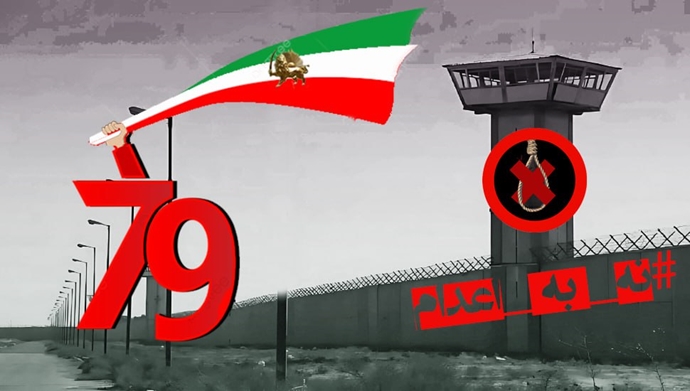

In a vicious escalation against organized dissent, the Iranian regime executed two political prisoners, Mehdi Hassani and Behrouz Ehsani, on Sunday, July 27, 2025. Both men were active members of the powerful “No to Executions Tuesdays” campaign, and their executions in Ghezel Hesar prison were carried out unjustly, without prior notice or a final meeting with their families.
The move, intended to terrorize and dismantle the prison-led movement, has instead ignited a new wave of defiance. In their weekly statement for the 79th week of the “No to Executions Tuesdays” campaign, members affirmed their resilience: “Despite a brutal attack on the heart of the ‘No to Executions Tuesdays’ campaign in Ghezel Hesar prison, this campaign continues with resistance and cohesion.”
A coordinated assault on the movement
The executions were the culmination of a targeted operation against the campaign’s nerve center in Ghezel Hesar prison. On Saturday, July 26, under the direct orders of prison chief Allahkaram Azizi and his deputies, over 100 armed guards and intelligence agents stormed Unit 4. They violently transferred all political prisoners to solitary confinement, subjecting them to the humiliation of being handcuffed, shackled, and hooded. Saeed Masouri, one of the campaign’s initial signatories, was forcibly exiled to the notoriously harsh prison in Zahedan.
The campaign’s statement identifies this violence as a sign of the regime’s desperation: “The ruling regime, incapable of resolving internal and external crises, has drawn its sword against the people more than ever.” This desperation is reflected in the state’s killing statistics.
In the past week alone, at least 20 people were executed in various prisons. Under President Masoud Pezeshkian, the regime’s reliance on capital punishment has surged, with a staggering minimum of 1,477 executions recorded in his first year in office—a significant increase compared to previous years. The Judiciary Chief, Gholam-Hossein Mohseni-Eje’i, recently boasted of this repressive climate, admitting to the arrest of over 2,000 people during the recent “12-day war” alone.
Unbroken resolve from inside prison walls
The regime’s attack failed to silence the prisoners. On Tuesday, July 29, the movement marked its 79th consecutive week with a coordinated hunger strike across an unprecedented 48 prisons in Iran. In a direct response to the executions, resilient prisoners in Qarchak and Greater Tehran prisons held ceremonies and chanted slogans, reaffirming their commitment to stopping the regime’s killing machine.
In their weekly statement, the campaign members articulated the regime’s motives and their own unwavering determination: “We, the members of the campaign, believe that the regime’s goal with this ceaseless violence is to create fear and to silence a society that, despite all pressures, continues to insist on its rightful demand for justice, freedom, human dignity, and the right to self-determination.”
Solidarity protests spread across Iran
The regime’s brutality inside prison walls was met with a powerful wave of defiance on the streets. On Tuesday, citizens in dozens of cities, including Tehran, Karaj, Rasht, Tabriz, Sanandaj, Ahvaz, and Isfahan, took part in a nationwide protest action.
Demonstrators held placards with potent slogans such as “Execution and exile no longer have an effect,” “Our response to execution is fire and uprising,” and “This is the final message: if you execute, there will be an uprising.” Many specifically honored the memory of Mehdi Hassani and Behrouz Ehsani, holding signs vowing to continue their struggle.
The families of other political prisoners on death row played a crucial role, joining protests in large numbers with pictures of their loved ones and demanding their immediate and unconditional release. Their presence transformed the political protest into a deeply human cry for justice, demonstrating that the opposition to the regime is a widespread, popular, and deeply felt movement.
In their statement, the campaign members issued a stark warning and an appeal for global support: “We… condemn the inhumane and unjust suppression and executions of prisoners. We call on all awakened and freedom-loving consciences, both domestic and international, to make the cry of ‘No to Execution’ louder with their active support for the ‘No to Executions Tuesdays’ campaign.”
The statement concluded with an urgent alert: “The lives of political prisoners in Ghezel Hesar prison and other prisons in Iran are in grave danger.” The regime’s violent crackdown has revealed not its strength, but its profound fear of a unified people, exposing a brittle power structure that relies on violence to mask its growing instability.