

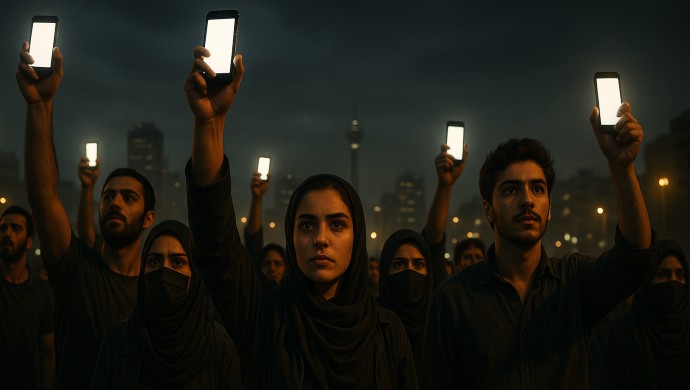

The government of Masoud Pezeshkian, who branded himself as a moderate, has fast-tracking a draconian new bill aimed at crushing the free flow of information online. The bill, ironically titled “Countering the Spread of False Content in Cyberspace,” was rushed to the regime’s Majlis (parliament) and approved with “double urgency” on July 27.
This legislation is not a good-faith effort to combat misinformation. It is a desperate act by a clerical regime besieged by social, economic, and political crises, and terrified of a populace that uses the internet to expose its corruption and organize dissent. This bill is a panicked confession that the regime sees the truth as its greatest enemy.
A regime fractures under the weight of its own repression
The bill has triggered such profound fear of a public backlash that it has caused unprecedented infighting within the regime’s own ranks. In a stunning display of disarray, 19 members of the same parliament that fast-tracked the bill wrote a letter to Pezeshkian demanding he “withdraw the bill as soon as possible.” They warned that “censorship and restriction are not tools of explanation, nor do they guarantee security,” calling the bill a “strategic error” that will only intensify public distrust.
The alarm bells are ringing across the political spectrum. Abbas Akhoundi, a former minister, warned Pezeshkian not to let the “bonds between you and society be broken one after another.” A Communications Ministry advisor bluntly called the bill a “threat to the security of the system.” Even the state-run newspaper Etemad pleaded, “Withdraw this bill; do not burden the system with its cost.” This internal panic exposes a ruling class terrified of the consequences of its own oppressive measures.
The true target: The PMOI and the voice of a rebellious youth
The regime’s fear is not of “false news,” but of the damning truths that spread like wildfire online. Cyberspace is where the hollow boasts of Supreme Leader Ali Khamenei and the empty promises of Pezeshkian are instantly dismantled amidst overwhelming evidence of water and power shortages and crippling inflation.
Most importantly, the internet is the primary arena for Iran’s organized resistance. It is where slogans like “Death to the Dictator” become viral and where millions of young Iranians witness the courageous activities of the PMOI’s Resistance Units. This is the regime’s greatest fear.
Khamenei’s Friday prayer leader in Karaj, Hosseini Hamedani, laid bare the regime’s true intentions, stating, “Today, we desperately need the ‘Chahar Zebar pass’ of cyberspace to be liberated from the enemy and these terrorists through a Mersad Operation.” This reference to the regime’s counteroperation to the PMOI’s Operation Eternal Light in 1988 is an admission that the regime views the online battle for hearts and minds as a war, and its primary enemy is the organized opposition.
The hypocrisy of a state built on lies
The ultimate hypocrisy is a regime notorious for disinformation appointing itself the arbiter of truth.
The bill’s vague definition of “false content” is a deliberate feature, not a flaw. Even regime insiders have warned that determining what is “contrary to reality” is complex, and the regime’s bill is designed to give its repressive judiciary a weapon to silence any dissenting voice under a pseudo-legal pretext.
This bill is a futile attempt by a dying dictatorship to hold back a flood of dissent. It is a clear sign that Khamenei and his entire apparatus, including his so-called “moderate” president, view the free flow of information as an existential threat. Their terror is a testament to the power of the Iranian people and their organized Resistance. This act of suppression will not bring security; it will only accelerate the regime’s inevitable downfall.