

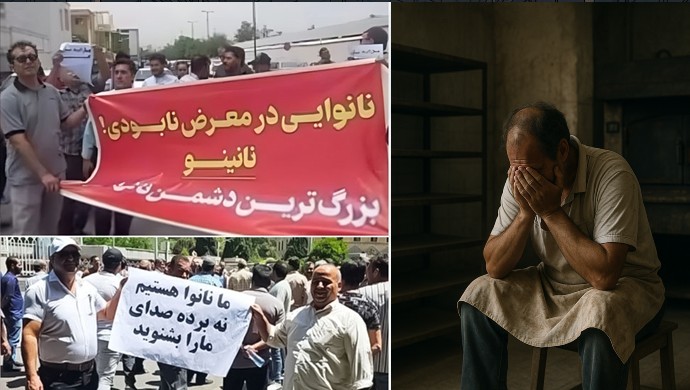

A powerful symbol of protest is sweeping across Iran, rising not from political rallies but from the heart of daily life: the nation’s bakeries. In cities from Rasht to Tehran and Mashhad, bakers are taking to the streets, returning state-mandated equipment, and warning of mass strikes. This is not a simple labor dispute. It is a nationwide cry of desperation against the regime’s disastrous “Nanino” digital system, a policy that has pushed a vital segment of society to the brink of collapse.
The protests reveal that a change of face in the government means nothing when the systemic corruption, incompetence, and oppressive policies, all dictated by the ailing supreme leader Ali Khamenei, remain unchanged. The people’s demand for bread is rapidly becoming an undeniable demand for an end to the entire ruling theocracy.
‘Nanino’: a tool of oppression, not a solution
Implemented under the guise of a “smart” system to manage flour subsidies, the Nanino app has become what protesting bakers in Rasht call their “biggest enemy.” Far from being a tool of efficiency, it is a centrally-controlled mechanism of extortion. From a command center in Tehran, the system arbitrarily slashes bakers’ monthly flour quotas for vague “violations.” One baker reported his daily quota was cut from 10 bags to just three, making it impossible to cover his costs.
The system traps bakers in a cruel, no-win scenario. It uses unrealistic metrics to estimate how many loaves can be produced from a bag of flour. If a baker produces a realistic amount, the system accuses them of selling flour on the black market. If they try to meet the system’s inflated target by reducing the bread’s weight, they are accused of short-changing customers. Either path leads to crippling fines and further quota cuts. In a sign of the regime’s complete disregard for reality, bakers are even penalized for circumstances beyond their control, such as the frequent power outages plaguing the country or poor internet service. In protest, bakers in cities like Kangavar and Bojnurd have taken the dramatic step of returning their state-mandated card readers, officially ending their cooperation.
July 8—Mashhad, northeast Iran
Bakers hold rally in front of the provincial governorate, protesting the inefficiency of the state-run Nanino bread distribution system.
"We bake bread but can't make ends meet," protesters say.#IranProtestspic.twitter.com/HU93XTTiEz— People's Mojahedin Organization of Iran (PMOI/MEK) (@Mojahedineng) July 8, 2025
The human cost: empty tables and crushed dignity
Beyond the technical flaws, the regime’s policies are inflicting profound human suffering. The protests are fueled by the raw pain of citizens unable to provide for their families. On July 8, a baker in Mashhad cried out in frustration, “I swear on the verses of the Quran, today I didn’t have the money to pay the wages of a worker who has been working since morning. I couldn’t buy potatoes and onions for my wife and children.” Another lamented that after 50 days of waiting, a promised 50% rate increase never materialized.
This despair is echoed across the country. On July 5, bakers in Urmia declared that “bankruptcy, in the truest sense of the word, is walking through the alleys of Urmia’s bakeries.” They announced, “Our tables are empty, and our shops have reached the brink of closure. The baker can no longer afford to pay the worker’s salary, insurance, electricity, water, repairs, or even provide for his own family.”
A regime admitting its own failure
The crisis has become so severe that even figures within the regime’s own parliament are publicly panicking. In a striking admission of failure, parliament member directed his criticism at the Pezeshkian government on May 21, stating, “The Nanino system… has fueled these challenges.” He issued a direct demand: “Mr. Minister of Industry! Mr. Minister of Agriculture! Shut down the Nanino system, stop it. Today, the problems of bakeries in the country have become a super challenge.” He added a stark warning about the broader social impact, saying, “Regarding the frequent power cuts and widespread blackouts, I warn that this has broken the people’s patience.”
July 8—Rasht, northern Iran
Bakers hold rally in front of the provincial governorate, protesting the inefficiency of the state-run Nanino bread distribution system and the bread crisis.#IranProtests pic.twitter.com/ezzIfhPcM7— People's Mojahedin Organization of Iran (PMOI/MEK) (@Mojahedineng) July 8, 2025
The tinderbox is drier than ever
These protests are a clear sign that the Iranian people’s capacity to endure the regime’s corruption has run out. A state-affiliated expert, writing in the Jahan Sanat newspaper on July 8, issued a grim warning to the authorities, stating that “the situation is even worse than in 2018, 2021, and 2022.” The reason, the expert explained, is that “the governments during this period have consumed all existing reserves, and unfortunately, there is nothing left to keep the country afloat.”
The regime is running on empty, both financially and politically. The cries from Iran’s bakeries are not just about flour quotas; they are the voice of a nation that has had enough. The “bread uprising” shows that the foundation of the theocracy is cracking, and no superficial change in the presidency can repair the terminal decay at its core.