

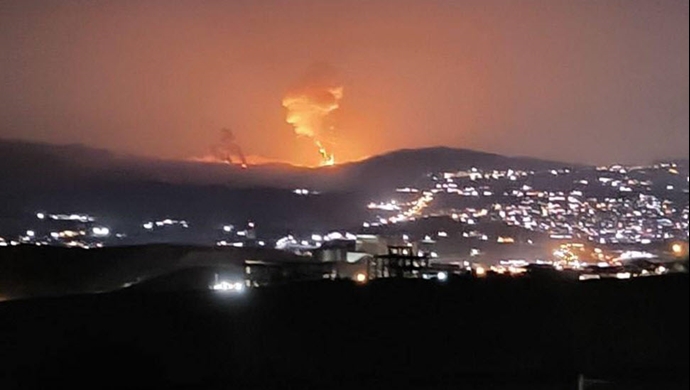

The conflict between Iran and Israel escalated sharply on its seventh day, June 19, with both sides launching significant attacks on sensitive targets, including nuclear facilities and civilian areas. As the death toll mounted, international leaders increased pressure for a ceasefire, while the Iranian regime faced diplomatic fallout and made significant changes to its military leadership.
Israel’s attacks on Iran
An Israeli military spokesperson confirmed on Thursday, June 19, that strikes had hit nuclear sites in Bushehr, Isfahan, and Natanz (Reuters). Further attacks targeted Iran’s Arak heavy water reactor, part of the regime’s sprawling nuclear program (Associated Press). The International Atomic Energy Agency (IAEA) later clarified that the Khondab (formerly Arak) heavy water research reactor was hit. The IAEA noted that the reactor was not yet operational and contained no nuclear material, resulting in no radiological effects.
IAEA has information the Khondab (former Arak) heavy water research reactor, under construction, was hit. It was not operational and contained no nuclear material, so no radiological effects.
At present, IAEA has no information indicating the Khondab heavy water plant was hit.— IAEA – International Atomic Energy Agency ⚛️ (@iaeaorg) June 19, 2025
In addition to nuclear sites, reports indicated Israeli attacks on an IRGC barracks and ammunition depot in Shiraz, a military base in Fardis, a Basij militia base in Karaj (Telegram – Akhbar Rooz Iran), and State Security Forces (FARAJA) headquarters, which resulted in injuries to several officers (Mehr News Agency). The IRGC’s public relations office in Zanjan province announced that two of its members were killed in an Israeli attack on Thursday (Zanjan Province IRGC Public Relations).
Iran’s regime’s attacks on Israel
Iran’s regime launched its “thirteenth wave of missile operations against Israel,” which its state-run Tasnim News Agency claimed caused “widespread destruction” (Tasnim News Agency). The IRGC’s Fars News Agency reported that drones were fired toward Israel early Thursday morning, preceding the missile strikes (Fars News Agency).
An Iranian missile struck the main hospital in southern Israel overnight, causing “extensive damage” and wounding people. However, the paramilitary Revolutionary Guard (IRGC) denied targeting the hospital, claiming the attack hit a nearby Israeli military intelligence compound. Other missiles hit a high-rise apartment building in Tel Aviv and other sites in central Israel (Associated Press).
Human cost and domestic impact
The human toll of the conflict continues to grow. According to a Washington-based Iranian human rights group, at least 639 people, including 263 civilians, have been killed in Iran, with more than 1,300 wounded. In Israel, the latest attacks wounded at least 240 people, with four of them in serious condition, according to Israel’s Health Ministry (Associated Press).
The conflict has also had a severe impact within Iran, where the regime has imposed a complete internet outage was reported, causing widespread public concern over the lack of communication. Additionally, authorities extended the cancellation of all domestic and international flights until 2:00 PM on Thursday, June 19 (Telegram – Chand Sanieh).
International statements and diplomatic tensions
U.S. President Donald Trump will decide within the next two weeks whether to strike Iran, the White House said Thursday, saying Trump still sees a “substantial” chance that negotiations can achieve U.S. and Israeli demands on Iran’s nuclear program (PBS).
“Based on the fact that there’s a substantial chance of negotiations that may or not take place with Iran in the near future, I will make my decision whether or not to go within the next two weeks,” White House press secretary Karoline Leavitt said, reading out a statement from Trump.
Elsewhere, world leaders urged restraint. Chinese President Xi Jinping called for an “immediate ceasefire,” warning that further escalation would cause greater losses for the region (Associated Press). German Chancellor Friedrich Merz urged Iran to “rapidly negotiate an agreement that removes the grave doubts about its nuclear programme.”
Iran is called upon to now rapidly negotiate an agreement that removes the grave doubts about its nuclear programme. We intend to play our part in diplomacy to this end.
— Bundeskanzler Friedrich Merz (@bundeskanzler) June 18, 2025
In Tehran, the regime’s Foreign Ministry summoned the Swiss ambassador to protest President Trump’s remarks and the German ambassador to protest Chancellor Merz’s statement (Mehr News Agency). The regime’s Foreign Minister, Abbas Araghchi, stated on X, “we have never sought and will never seek nuclear weapons.”
By now, the whole world should know that:
(1) Iran solely acts in self-defense. Even in the face of the most outrageous aggression against our people, Iran has so far only retaliated against the Israeli regime and not those who are aiding and abetting it. Just like Netanyahu… pic.twitter.com/cEUCaLHpAL
— Seyed Abbas Araghchi (@araghchi) June 18, 2025
Iran’s internal military changes
Amidst the escalating conflict, Supreme Leader Ali Khamenei appointed Brigadier General Mohammad Karami as the new commander of the IRGC’s Ground Forces. This followed the promotion of the previous ground forces commander, Mohammad Pakpour, to head of the entire IRGC after the reported death of his predecessor.