

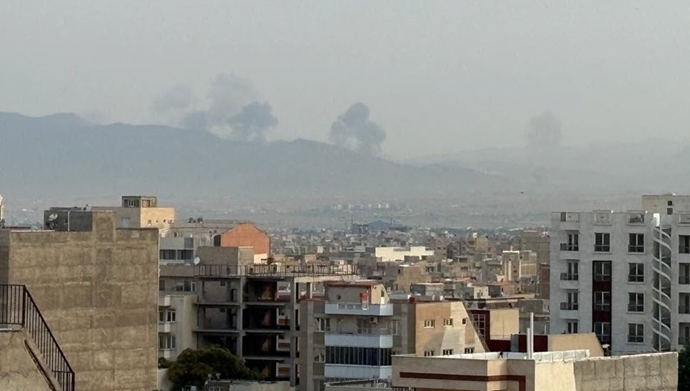

The conflict between Iran and Israel entered its eighth day on Friday, June 20, marked by continued military strikes from both sides, significant international diplomatic maneuvers, and a growing human toll.
As Israeli jets targeted locations in western and northern Iran, the Iranian regime launched new missile attacks on Israel. Meanwhile, the United States signaled a two-week window for a decision on its involvement, and European powers pushed for a negotiated end to the crisis.
Israel’s attacks on Iran
Israel’s military stated it carried out airstrikes on Friday morning targeting areas around Kermanshah and Tabriz in western Iran, using 25 fighter jets to hit “missile storage and launch infrastructure components” (Associated Press).
Reports from Iran indicated multiple points of impact. An Israeli airstrike hit an IRGC base in Bostanabad, resulting in the deaths of several IRGC members (The state-run ChandSanieh Telegram channel). In the north, major explosions were reported in the city of Rasht and in the vicinity of Lavizan in north Tehran (Iranian state television). One of the strikes in Rasht reportedly hit the Sefidrood Industrial Park, causing a massive fireball, according to the Deputy political chief of the regime’s governor in Gilan (Al-Jazeera). Prior to the attack, the Israeli army had issued a warning for residents to evacuate the village of Sefid Rood, located in the industrial area near Rasht (Al-Arabiya).
In a separate development, a notice was published in Iran regarding an evacuation warning for the Dimona reactor area in Israel (The state-run ChandSanieh Telegram channel).
Iran’s regime’s attacks on Israel
Iran launched at least one new barrage of missiles early on Friday, striking near residential apartments, office buildings, and industrial facilities in the southern Israeli city of Beersheba (Reuters). The Israeli military also announced that on Thursday, Iran had fired a missile carrying cluster munitions at a “densely populated civilian area” in Israel, marking the first reported use of such weapons in the conflict (Reuters).
Official statements from Iran and Israel
Israeli Prime Minister Benjamin Netanyahu said on Thursday that overthrowing the Iranian regime was not a goal of Israel’s attacks, but “could be a result” (Reuters). He stated that “the matter of changing the regime or the fall of this regime is first and foremost a matter for the Iranian people,” and thus he did not present it as a formal objective.
On the Iranian side, parliament speaker Mohammad Bagher Ghalibaf declared, “in Haifa, Tel Aviv, and other areas, we showed that we will strike wherever we decide.” The regime’s Foreign Minister, Abbas Araghchi, stated on Friday that there was “no room for negotiations” with the United States “until Israeli aggression stops” (Reuters). Meanwhile, on Thursday, June 19, the Iraqi militia “Kata’ib Hezbollah” threatened to close the straits of Hormuz and Bab al-Mandab if the U.S. were to enter the war (Asharq Al-Awsat).
International community responds with diplomatic efforts
The White House said on Thursday that President Donald Trump would decide within the next two weeks whether the U.S. would get involved in the air war, citing a “substantial chance of negotiations” with Iran (Reuters).
It was also revealed that U.S. special envoy Steve Witkoff and Iranian Foreign Minister Abbas Araghchi have held several direct phone calls since the conflict began last week in an effort to find a diplomatic solution (Reuters).
European leaders also stepped up diplomatic initiatives. The Elysée Palace announced that France, in coordination with its European allies, is preparing a proposal for a negotiated solution (AFP).
French President Emmanuel Macron called on Israel to halt strikes on Iran’s “civilian infrastructure” and insisted on the need to resume negotiations on Iran’s nuclear and ballistic missile programs, as well as its financing of “terrorist groups” (Associated Press).
In response to the escalating conflict, Australia announced on Friday it had suspended operations at its embassy in Tehran, citing a “deteriorating security situation” (Reuters). The Australian foreign minister stated that defense personnel were being deployed to the Middle East as part of a contingency plan to evacuate citizens and diplomats once airspace reopens.
Human cost and internal impact
The week-long conflict has inflicted a significant human toll. A Washington-based human rights group reported on Friday that at least 657 people have been killed and 2,037 others wounded in Iran as a result of Israeli strikes (Associated Press).
The regime has also tightened its control over information. As of Friday, Iran had been disconnected from the global internet for 36 hours, with connectivity trackers showing that national access remained at a very low percentage of ordinary levels.
https://twitter.com/netblocks/status/1935864845821206649
In a sign of surreal normalcy, the police chief of Mazandaran province, a popular domestic tourist destination, reported that six million travelers had entered the region since the previous Saturday (The state-run ChandSanieh Telegram channel).