

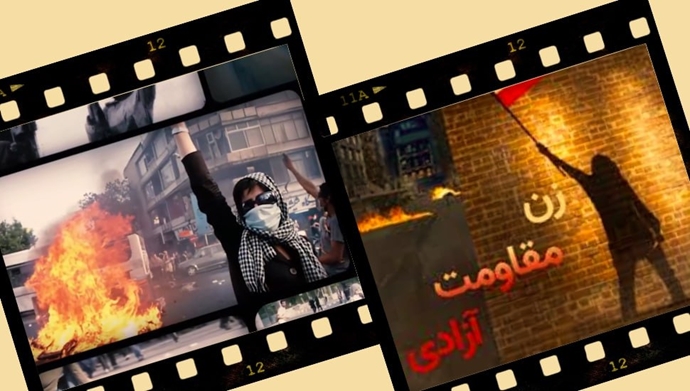

In every society ruled by a dictatorship, internal and popular resistance stands as the most decisive force that damages the foundation and structure of the dominant order, eventually leading to its fragmentation and downfall. While external factors related to international politics and the relationships of other governments with a dictatorship are not entirely without influence, the primary force that determines and transforms the conditions against dictatorship is internal, national, and popular resistance.
If we examine the history of splits within the structure of Iran’s ruling system, we see that there has always been a force outside the regime that has stood firm and refused to surrender, and the impacts of that resistance have inflicted major blows on the regime’s structure. Resistance against Ruhollah Khomeini’s fundamentalist absolutism, political prisoners’ defiance in the 1980s, women’s resistance against the clerical regime’s misogyny, opposition to its foreign belligerence and terrorism, the resistance against the regime’s cultural coup in universities, and the national struggle against forced religion, compulsory hijab, and theocratic rule — all of these have turned the clerical regime into a patchwork of ruptures.
Today, the inherent misogyny of the clerical regime has become a noose around its own neck. The authenticity of women’s perseverance against the regime stems from the essence of a demand for equality, the rejection of class and gender-based exploitation, and the pursuit of full natural citizenship rights. From the 1980s until now, this struggle — spanning from prisons to the streets — has delivered powerful and unrelenting blows to the regime’s structure, giving rise to deep and irreparable internal crises.
Now, thanks to the resistance led by the vanguard forces, nationalists, and the public, the very chains that once held the regime together are breaking one by one, forcing the system into isolated, diverging factions. This undeniable and vivid reality has now surfaced in the regime’s media, which has been compelled to expose it.
On April 13, Etemad newspaper reported a new case of deep rift within the regime’s structure due to the suspension of the “chastity and hijab” bill. The article was titled “The System’s Hard Core Against the System” and included the following:
“In Farvardin [March–April] this year, a video was released of Seyed Manan Raisi, a member of the 12th Majlis from Qom, recorded in Esfand [February–March] last year. Raisi, who led Saeed Jalili’s election campaign in Qom, said in this video: The system’s hard core, who endure 1-billion-rial gold coins and 1-million-rial dollar exchange rates, are content because they believe God’s laws are being enforced here. He says, ‘I support the Islamic Republic because of its association with Islam. If it is to be emptied of Islam, why should we shed blood, why should we endure inflation?’”
The newspaper also pointed to a similar case, where the failure of misogyny and the society’s explosive state have created new cracks within the regime’s power structure, with some regime insiders threatening to jump off the train:
“In a video, Vahid Yaminpour directly uses the language of threat: The Islamic Republic is a train, and its locomotive is the ‘hard core of loyalists.’ If the regime compromises on a few key principles, that loyalist core will be the first to get off the train.”
Another dimension of the severe blows inflicted by resistance and perseverance, as mentioned by this regime-run media, is a comparison between the regime’s fate and that of the Syrian dictator Bashar al-Assad:
“In Azar last year [November–December 2024], Foad Izadi said in a YouTube interview: If the youth who are supposed to defend the country feel the government is not very Islamic, they will not defend it, and Iran will turn into Syria. Therefore, the hijab issue becomes a matter of foreign policy.”
It becomes evident that the authenticity lies in resistance and steadfastness, whose effects and messages have turned the regime’s monolithic red lines into multiple conflicting red lines among its various circles. These examples affirm the undeniable reality that Iranian women — from prison cells to the streets, from the women of the resistance units to those in leadership roles within the Iranian Resistance — will deliver the final, decisive blow to the clerical regime’s structure.