

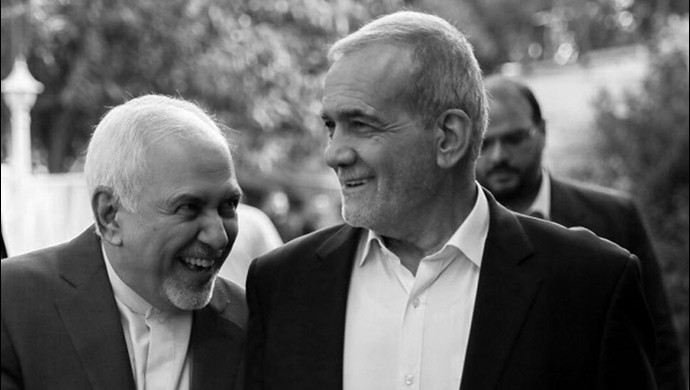

Mohammad-Javad Zarif, the regime’s long-time apologist for its crimes and corruption, has once again resigned—this time in the midst of intensifying factional infighting within the Iranian establishment. His departure, coming just after the dismissal of Economy Minister Hemmati, exposes not only the internal fractures within the so-called “national unity government” but also signals an accelerated collapse of the regime’s fragile power structure.
Despite official claims that Zarif’s resignation was linked to the foreign citizenship status of his associates, the reality runs much deeper. At its core, this is yet another battle in the ongoing war between the regime’s mafia-like factions over the spoils of the nation’s wealth. After all, both sides of the ruling elite are known to have their own networks of privileged, dual-national offspring benefiting from Iran’s plundered resources. In October 2022, IRNA reported that approximately 5,400 offspring of Iranian state officials reside abroad. The ousting of Zarif is therefore not about “upholding national interests” but rather about eliminating rivals in a desperate attempt to consolidate power.
The regime’s own media outlets reflect this growing instability. The government-aligned Mehr News Agency noted that Zarif’s departure could trigger a wave of resignations and dismissals, warning that the regime is “losing a significant portion of its human capital.” But behind this concern lies a deeper fear—what remains of the state’s internal cohesion is unraveling.
Even pro-regime publications have subtly acknowledged the reality. The Tasnim News Agency, affiliated with the IRGC, attempted to frame the situation as a necessary restructuring, arguing that “national unity is about solving the people’s problems, not merely retaining officials in power.” Yet, this rhetoric rings hollow at a time when the government’s so-called unity is crumbling under the weight of its own contradictions.
The reality is that the regime’s “national unity” project was always a farce—a temporary arrangement meant to ensure elite power-sharing while maintaining a façade of stability. With Hemmati’s dismissal and Zarif’s resignation, the illusion has been shattered. As the Ham-Mihan newspaper observed, “The end of unity has been signaled… When there is no unity within the state, any talk of unity with the people or the world is meaningless.”
In truth, the “unity government” was never meant to serve the Iranian people. It was a last-ditch attempt to prevent regime factions from turning against each other in an all-out power struggle. But this fragile truce has now collapsed, revealing the system’s fundamental instability.
Meanwhile, as the regime accelerates its domestic repression—with executions reaching shocking new levels in recent months—the growing rage among Iran’s youth, retirees, and disenfranchised classes is becoming impossible to ignore. The wave of street protests, coupled with acts of defiance against symbols of state oppression, underscores a stark reality: while the regime tightens its grip, the people’s resistance only grows stronger.
Zarif’s resignation, then, is not merely an internal political maneuver. It is a symptom of a dying regime—one that, despite all efforts to contain its decay, is inevitably imploding under its own weight.