

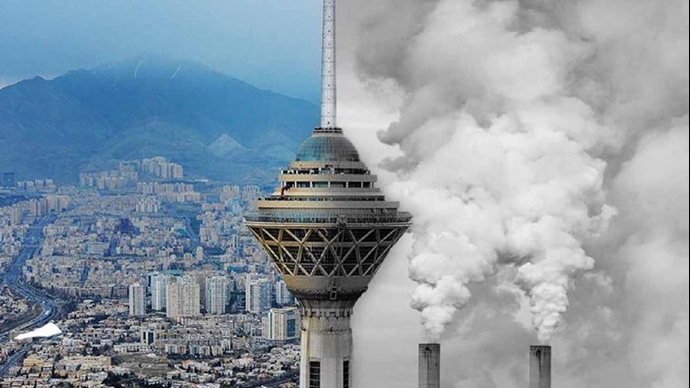

In its endless streams of crimes against the people, Iran’s regime is willing to strangle even “oxygen” and “air” to maintain its hold on power. Fuel shortages amid deadly cold and the deaths of thousands due to air pollution are yet another disaster of the clerical regime, despite Iran possessing the second-largest natural gas reserves in the world.
According to regime-affiliated media, on Tuesday, February 11, most schools across various provinces were closed due to air pollution and severe cold. The state-run Khabar Online reported, “The Tehran Meteorological Office has warned about the gradual accumulation of pollutants and declining air quality until Thursday, February 13.”
Since shutting down schools and workplaces as a solution to air pollution and cold weather is a disgrace, regime-controlled media have not provided transparent details about affected cities and the impact of closures on people’s lives. The state-run IMNA news agency, in a report on February 8 titled “Air Pollution and Cold Weather Closures in 2025: How Many Days Have We Stayed Home This Year?” wrote, “It is not easy to access accurate and comprehensive statistics on the total number of closure days nationwide due to air pollution and cold from March 2024 to February 9, 2025. Various organizations and institutions may provide differing figures, and media coverage may not be complete…”
Nevertheless, on the same day (February 8), some media outlets reported school and office closures in 27 provinces, including Tehran, Alborz, Kerman, Semnan, Hamedan, Zanjan, South Khorasan, Khorasan Razavi, North Khorasan, Markazi, Qom, Bushehr, East Azerbaijan, West Azerbaijan, Lorestan, Isfahan, Mazandaran, Gilan, Chaharmahal and Bakhtiari, Kurdistan, Ilam, Kermanshah, Fars, Qazvin, Golestan, Ardabil, and Khuzestan.
On February 1, the state-run Entekhab newspaper quoted Jafar Hashemi, a member of Tehran’s City Council, acknowledging the regime’s failure in handling air pollution, as saying, “Decision-making regarding air pollution has become truly disgraceful. How many days per year must school and office closures be the only available solution? Are we the only country in the world facing this issue?” He further noted, “Every year, 50,000 people in Iran lose their lives due to air pollution. This number is more than twice the annual fatalities from traffic accidents—accidents that have already placed us among the worst countries in terms of road casualties.”
In February, many people in cities affected by the burning of mazut (high-sulfur fuel oil) and toxic emissions from industries affiliated with the Islamic Revolutionary Guard Corps (IRGC) protested against severe respiratory illnesses caused by the pollution.
On Tuesday, February 4, more than a thousand people in Arak protested against the deaths caused by air pollution. Some of the banners and placards they held read: “Arak has no air,” “Stop burning mazut,” “Thanks to officials, we’ve turned from an industrial hub into a cancer center,” “I can’t breathe in this city,” “Clean air is Arak’s right,” and “Replace politicians with trees so the air gets fresh…” During the gathering, a student took the microphone and loudly recited:
“Rise and gather, for autumn is here, the pollution blows from Shazand near.
Though industry was a gift to this land, its only offering is cancer at hand.”
He continued: “Health is our right, clean air is our right, breathing without medication and without stress is our right.”
At the start of power cuts and rationing, Iranian regime president Pezeshkian deceitfully claimed that the goal was public health. “We are cutting electricity to avoid burning mazut in power plants and polluting the air,” he said. However, by the end of December and early January, it was revealed that the closure of schools and many educational, healthcare, and government centers in Tehran, Tabriz, Mashhad, Arak, and Alborz was due to air pollution caused by burning mazut in power plants. In the end, they not only cut off electricity but also raised gas prices and continued burning mazut.