

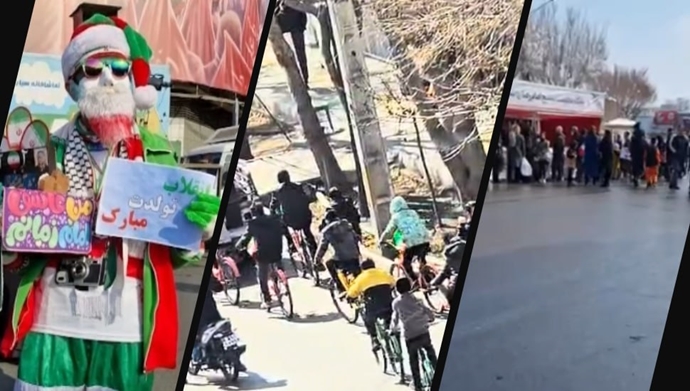

Every year, the Iranian regime attempts to salvage its fractured and dire situation or to feign popular support through holding the so-called Ten Days of Dawn (Decade of Fajr), a series of celebrations commemorating the anniversary of the 1979 revolution. Preparations for these state-organized events begin long in advance, and all government bodies are mobilized to maximize participation.
Failure in Mobilizing Crowds as Before
This year, more than ever, the regime focused on revitalizing this lackluster display with various well-known ploys, yet the result was more shameful than ever. Statements by regime supreme leader Ali Khamenei reveal the regime’s need for this mobilization:
“My insistence on the maximum and general presence of the Iranian nation is because I see and know that the unified presence of the people, the enthusiastic, hopeful, and powerful presence of the people, will disappoint the enemy; when the enemy is disappointed, it will lose its effectiveness. The country’s immunity depends on the presence of the people; reducing the pressures of the enemies depends on the presence of the people, depends on the unity and cohesion of the people with the system and with the Islamic Republic apparatus, and the sense of mutual trust between the people and officials. This sense must be strengthened day by day.” (Source: Hawzeh News, February 10, 2025)
In a meeting with the Air Force personnel, he also said:
“What solves the problems is the internal factor, which is the ‘effort of committed officials and the solidarity of the united nation,’ and the manifestation of this national unity is the February 11 march, in which, God willing, we will see this unity this year as well.” (Ibid.)
What enemy did he want to “disappoint”? The people of Iran have been chanting and continue to chant in the streets that the real enemy is right here. The enemy is not outside the borders of Iran, but rather sitting in Khamenei’s office.
Empty Glitz and Propaganda
Khamenei sought to ensure the “immunity of the country”—by which he means the immunity of the regime—and “reduce the pressures of the enemies” through mobilizing crowds, but it became clear that he no longer has the ability to mobilize crowds even with blatant and exposed methods.
This time, the regime tried to show that a large number of people came to the demonstrations by exaggerating the display and magnifying marginal and promotional issues such as “flying a balloon from the Azadi Tower (Freedom Tower)”, “demonstrating paratrooper operations,” and mentioning the figure of “7,200 reporters and photographers covering the demonstrations.” In addition, it announced that the ceremony was held simultaneously in “1,400 districts, cities, and counties, and more than 38,000 villages in the country.”
Bankruptcy of the Regime After 46 Years of Stealing the Anti-Monarchical Revolution
On the 46th anniversary of the anti-monarchical revolution, it can be stated with certainty that the era of this regime has come to an end. The situation of the religious fascism is more critical than it appears on the surface.
There is intense internal repression, widespread corruption, and social and economic crises. The regime’s repressive policies, accompanied by widespread executions, indiscriminate arrests, and strict control over civil liberties, have failed to ensure the regime’s stability and have instead increased public anger.
The unbridled devaluation of the national currency, economic bankruptcy, declining purchasing power, 40% inflation, and basic shortages such as water and electricity have led to widespread public discontent. Inefficient economic policies and systemic corruption have diverted the country’s resources to serve the regime’s political and military goals in the region, and instead of the well-being of citizens, billions of dollars have been spent supporting regional allies. The overwhelming boycott of the regime’s sham elections showed that the regime no longer has a significant social base and that people are dissatisfied with the government.
Chain Failures From Syria to Lebanon
The regime’s strategy to expand its influence through supporting governments and proxy groups in the Middle East is now facing serious constraints. The fall of the Syrian dictatorship, which was considered one of the regime’s most important strategic allies, was a turning point in these failures. The Syrian army, which had been supported by the Islamic Revolutionary Guard Corps (IRGC) and Hezbollah for years, could not resist internal and external pressures, and the Iranian regime also failed to keep Bashar al-Assad’s dictatorship in power.
The closure of land and air corridors that were used from Syria to support the regime’s forces in Lebanon has changed the balance of power in the region to the detriment of the regime.
The people of Iran clearly saw how weak and fragile the IRGC and the regime’s proxy forces are. This has increased confidence in the power of the people to change the regime and has given new energy to the protests.
Religious Fascism Under Siege and at an Impasse
If we add the crisis of whether or not to negotiate with the U.S. to the domino of the regime’s failures, it will only exacerbate the situation. Now, Khamenei and his ilk know that if they give in to negotiations, they must crawl towards surrender on bloodied knees; if they refuse, they must endure even harsher outcomes. This is only part of their problem. The main problem comes from the people and their organized resistance.
The mullahs’ regime is besieged on all sides; besieged by Resistance Units and rebellious youth, besieged by a society overflowing with anger and rebellion, and besieged by various internal and external conflicts.
The street theater and colorful displays on February 10 demonstrate the bankruptcy and emptiness of the regime’s coffers, which are mired in crisis. Its efforts to deal with complex crises in the current situation has failed. All that hype was for nothing.
Now, in continuation of the closing its ranks in the streets in Iran, it must also close ranks within the office of the supreme leader because the freedom fighters and rebellious youth will not be satisfied with anything less than overthrowing the regime.