

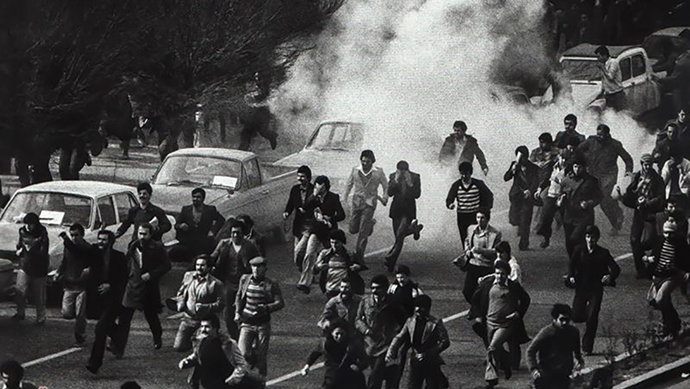

Iran’s 1979 revolution, which led to the overthrow of the Shah’s dictatorship, is one of the most complex and challenging transformations in Iran’s contemporary history. Therefore, it is important to study the origins and demands of the 1979 revolution and examine how Khomeini distorted and deviated it from its democratic goals.
The distortion and deviation of the revolution’s democratic goals, along with the falsification of contemporary history, have become such a primary objective of the regime that state-controlled media have quoted cleric Javad Jafari, a member of the regime’s Assembly of Experts, stating:
“Today, some claim that we revolted to improve our economic situation; this is a distortion—these were not the goals of the revolution. One should not think that people revolted for bread and livelihood. Among the revolution’s goals, economic and livelihood issues ranked lower than religious matters, independence, and dignity. One of the reasons for the corrupt nature of the Shah’s regime was its disregard for Islamic values.” (Entekhab, January 31, 2025)
The Shah dictatorship and the people’s demands
Between 1971 and 1978, various political groups in Iran, including the People’s Mojahedin Organization (PMOI/MEK), strongly emphasized the struggle against the Shah’s dictatorship and the establishment of a free and independent state. The slogans of the revolution clearly demanded the creation of a democratic republic based on individual and social freedoms. During this period, there was no mention of concepts such as the “Assembly of Experts,” “Guardianship of the Jurist (Velayat-e Faqih),” “Absolute Rule of the Jurist,” “Supervisory Approval (Nezarat-e Estesvabi),” or “Islamic legal limits and rulings” among the people’s demands. This indicates that, at the beginning of the revolution, the people sought a national, popular, and democratic government in which human rights and individual and social freedoms would be guaranteed.
Following the path of the Constitutional Revolution and other liberation movements, they aspired to achieve democracy, freedom, social justice, and economic and social development. Their goal was to permanently eradicate individual rule and autocracy, regardless of its form or title.
A historic document
To gain a clearer picture of the early days following the victory of the anti-monarchic revolution, we review an important speech.
On January 24, 1979, just three days after being released from the Shah’s prison amid the people’s uprising, PMOI leader Massoud Rajavi gave his first speech at the University of Tehran, where he said on behalf of the PMOI: “Victory to Iran’s Democratic Revolution.”
At that time, Khomeini’s followers had just begun calling for an “Islamic Revolution.” One of the attendees asked Massoud Rajavi, “What does a democratic revolution mean?” to which Massoud Rajavi replied that it means a revolution with the participation of the people—that is, the involvement and governance of all classes and social groups.
In that speech, Mr. Rajavi said, “I have not come here merely to praise the natural course of events. We have not come simply to endorse what exists. We must also think about what should be and what should not be.”
Thus, the goal of the pioneers and those who paid the price for that 1979 revolution was not to establish the rule of the Supreme Leader (Velayat-e Faqih) or any other meaningless title of this kind. They did not seek to overthrow tyrant monarch only to replace him with a turbaned cleric sitting on the throne. The objective was not to transition from one form of dictatorship to another.
Those who, intentionally or unintentionally, equate every aspect of the 1979 revolution with Khomeini’s reactionary regime are, knowingly or unknowingly, serving the interests of the mullahs’ regime.
Hijacking the revolution
The path of this revolution was paved years before, through the suffering, blood, and struggles of revolutionary groups such as the PMOI and the People’s Fedai Guerrillas, and hundreds and thousands of freedom fighters who laid down their lives and endured prison during the Shah’s rule.
As soon as the iron grip of the Shah’s police-military dictatorship weakened, massive popular uprisings began.
In the absence of the true pioneers and leaders of the revolution, who were mostly in prison until the final days of the Shah’s rule, Khomeini rode the wave of millions of Iranians’ protests and ultimately stole the leadership of this glorious revolution.
Had the Shah not kept the leaders of organizations such as the PMOI and the Fedai Guerrillas imprisoned until the final days of his rule, there is no doubt that the leadership of the revolution would have taken a different course.
By usurping the revolution’s leadership, Khomeini pursued a different agenda. As he gradually consolidated power, he revealed his true nature. This treacherous transformation was met with fierce opposition from various political groups, including the PMOI. They believed that Khomeini had deviated the revolution from its original path and was trampling the democratic freedoms won by the anti-monarchic uprising under the guise of religious dictatorship.
The Distortion of Revolutionary Demands: From Democracy to Tyranny
In his initial interviews and speeches in Paris before the revolution, Khomeini emphasized freedom and democracy. During this period, by claiming neutrality toward various political groups and promising the establishment of a democratic government, he gained the trust of large segments of the people and political organizations. However, as soon as he returned to Iran and seized power, Khomeini gradually removed his mask and took actions that bore no resemblance to his initial promises.
One of his most blatant betrayals was the imposition of mandatory hijab on women. While Khomeini initially stressed that hijab should be a personal choice, after seizing power, he swiftly enforced compulsory hijab policies. This not only violated women’s rights but also served as an early indication of how the 1979 revolution was being distorted and derailed.
Suppressing the Children of the Revolution
To fully distort and divert the anti-monarchic revolution from its democratic goals, Khomeini needed to eliminate its true heirs. The PMOI was the first group to be targeted by his club-wielding and knife-carrying thugs. In 1981, following the bloody crackdown of June 20, 1981, thousands of PMOI members were arrested and executed. These repressive policies posed a serious threat not only to the Mojahedin but also to many progressive thinkers, dissidents, nationalists, and even some critical clerics.
Indeed, Khomeini’s historical counter-revolutionary mission was to destroy the great Iranian people’s revolution and crush those who had shed blood for it, endured suffering, and survived the Shah’s prisons. He betrayed the people who had faced bullets with bare chests and, above all, those who, in the words of Ayatollah Taleghani—the true spiritual leader of the anti-monarchic revolution—had paved the path of struggle and revolution. In short, since Khomeini was incapable of advancing the revolution toward its ideals of freedom and justice, he had to suppress and annihilate the liberated forces of the revolution: by placing them before execution squads, by torturing and killing them in the dungeons of Evin, Ghezel Hesar, and Gohardasht, or by throwing them into the furnace of the Iran-Iraq war. Torture and execution were the fate of the PMOI and other dissidents, while war became the fate of Khomeini’s own loyalists and other Iranian citizens.
From the Crowned to the Turbaned Tyrant
By establishing a judiciary fully subservient to him, Khomeini used the unlimited powers of Velayat-e Faqih (Guardianship of the Jurist) to suppress dissent. Prisons filled with political prisoners, and issuing death sentences for anyone opposing the regime became routine.
With the creation of his tyrannical rule, Khomeini brought all branches of government under his control, rapidly violating the democratic rights of the people. From then on, genuine public participation in elections ceased, and all major decisions in the country were made solely by Khomeini and his clerical rulers.
The PMOI had warned from the outset about this trajectory. Through numerous speeches and statements, they alerted the people and political groups that Khomeini was transforming the revolution into a religious dictatorship. However, Khomeini ignored these warnings, and what followed was the tragic reality of an absolute clerical rule.
The Revolution is Alive
Despite Khomeini’s treacherous transformation and the distortion of the anti-monarchic revolution, that revolution did not die or fade into ashes. It had children and pioneers willing to carry it forward, paying the price with their flesh, blood, and bones. This is the essence of the four-decade-long resistance.
To this day, this Resistance movement has prevented Khomeini and his regime from completely annihilating the free forces unleashed by the 1979 revolution. It has demonstrated that the people and history of Iran refuse to accept the disgrace of surrendering to the great usurper and thief of the century—the usurper of the Iranian people’s sovereignty and the great hijacker of the anti-monarchic revolution.
Thus, despite the mullahs’ wishes, the Resistance has kept the flames of defiance and revolution burning, ensuring that one day, the Army of Freedom, alongside the entire Iranian people, will overthrow this deceptive and inhumane regime. A regime that has surpassed even the Pahlavi monarchy in committing atrocities and destroying Iran’s resources and future.
Today, the spirit of the revolution is alive in the Resistance Units and rebellious youth who, in every corner of Iran, are defying the regime and shaking its foundations. It is alive in thousands of freedom-loving Iranians who gathered in Paris on February 8, 2025, to commemorate the revolution and reiterate their commitment to establishing a free and democratic republic of Iran.
A revolution that was able to dismantle the ancient monarchy will undoubtedly bring an end to the rule of the mullahs in Iran. Signs of this inevitable transformation are already visible everywhere.