

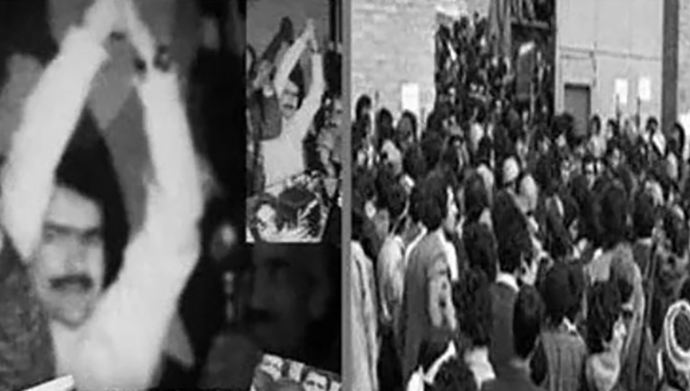

Every revolution, from its inception and formation to its culmination and victory, passes through milestones and turning points that play a decisive role in shaping the roadmap and nature of the revolution. January 20, 1979, and the release of Massoud Rajavi along with the last group of political prisoners from the Shah’s prisons in Iran, was undoubtedly a decisive turning point in the path of Iran’s democratic revolution and the struggle for freedom.
The treacherous Shah, after the fall of the monarchical dictatorship, lamented the release of political prisoners and mentioned in his book that his greatest mistake was freeing them from prison.
The mullahs’ regime also saw the vanguards of the anti-monarchical revolution as the main obstacle to establishing its dominance. In his actions, fatwas, and vengeful claims against Massoud Rajavi and the PMOI, regime founder Ruhollah Khomeini clearly demonstrated that they were the primary threat to his absolute rule.
Four days after his release from prison, in his first public speech at Tehran University, Massoud Rajavi explicitly stated: “I have not come here to merely praise the spontaneous course of events; we have not come to simply affirm what is and only what is. We must also think about what should be and what should not be.” It was there that Massoud raised the slogan “Long Live the Democratic Revolution of Iran” in opposition to Khomeini’s deceitful slogan of “Islamic Revolution.”
Since then, the contemporary history of Iran, during this turbulent 45-year period, has been shaped by the struggle between these two completely opposing forces. On one side stands Khomeini, a symbol of decayed reaction emerging from the depths of history’s swamp, and on the other side stands the PMOI, the embodiment of a history of struggle and the Iranian people’s fight for freedom.
Confronting Khomeini’s regressive deceit, which corrupted the meaning of words to present his pure reactionism as the “Islamic Revolution,” Massoud Rajavi defined the primary issue of the revolution as “freedom” and stood firmly by this word against the united front of the reactionary mullahs.
In this context, Massoud Rajavi stood against Khomeini’s fabricated slogan of “Either headscarf or baton,” and the division between veiled and unveiled women. He elevated the ideals of equality and rejected the regime’s misogynistic views by elevating women’s leadership in the movement.
Since taking on the mantle of leadership of the Iranian Resistance, Massoud Rajavi has led the largest, longest, most complex, and bloodiest organized resistance in Iranian history under the guiding principle of “Neither shah nor mullahs.”
He established the National Council of Resistance of Iran (NCRI) as a democratic, pluralistic, and independent alternative and a pioneer of a revolutionary and popular solution. He guided it through the twists and turns of these years and solidified its position as the longest-lasting political coalition in Iranian history and the sole alternative to the mullahs’ regime.
Massoud Rajavi founded the National Liberation Army of Iran as the missing link in Iranian history. This army dismantled Khomeini’s war machine and forced the warmongering despot to drink the chalice of poison when he conceded to the ceasefire on the Iran-Iraq war. On the foundation of this army, heroic Resistance Units have grown and thrived, preparing for an uprising to overthrow the ruling religious fascism.