

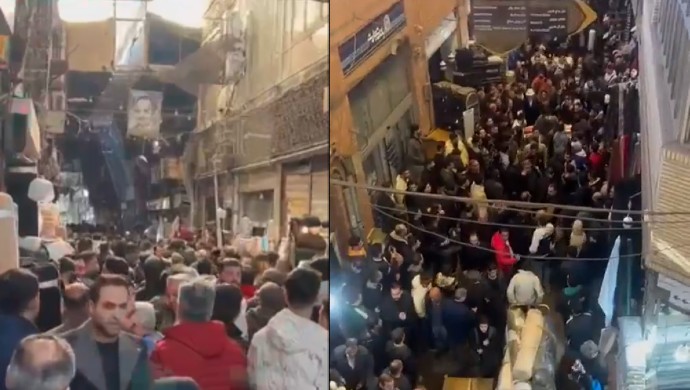

On Sunday, December 29, the Tehran bazaar witnessed widespread protests against inflation and rising prices. The demonstrations started in the shoemakers’ market and quickly spread to the fabric sellers’ market and several other areas and alleys. The protesting merchants claimed that the runaway increase in the dollar exchange rate, surpassing 800,000 rials, had effectively halted businesses and made transactions impossible.
The striking merchants, chanting slogans such as “Brave merchants, support, support” and shouting “Close, close!” called on their colleagues to join their movement. In response, many shopkeepers also closed their stores and joined the ranks of the protesters.
December 29—Tehran, Iran
Merchants continue their strikes despite repressive measures by the regime's security forces. The Grand Bazaar is in a state of shutdown. #IranProtestspic.twitter.com/5ztpRqCrVs— People's Mojahedin Organization of Iran (PMOI/MEK) (@Mojahedineng) December 29, 2024
The Tehran bazaar’s participation in protests alongside workers, retirees, and other oppressed groups plays a significant role in expanding and strengthening the movement. Historically, the Tehran bazaar, as an influential economic and social hub, has consistently played a special role in major events, from the Constitutional Revolution to the National Movement, the anti-monarchical revolution, and uprisings against clerical dictatorship.
The interconnectedness of the various trades and guilds in the bazaar and the close ties between the Tehran bazaar and those in other cities present a daunting prospect for the embattled clerical regime. This is especially true following the rapid fall of the Assad dictatorship in Syria and the collapse of the regime’s strategic depth in the region. The regime is extremely vulnerable to the anger and protests of the desperate population and the flood of these protests pouring into the streets.
The Tehran bazaar protests, which coincided with demonstrations by various groups, including retirees, workers, and government employees, overlapped with limited government rallies marking the anniversary of the pro-regime counter-demonstrations of December 30, 2009, held in Tehran and a few other cities over the preceding Saturday, Sunday, and Friday.
December 29—Tehran, Iran
The strikes that began in the gold bazaar of Tehran this morning has spread to the entire Grand Bazaar in protest to inflation and high prices. #IranProtestspic.twitter.com/qgTr876sOl— People's Mojahedin Organization of Iran (PMOI/MEK) (@Mojahedineng) December 29, 2024
The slogans of regime authorities at these rallies, attempting paradoxically both to inject hope into the regime’s demoralized forces and to make them aware of the worsening situation, were ineffective and instead deepened their despair:
Cleric Ahmad Khatami attempted to inspire hope among the regime’s forces during the regime rally in Isfahan by recalling the 2009 protests. He argued that just as the regime survived that crisis, it could also endure the current predicament. He stated, “Some war commanders said these eight months were tougher than eight years of the [Iran-Iraq] war. It wasn’t an ordinary story; it was an overthrow plot aimed at toppling the state.”
Mohammad Hossein Safavi, the regime’s Friday prayer leader in Rasht, stated: “During the 2009 sedition, domestic hypocrites were very systematic and precise in their involvement. Their goal was to overthrow and transform the system, to eliminate the Supreme Leadership, and to establish an entirely different system.”
Hossein Tayebifar, Khamenei’s deputy representative in the IRGC, expressed great fear during the December 29 regime rally in Bojnurd, saying, “They launched assassination networks in the country. They paraded armed in Tehran and assassinated over 17,000 people nationwide to break the leadership.”
He described a behind-the-scenes incident involving Khamenei’s office during the uprising, adding, “The Supreme Leader asked the then-Minister of Interior, ‘What is going on in Tehran?’ They replied, ‘There’s nothing major, just a few fires, and it’s over!’ The Supreme Leader responded, ‘Right now, over 100 places in Tehran are burning. Are you lying to me as well? Do you think I’m unaware or uninformed?'”
What garnered attention simultaneously with and parallel to the Tehran bazaar protests was the statement issued by the IRGC, declaring that the government “will overcome the challenges and issues stemming from the injection of despair, hopelessness, and fear.” The central message of this statement was the IRGC and Basij’s “readiness to confront insecurity and sedition,” a clear indication of the regime’s fragility in the face of an explosive society.