

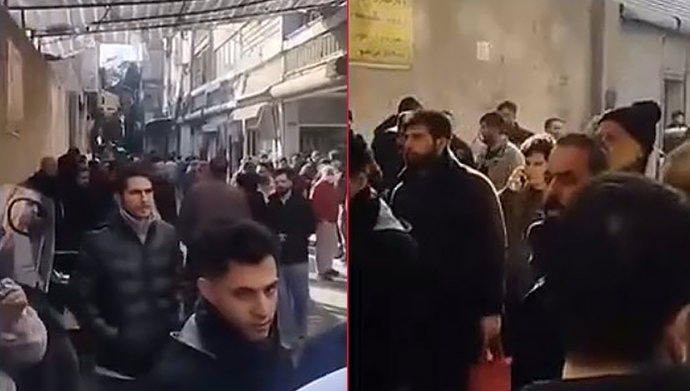

On December 29, Tehran’s Grand Bazaar experienced a widespread wave of protests involving various trade sectors, amidst increasing calls for immediate government intervention to address soaring prices and ongoing inflation threatening the local economy. In the past weeks, the rial has depreciated to record lows, trading at more than 800,000 against the U.S. dollar, disrupting many sectors. At the same time, skyrocketing inflation continues to push more of the population into poverty and misery. Meanwhile, the regime is doing nothing to address the people’s needs and is squandering the country’s resources on terrorism and nuclear weapons.
December 29—Tehran, Iran
Merchants continue their strikes despite repressive measures by the regime's security forces. The Grand Bazaar is in a state of shutdown. #IranProtestspic.twitter.com/5ztpRqCrVs— People's Mojahedin Organization of Iran (PMOI/MEK) (@Mojahedineng) December 29, 2024
In the heart of Tehran, near Sabzeh Meydan, gold traders closed their shops to participate in the protests. Gold traders are particularly sensitive to economic changes due to the direct impact of inflation and currency depreciation on the gold market. The use of security forces by the authorities to confront the protesters in this market reflects the significant economic importance and the intense tension that has developed.
Shoe and fabric merchants, who represent a large part of the market’s commercial activity, showed strong solidarity in the face of economic challenges by shutting their shops and joining the front lines of the protesters. The high prices of raw materials and rising production costs are heavily burdening these groups, threatening the continuity of their businesses and jeopardizing their livelihoods.
December 29—Tehran, Iran
Textile merchants close shop and join the strikes in Tehran's Grand Bazaar against inflation and high prices.#IranProtestspic.twitter.com/hwvZkwI5t5— People's Mojahedin Organization of Iran (PMOI/MEK) (@Mojahedineng) December 29, 2024
The participation of traders from Abbas Abad Market in the protests reflects widespread solidarity among merchants across different markets in Tehran. This active participation demonstrates the unity of demands among various market traders and underscores the shared desire to address current economic challenges, as they all call for government interventions to stabilize prices and improve economic conditions.
Pervasive corruption at all levels of government exacerbates the crisis, as many believe that the current regime is not addressing the root problems of the economy but rather complicating them further. In this context, observers believe that the protests could escalate into a broader movement that may lead to an uprising if the government does not take serious steps to reform.
December 29—Tehran, Iran
Merchants in Mellat market close shop and join the strikes in Tehran's Grand Bazaar against inflation and high prices.#IranProtestspic.twitter.com/nWChzEKODk— People's Mojahedin Organization of Iran (PMOI/MEK) (@Mojahedineng) December 29, 2024
These protests reflect a general state of public anger and desire for change, emphasizing that economic demands could be the spark for larger political shifts in Iran, suggesting that economic stability is far from reach under the current policies and could lead to radical changes in the country’s political structure.
In tandem with the strikes in Tehran’s Bazaar, protests swept various regions of Iran, including Ahvaz, Shush, Ilam, Sirjan, Isfahan, and Qaem Shahr, marking a significant escalation in the ongoing socio-economic unrest in the country. These protests, organized by employees and retirees from various sectors, responded to the persistent economic difficulties and the government’s neglect.
More footage of protests by retirees of Social Security Organization in Ahvaz.#IranProtestspic.twitter.com/dBwJIV6j1O
— People's Mojahedin Organization of Iran (PMOI/MEK) (@Mojahedineng) December 29, 2024
In Ahvaz, southwest Iran, retirees associated with the Social Security Organization gathered in a vocal demonstration. The protesters chanted, “They have plundered Iran and ruined our lives,” expressing their frustrations with deteriorating living standards and deficiencies in pension funds. Their grievances highlight a broader problem related to poor economic management that has ravaged their lives and livelihoods.
Similarly, in Shush, retirees expressed the same sentiments, organizing a protest to demand adjustments to their pensions based on increasing living costs. The government’s ongoing neglect of these issues has strengthened the retirees’ resolve to seek justice.
December 29—Ilam, western Iran
Employees of Ilam Medical Sciences University rally to protest poor working conditions, low pay, and destructive policies.#IranProtests pic.twitter.com/W3a8w9hSQJ— People's Mojahedin Organization of Iran (PMOI/MEK) (@Mojahedineng) December 29, 2024
In the north, in Qaem Shahr, retirees from the steel industry resumed their protests in front of the Mazandaran Steel Retirement Fund offices. Their continued demands for adjustments to retirement pensions according to rising living costs represent a critical aspect of the economic challenges faced by Iranian retirees.
The protests also extended to the healthcare and academic fields in Ilam, where employees of the Ilam University of Medical Sciences gathered to protest against what they described as “poor working conditions, low wages, and destructive policies.” This group’s complaints highlight widespread dissatisfaction among public sector workers facing economic instability.
December 29—Sirjan, southern Iran
Workers of the Frico cooking oil company rally to protest unpaid wages and insurance that have been delayed for six months.#IranProtestspic.twitter.com/kJcKuWkpSm— People's Mojahedin Organization of Iran (PMOI/MEK) (@Mojahedineng) December 29, 2024
In the industrial city of Sirjan, employees of Frico Cooking Oil Company demonstrated against six months of unpaid wages and delayed insurance. This situation reflects the tough economic conditions within the private sector, highlighting companies’ failures to meet basic obligations to their employees.
In Isfahan, central Iran, retirees from the steel and mining industries gathered to express their demands for higher retirement pensions and access to basic services. Their plight reflects the difficulties faced by older industrial workers, particularly affected by economic downturns.
December 29—Isfahan, central Iran
Retirees of the steel and mines industry hold protest rally, demanding higher pensions and access to basic services.#IranProtestspic.twitter.com/sstF8eolBL— People's Mojahedin Organization of Iran (PMOI/MEK) (@Mojahedineng) December 29, 2024
These widespread protests across various Iranian cities reflect the deep frustration felt by residents of these sectors due to worsening economic problems and the general sense that the government is ignoring these issues without taking effective steps to resolve them.