

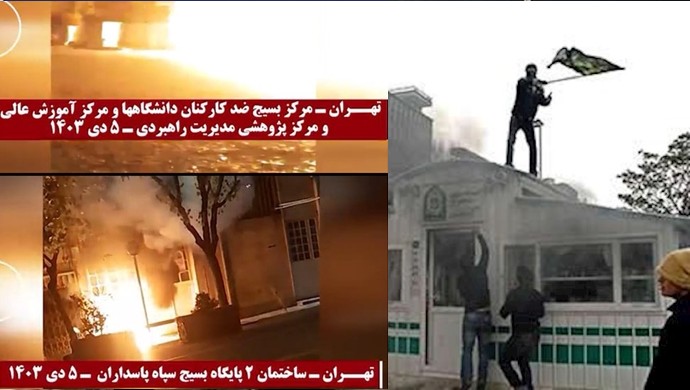

On December 25, the anniversary of the 2009 Ashura Uprising in Iran, rebellious youth targeted several regime centers of repression and crime in Tehran. These fiery assaults conveyed to the regime that the flame of rebellion ignited on December 27, 2009 (coinciding with Ashura), which shook Tehran under the feet of the mullahs’ regime, still burns bright. This occurs amid a state of dread engulfing the regime, which is caught in crises following the fall of the Assad regime in Syria and the collapse of the Iranian regime’s strategic depth in the region.
Three days after the Ashura Uprising in 2009, during a government-backed rally on December 30, regime cleric Ahmad Alamolhoda stated: “The leadership of the Ashura day movement was in the hands of the [PMOI] because the slogans that the [PMOI] had posted on their website since December 7 were echoed by the Ashura protesters. Therefore, these people were the assistants of the [PMOI]. The leadership of the Ashura day’s movement was the [PMOI]. The [PMOI] commanded the operations of Ashura day. These people not only declared cooperation but also became foot soldiers for the [PMOI] and entered the field as their soldiers.”
This is merely a part of the bitter laments of the regime’s leaders and officials following an uprising that, according to senior officials, brought the regime to the brink of overthrow.
IRGC commander Saeed Qasemi, a loyal enforcer of regime supreme leader Ali Khamenei, remarked, “It was over. I understood this in the heart of the capital, just like the early days of the [1979] revolution when they told me to come to the streets because it was all over. At Enghelab Square, Massoud Rajavi and his group were dismantling the state’s setup. It was over, son. People, even the Basijis in the oil company and elsewhere, were begging their Basij commander, ‘Sir, remove our names as Basij members. It’s over.’ For many, it had become clear that it was over. That’s why [Khamenei] says they brought me to the edge of the cliff.”
The 2009 Ashura uprising proved that the people despise the regime and as soon as a crack appears within the regime’s tightly held apparatus of repression, the explosive potential of society spills into the streets, against the regime.
A year later, on February 16, 2011, following another round of uprising in which the youth chanted “Death to the principle of the Supreme Leader,” regime cleric Ahmad Khatami declared: “The nature of the disturbances on February 14 was the same as that of Ashura Day disturbances. It means the same criminals who chanted ‘Death to the principle of the Supreme Leader.’ For this reason, we demand resolute, revolutionary action from the respectable officials of the regime against all sedition movements.”
Indeed, the central issue is the overthrow of the regime, and the main slogan remains “Death to the principle of the Supreme Leader.” On Wednesday, December 25, 2024, on the anniversary of the 2009 Ashura uprising in Tehran, rebellious youth, with the slogan “This is Tehran, the most rebellious city in the world,” struck the regime centers and symbols of repression and corruption:
- An arson attack at the building of two Basij headquarters
- An arson attack at the Basij center for suppressing universities, higher education, and strategic management research
- Setting fire to the Al-Zahra headquarters for suppressing women and promoting fundamentalism
- Burning billboards of Khomeini and Khamenei.
- Burning a Basij banner.
- Burning the regime’s proxy posters in two locations in Tehran.
Thus, following the blazing flames of the 2009 Ashura, the fire of heroic and rebellious youth of Iran spreads and multiplies across the cities of Iran.