

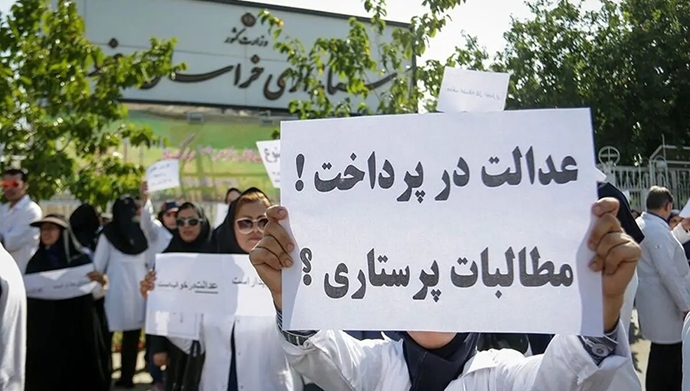

Despite their extremely hard working conditions and dedication to their profession, Iran’s nurses face some of the worst professional behavior from the regime.
Nursing is one of the most arduous jobs under the clerical regime. Many nurses are forced to work two consecutive shifts just to survive below the poverty line. Despite this, the shortage of nurses remains a chronic issue. Additionally, many nurses have emigrated due to the exhausting working conditions and the lack of essential livelihood and welfare facilities, and this trend continues widely. In recent years, it has been reported that there is a shortage of at least 100,000 nurses. At the same time, the regime is implementing plans for the “gender segregation” of nurses.
Nurses Protest Their Dire Working Conditions
Nurses’ protests, like those of other social groups such as workers, teachers, farmers, and retirees, are a manifestation of the public’s anger towards the destructive policies of the mullahs’ regime, which, due to its plundering actions and approaches, has driven the people deeper into poverty every day, while the pockets of the regime’s leaders and officials are filled with the wealth stolen from these same people. For this reason, nurses have never stopped and will never stop protesting
Paying attention to a few of the nurses’ problems reveals the depth of their suffering: the improper implementation of the Nursing Services Tariff Law, mandatory overtime work with meager pay, excessive pressure on working nurses, and the failure to hire new staff are just a small part of their difficulties, which lead to the migration of nurses.
Migration Crisis: 200 Nurses Leaving Every Month
A member of the Supreme Nursing Council says: “One of the important demands of nurses is the proper implementation of the Nursing Services Tariff Law. It has been a long time since the nurses’ service fees were deposited into their accounts, and it has been over a year since these fees were received by the nurses. In addition, the welfare of nursing colleagues is completely inadequate. The overtime pay for nurses is also very low and not commensurate with their status; currently, a nurse with 25 years of experience receives 300,000 to 400,000 rials per hour for overtime, which is a very low amount, and even taxes are deducted from these amounts. Hiring the active staff during the COVID-19 pandemic is also one of the serious demands of the nursing community from the future government” (Source: Mehr News agency, July 21). The member of the Supreme Nursing Council warns that the nurses’ situation must be addressed; currently, 150 to 200 nurses are leaving the country each month.
90 Percent of Nurses in Shiraz on Strike
Last week, nurses across the country went on strike and protested due to the severity of their work-related crises, with about 90 percent of nurses in Shiraz staging a widespread strike.
On August 11, Aftab News website wrote, “Nearly nine hospitals in Shiraz and one hospital in Karaj faced a severe crisis last week. Their nurses stopped working and stayed home in protest of mandatory overtime, non-implementation of laws, low wages, excessive and hard work, insults, and threats.”
Although during this time, they have faced multiple phone calls from security forces, threats of dismissal, and the formation of security court cases, the president of Shiraz University announced that all protesting nurses would be fired, and hospitals have resorted to seeking help from hospitals in Tehran, the army, midwives, health soldiers, and nursing students to make up for the lost workforce.
“In May of this year, following continuous protests, a group of nurses from Tajrish Shohada Hospital in Tehran, Taleghani Hospital in Chalus, Taleghani Hospital in Abadan, and nurses from several medical centers in Yazd made headlines with their collective resignations. During the same period, nurses at Golestan and Baghaei hospitals in Ahvaz and Baghmalek Hospital also protested” (Source: Ham-Mihan newspaper, August 11).
Astronomical Salaries for Repressive Plunderers
While millions of people in Iran suffer from the poverty and misery caused by the destructive policies of the ruling regime, workers, retirees, and today nurses, and tomorrow other exhausted social groups, raise their voices in protest at their workplaces and in streets across the country. Meanwhile, regime officials are filling their pockets with the wealth of these very people.
Experts from the country’s Court of Audit have announced: “Twelve executive bodies of the country have violated Article 12, Clause C, of the 2023 National Budget Law, which prohibits salaries and benefits exceeding 550 million rials per month for 10,174 people” (Source: the state-run Alef website, August 10).
The protests of suffering nurses, the loud cries of retirees, the strikes and protests of workers, the outcry of farmers, and the voiceless cries of the hungry and unemployed are the sparks of anger of an enslaved people against a shared pain. It won’t be long before the people and their organized resistance the tyrannical regime of the mullahs.