


As the new government of Iran’s regime prepares to take office, the living conditions of the Iranian people continue to decline with lack of electricity and water, lack of money and jobs. For more than forty years, the religious fascism ruling Iran has entrenched itself in the nation’s water, soil, and resources, devastating the people’s existence through looting and destruction. Thousands of billions of dollars in damage from warmongering and exporting terrorism, and hundreds of billions of dollars in plundering and embezzling people’s money, have left a country as capable as Iran without water and electricity in the summer heat, causing the people to suffer in the scorching weather. Its youth, hopeless about the future, are unemployed and desperate, and some dream of fleeing the country. Even regime supreme leader Ali Khamenei was forced to prioritize the economic crisis in his speech at the inauguration ceremony: “Everyone knows I am very sensitive to cultural issues, but today’s priority is economic issues.” Experts say that even a semi-accurate understanding of the dire situation in the clerical regime is unimaginable.
On July 29, the state-run Donya-ye Eghtesad newspaper wrote, “It can be said with certainty that 70% of Iran’s problems and issues in various sectors are due to ignoring the basics and fundamentals of economics and enacting anti-economic regulations: the electricity crisis, water crisis, issues in health and education sectors, gasoline, air pollution, environment, smuggling, rent-seeking and corruption, low productivity, the state of cars, housing, labor force, poverty, etc. do not need extensive multi-thousand-page programs for each ministry; the basics need to be adhered to. The entire governance system, especially the government in Iran, requires a review and a change of course: shifting the focus from anti-economy to economy.”
It is obvious that the unspoken lines of the above media report, like other government media trying to dissect the root causes of all the turmoil, are summed up in a few words: the ruling regime characterized by looting, repression, and rent-seeking economy.
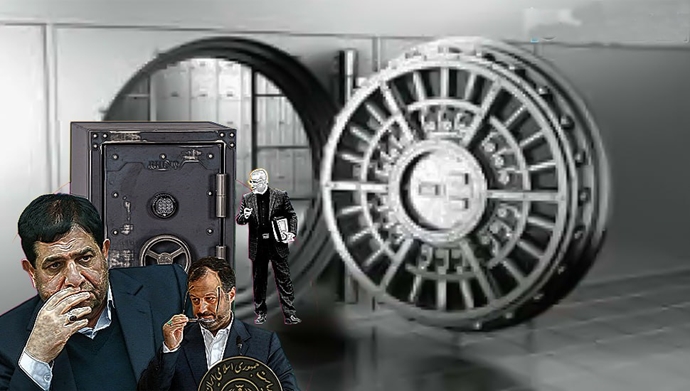
A country shut down with an empty treasury—the rigid reactionaries have done to the economy what they did to the treasury, the development fund, and the savings of the impoverished people of Iran; to the point that when they want to hand over the treasury to the new government, they have nothing. In an official letter to the acting president” on July 27, the Minister of Economic Affairs and Finance announced that the cash balance of the treasury is 105 trillion rials, about 170 million dollars. This amount is literally “nothing” for the treasury of a country like Iran, not even enough to pay the weekly pay of government employees. According to the head of the Administrative and Recruitment Organization of the country, the government pays 1.5 quadrillion rials in salaries and wages to employees every month. So, the simple question is, assuming the claims of selling oil and bypassing sanctions are true, where has the money gone?
On July 29, Asr-e-Iran news website pointed out the contradiction between oil sales and the empty tables of the people: “The thirteenth government always claimed that it was able to increase oil sales and the resulting revenues and other exports and domestic revenues several times more than the previous government, but despite all these claims, it has handed over a treasury with 170 million dollars. This is where one must ask, where are the results and signs of all those revenues and claimed remarkable economic successes? They are not on people’s tables! They are not in the treasury either! So where are they?”
Inflation, poverty, lack of growth, or imbalances; which is more urgent? The desperate regime and the bankrupt incoming government, which incurable pain should they address and where should they even start? Who knows? Each faction and wing have its own plans and tricks to maintain its privileges and monopolies.
On July 29, Jahan-e Sanat news website wrote, “The unprecedented heatwave has caused some to identify addressing the energy imbalance as the most urgent task for the government. Is the energy imbalance the biggest crisis in Iran’s economy? If so, where do inflation, low and volatile economic growth, banking system imbalances, pension fund imbalances, unemployment, etc. fit into the government’s agenda? In other words, which of these economic problems is more important and should be addressed as the most urgent task of the fourteenth government’s economic team?”
Government debt to wheat farmers exceeds 1 quadrillion rials. Now let’s point to one case. For more than forty years, the childish and deceitful game of “self-sufficiency” without providing the scientific and structural requirements, which was one of the nonsenses of Iranian regime founder Ruhollah Khomeini, has led the country’s water and soil resources to ruin, and the clerical regime would become “self-sufficient” every other year, and the next year, their imports would cause embarrassment. For a few years, they have been promising poor and waterless farmers without the necessary facilities to plant wheat, saying, “We will buy it!” But now, the talk is about the government’s debt of thousands of billions to this hardworking segment of the nation.
On July 25, the head of the National Wheat Farmers Foundation, announcing that the government’s debt to wheat farmers has reached 1.04 quadrillion rials, said that the Program and Budget Organization “does not prioritize agriculture and paying the demands of this segment of the people of the country.”
Although the regime’s coffers are emptier than ever, the power and motivation of the aware and brave youth of the nation are beyond any barrier or obstacle and will dismantle the tyrannical rule of the mullahs.