

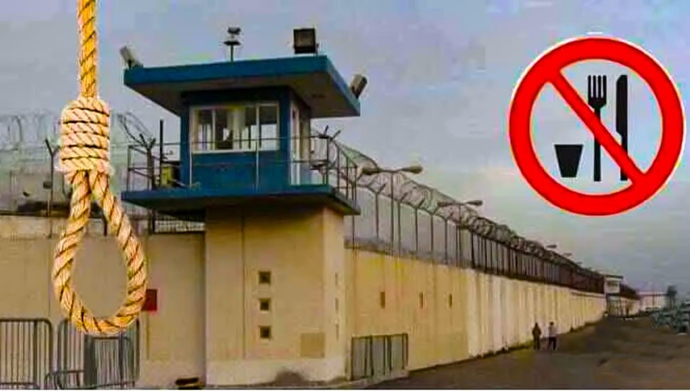

In a bold move against the rising tide of executions in Iran, political prisoners across 17 prisons have launched the “No to Execution Tuesdays Campaign,” now in its 27th week. The campaign, which began with a handful of prisons, has expanded to include facilities in major cities such as Tehran, Karaj, Mashhad, and Tabriz, as well as smaller towns like Khoy, Naqadeh, and Saqqez.
The latest round of protests, which started on Tuesday, July 30, 2024, saw prisoners in various wards of Evin prison, Ghezel Hesar, Central Karaj, Khorramabad, and other facilities embarking on hunger strikes. The campaign has gained momentum with the recent addition of Nezam Prison in Shiraz.
This surge in activism comes in response to an alarming increase in executions across Iran. In just one week, 23 prisoners, including four women, were put to death in prisons spanning from Zahedan to Urmia. The execution of Kamran Sheikheh, a 40-year-old Sunni political prisoner, on July 25 in Urmia prison after 15 years of imprisonment, has particularly galvanized the movement.
Sheikheh’s case exemplifies the concerns raised by the campaigners. Arrested during the 2009 uprising, he and six other Sunni compatriots were subjected to severe torture and a flawed and unjust judicial process.
In March 2016, they were sentenced to death on charges of “acting against national security, propaganda against the regime, and corruption on earth” by Mohammad, a criminal judge who has been sanctioned internationally for his human rights abuses. Their death sentences was confirmed in June 2018 by Abolghassem Salavati, another criminal judge. The regime’s Supreme Court upheld these sentences in 2019.The campaign has also drawn attention to the plight of Kurdish political prisoners. Three individuals from Bukan – Soleiman Adhami, Hossein Khosravi, and Hiwa Nouri – were recently accused of “Baghi” (rebellion against Islamic rule) in the Revolutionary Court of Urmia. The protesters argue that these charges were brought without adherence to basic rights or fair trial procedures, raising fears of potential death sentences.
On July 24, political prisoners in the women’s ward of Evin Prison staged a protest and sit-in following the death sentence issued for Pakhshan Azizi, a Kurdish political prisoner. In a powerful display of solidarity, they chanted slogans against the regime and symbolically set fire to a noose, vowing to “stand until the end for the abolition of the death penalty.”
The death sentence for Azizi, following similar verdicts for Sharifeh Mohammadi and accusations against Nasim Gholami Simyari and Varisheh Moradi, is part of a targeted effort to suppress women and instill fear in the population.
These developments occur against the backdrop of international condemnation. Javaid Rehman, the UN Special Rapporteur on Human Rights in Iran, recently released a report condemning the regime for arbitrary killings in the 1980s and 1988, characterizing them as crimes against humanity and genocide. Rehman has called for the prosecution of those responsible, adding international pressure to the domestic campaign.
The “No to Execution Tuesdays” campaign is a defiance to the Iranian regime’s use of capital punishment. By coordinating hunger strikes across multiple prisons, the protesters aim to draw attention to what they see as systemic human rights violations and the arbitrary use of the death penalty as a tool of political repression.
In their statement, the striking prisoners have appealed to political and human rights activists, as well as international organizations, to amplify their cause. They are calling for concerted efforts to abolish executions, torture, and what they term “inhumane sentences.”
From its inception to now encompassing 17 prisons across Iran, the campaign’s growth demonstrates the courage of these prisoners, who risk further punishment by participating in these protests.
As the “No to Execution Tuesdays Campaign” enters its 27th week, it stands as a testament to the resilience of political prisoners in Iran and their unwavering commitment to human rights. The involvement of prisoners from diverse backgrounds – political, ideological, and general – underscores the broad-based opposition to the current application of the death penalty in Iran.
The Iranian Resistance has called on the UN High Commissioner for Human Rights, the Special Rapporteur on the human rights situation in Iran, and all human rights organizations to take immediate action to free political prisoners and save the lives of those on death row. The Resistance urges the UN Security Council to address the extensive record of human rights violations committed by the religious fascist regime ruling Iran. Regime supreme leader Ali Khamenei and other regime leaders must face justice for four decades of crimes against humanity and genocide.