

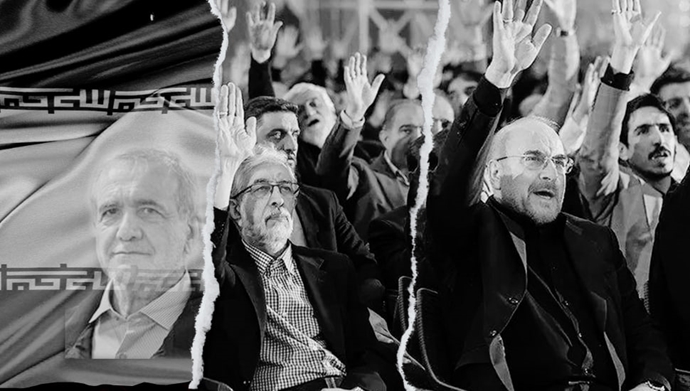

Before being appointed as the Iranian regime’s new president, Massoud Pezeshkisn repeatedly emphasized his loyalty to Supreme Leader Ali Khamenei and the continuation of the deceased Ebrahim Raisi’s path. He visited Raisi’s home and described his disastrous presidency as “valuable and unforgettable efforts” and expressed his “appreciation” for it.
Pezeshkian, in his congratulatory message to Hassan Nasrallah, the leader of the terrorist Hezbollah group in Lebanon, expressed his full support for him, emphasizing that this support “is rooted in the fundamental policies of the system and the ideals of Khomeini and guidelines of Khamenei.”
These statements by Pezeshkian were praised by the regime’s Friday prayer leaders and state-run media.
Despite these formalities, the infighting in the fractured regime is limitless. A striking example of this is the first Friday prayer sermons after the end of the electoral charade, where the regime’s Friday prayer leaders, despite Pezeshkian’s subservience, remind him not to stray off course.
The Friday prayer leader of Isfahan said, “He must firmly and strongly continue Raisi’s path” and “a large portion of Raisi’s government officials should not be replaced.”
Ahmad Khatami, the interim Friday prayer leader of Tehran also warned: “I ask the elected president not to reignite the dual dispute of commitment and expertise after 45 years.”
The regime’s Friday prayer leader in Ardabil said: “If he wants to be and remain reputable, there is only one way; that is to follow Khamenei’s directives.”
The regime’s Friday prayer leader in Bojnord said: “He must strive to have the same characteristics as Raisi.”
These warnings echo Khamenei’s statements following the announcement of the electoral charade results on July 7, when he said: “Dear Raisi, as a model, showed that one can, as the president of a country, possess this set of intellectual, heartfelt, and practical qualities and follow them in practice.”
On the other hand, Pezeshkian has not remained idle and issued a directive to acting president Mohammad Mokhber, stating that dismissals, appointments, contract signings, and financial decrees must be halted until he starts his work.
This directive was met with a backlash by the incumbent officials, stating that Pezeshkian is not yet the established government and should not issue directives.
Of course, the remnants of Raisi’s government, as reported by the state-run Entekhab news website, on July 10, are busy in the remaining time with various last-minute transfers, including the “transfer of Parsian Gas Refining Company, Fajr Jam Gas Refining Company, Moghan Agro-Industrial, Abadan Oil Refinery, and Oil Design and Construction Company through OTC.”
On July 11, Arman-e Melli newspaper wrote, “Creating crises and generating dissatisfaction for the new government is on the agenda in the early days of its work” and that dam water has been released so that “the new cabinet will start its work with an 8,000-megawatt hydroelectric energy deficit.”
The most spectacular example of the infighting involves Saeed Jalili, Pezeshkian’s rival in the election, who said to his campaign team: after the results were announced, I met with Pezeshkian and told him we, as the “shadow government” and “with power,” want to “help” Pezeshkian’s government. “Shadow to shadow” we will follow them and “God forbid if we see a mistake forming somewhere, we will powerfully try to help correct that mistake.”
These threatening statements have provoked anger and a sense of threat from the opposing faction. Politician Mostafa Hashemitaba, said, “I don’t know who gave the duty of being the shadow [government] to Jalili… From whom did they get the mandate? Did the Supreme Leader mandate them to be the shadow government?” (Source: State-run Khabar Online news website, July 11).
The state-run Ham-Mihan newspaper, on July 11, considered Jalili’s statements about the “continuation of the shadow government’s activities” as an example of “movements and threats,” noting that “in the unofficial and virtual sphere, the extent and explicitness of these orchestrations are broader.”
These are just a glimpse of the fractured and crisis-ridden state of Khamenei’s regime following Raisi’s death and after two devastating popular boycotts, showing that the people, who do not want this regime in its entirety, are determined to rise and overthrow it.