

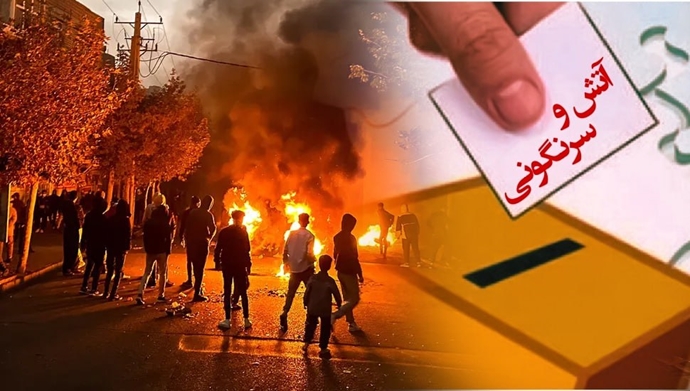

After the Iranian regime’s sham presidential election, the Social Headquarters of the People’s Mojahedin Organization of Iran (PMOI/MEK) inside Iran announced: “Voluntary and compulsory votes in 58,640 fixed and mobile polling stations are about 5.5 million… the maximum participation in the second round of the fraudulent election is about 9 percent of eligible voters, and 91 percent of Iranians boycotted the presidential election of the Velayat-e Faqih dictatorship.”
After the first round of the sham elections, the Social Headquarters of the PMOI inside Iran monitored over 14,000 polling stations across the country, including large cities, small towns, and rural areas, from 8:00 a.m. to midnight. They reported that despite extensive fraud and rigging, fewer than 7,400,000 people, only 12 percent of eligible voters, participated in the mullahs’ presidential election, whether voluntarily or under coercion. Consequently, 88% of the Iranian people wielded the “crushing sledgehammer of boycott” against regime supreme leader Ali Khamenei’s election masquerade and resoundingly rejected the religious dictatorship. They declared their definitive vote was for the overthrow of the regime.
Thus, two heavy nationwide election boycotts delivered a decisive blow to Khamenei and shook the foundations of his regime. The mullahs’ regime was also forced to admit the lowest participation rate in the regime’s history (around 40 percent) in its official and fraudulent statistics.
On July 7, state-run Didar news website quoted politician Ebrahim Asgharzadeh, as saying, “More than 60 percent of the people did not come to the ballot box, and this was not surprising at all. It was a conscious social movement that did not come to the ballot box. Your most important achievement from the revolution was the ballot box, and this was supposed to show that elective institutions have power. But what happened in practice is that society rejected you, and this cost is very high, higher than several atomic bombs.”
After the first round of the election, Khamenei, after five days of silence, was forced to say: “In the first stage of the elections, the people’s participation was not as expected. It was less than what we expected.” Then he ridiculously said: “If anyone thinks that those who did not vote did so because they were against the regime, this understanding is one hundred percent wrong.” He then prepared the groundwork for vote manipulation and fraud for the second round, and at the beginning of the second act of the show, before the actors even took the stage, he absurdly spoke of the “people’s enthusiasm and interest.”
On July 7, a former parliament member, Gholam Ali Jafarzadeh Imenabadi, trying to reduce the number of people who have turned against the entire regime, said: “30 million people will not come under any circumstances; neither oath, nor friendship, nor country, nor martyrdom, nothing will make them come. Well, this is not a boycott; it is a divorce. You cannot say they boycotted; it is a divorce, meaning a separation between themselves and the government and the Islamic Republic… And this is a major social damage that requires a prescription.”
“Major social damage” is a means the eruption of people’s anger and the inevitable uprising that will burn the roots of the regime along with all its factions. For this despised and crisis-ridden regime, there is no remedy other than to be overthrown.