

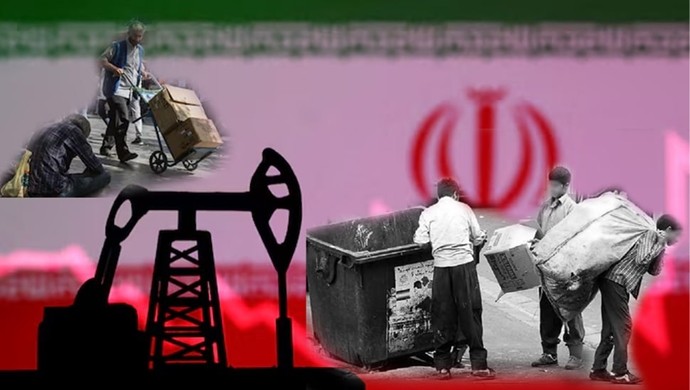

The Iranian regime’s current executive and legislative branches have broken the records of their predecessors in taxation, surpassing previous governments to the extent that they have introduced over 20 new types of taxes.
On September 5, 2023, the state-run Khabar Online news website wrote, “The ‘principlist’ movement, from 2019 until now, by first gaining control of the Majlis [parliament] and then the government, has imposed more than 20 new taxes and expenses on the people, breaking the record for the highest tax collection from the people compared to previous governments and parliaments. These include property tax, rent, vehicle tax, card reader tax, bills, money transfer tax, increased tariffs, various government service charges, and of course, VPN [fees].”
Of course, this extortion and predatory behavior does not apply to the regime’s elements. The Astan-e Quds Foundation, the 15 Khordad Foundation, the Mostazafan Foundation, the Housing Foundation, the Kowsar Economic Organization, the Alavi Foundation, along with dozens of covert companies and other anonymous institutions, together with Islamic Revolutionary Guard Corps (IRGC), control over 60 percent of the country’s economy and are exempt from paying taxes.
The regime planned to collect 3.25 quadrillion rials in taxes in the 2021 budget. For the year 1401 (2022-2023), it planned to collect 5.26 quadrillion rials in taxes, which was more than twice the record for tax collection in the past 40 years. However, the regime continues to find new ways to levy taxes, including handing fines to girls and women who do not comply with the regime’s misogynistic hijab rules.
Taxation under the guise of fines for unveiled women is one of the most oppressive measures witnessed by the distressed Iranian people in 2024. The government’s tax collection has left no room for complaint about “no people has seen so much injustice,” which has become the slogan of protesters from all walks of life.
The proposed budget for the year 1403 (2024-2025) by the Raisi government aims to increase the income from taxation by 44 percent compared to the previous year. The tax on income from professions and guilds has increased by 95 percent, and the tax on workers’ wages has also exceeded 70 percent. Another blow to consumers is the 10 percent value-added tax in the face of inflation and recession, which is astonishing.
On March 18, Asr-e-Iran news website wrote, “According to the budget law for the year 1403 (2024-2025), to provide the necessary resources to adjust the salaries of military retirees, civil servants and the value-added tax rate specified in Article 7 has been increased from 9 percent to 10 percent. This measure aims to generate additional revenue for the government.
Traffic fines have also become a means for the government to secure funds for its “morality” patrols. The new tariffs, under the pretext of not observing the hijab in vehicles and other self-imposed offenses, will generate over 60 trillion rials in revenue for the government.
On April 21, Khodro45 website wrote, “The government plans to collect an average of 3.75 million rials in fines per vehicle in 2024.” Whereas in the previous year, it was only able to generate 20 trillion rials through this means.
Over the past three years, the Raisi government has demonstrated how it has burdened the people with a tax collection growth of over 300 percent.
On May 7, the state-run Ham-Mihan newspaper wrote, “In the three budgets presented by the Raisi government, tax revenues have seen a growth of over 300 percent. This means that tax revenues have nearly quadrupled compared to the last budget of the Rouhani government.”
According to economist Hadi Haghshenas, this year the regime will have a budget deficit of at least 3.7 quadrillion rials. It is evident that these deficits are a result of the costs of suppressing protests within the country and engaging in provocative military actions in the region, which is alarming. Oppressive regimes only exert pressure on the people while the government’s gangs and mafia always find ways to evade taxes. It is the wage earners, workers, and producers who bear the burdensome costs of government expenses. More than 20 provinces in the country are reeling in the aftermath of seasonal floods and the destruction they left in their wake. Who will bear the costs of this devastation, especially when taxation and extortion have burdened the people, bending their backs?