

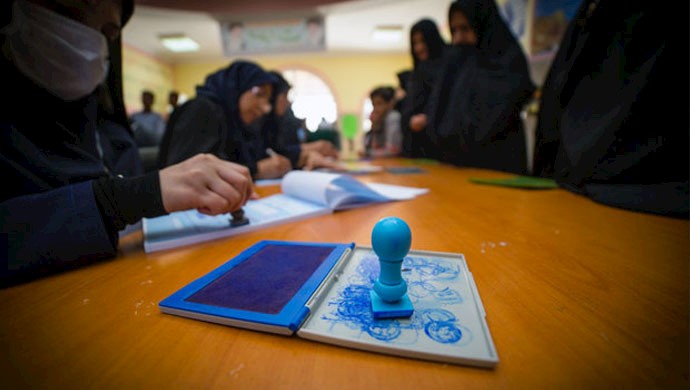

Concepts such as “democracy” and “elections” are terms used by a democratic state to establish a civil and advanced society. Movements that advocate for elections believe in the people determining their fate. The rule of the mullahs in Iran, based on the theory of Velayat-e Faghih (Rule of the Guardian Jurist), fundamentally rejects the role of the people and popularly elected government. The concept of Supreme Leader is equivalent to the rejection of popular vote and rulers elected by the people.
Guardians and minors
According to the statements of Mohammad Taghi Mesbah Yazdi, a member of the Assembly of Experts until his death in 2021 and one of the closest mullahs to regime supreme leader Ali Khamenei, “Not only is the legitimacy of the regime not dependent on the vote and consent of the people, but the people’s vote has no influence or interference in its credibility.”
His statements are still the basis of action for this regime: “In an Islamic government, the people’s vote has no legal or religious credibility, neither in determining the type of political system in their country, nor in the credibility of the constitution, nor in the election of the presidency, the Assembly of Experts, and the leadership. The sole criterion for legal credibility is the ‘satisfaction of the Guardian Jurist.'”
If there have been discussions about elections in the Islamic Republic so far, it is solely because the Khamenei has deemed it expedient to have elections for now and consider the people’s opinions.
The Supreme Leader has the authority to choose a different form of ruling regime at any time he wishes and deems it in the best interest, even if it means not relying on the people’s vote at all. The legitimacy of the regime is not solely dependent on the vote and consent of the people, and the people’s vote has no influence or interference in its credibility.
A façade of democracy
The revelations by the People’s Mojahedin Organization of Iran (PMOI/MEK) have made it clear that Khomeini and his regime’s operatives only needed the people’s votes in elections to claim legitimacy for their regime.
According to this perspective, Islam has only one representative, which is the Valiy-e Faghih (Guardian Jurist or Supreme Leader) or the Caliph. It is believed that the Supreme Leader should have complete and absolute power and should be accountable only to himself, not to anyone else.
The clear reason behind this is that the Supreme Leader, whenever he is compelled to use terms such as “people” or “freedom,” immediately attaches these words to his desired interpretation of “religion.” He uses combinations like “religious popular sovereignty” instead of “democracy” or “religious intellectual freedom” instead of “religious freedom.” However, the regime’s intended meaning of “religious popular sovereignty” specifically refers to the paramilitary forces affiliated with the Islamic Revolutionary Guard Corps (IRGC) that it considers as the embodiment of religious popular sovereignty.
Complaints within the regime’s ranks
Even the regime’s own authorities are questioning the structure of governance. One of them is Mohammad Javad Hojjati Kermani, who has been disqualified from participating in the elections due to the narrowing circle of power. His exact words were: “They have taken control to such an extent that no one is left!”
Regarding the Guardian Council, the body that oversees the elections, he added, “The Guardian Council does not accept anyone. The only person who can correct the wrong policy of the Guardian Council is Mr. Khamenei; only he has the power to order Mr. Jannati to abandon this wrong policy.”
It is worth noting that the 12 members of the Guardian Council are directly and indirectly appointed by Khamenei himself.
Kermani complained that he and other candidates were disqualified because they had “different views.”
Ironically, after four decades, he has just happened to notice that the only way to climb the echelons of power is to be in full accordance with the regime’s supreme leader.
It appears that the escalation of destructive warfare in Gaza has not been able to serve as a useful distraction for the ruling establishment in managing internal challenges and crises, including the staged elections of the Assembly of Experts and the Majlis (Parliament).
It seems that this is still the beginning of the story, and the internal conflicts and struggles within the ruling establishment persist. The significant challenge facing the regime is the escalating uprising and unstoppable anger of the people aimed at uprooting the clerical regime. The fire of the people’s anger will soon put an end to this warmongering regime, liberating the people of Iran, the region, and the world from the grip of the snake whose head is in Tehran.