


Latest update – 8:20 pm CET
Iran’s nationwide uprising is witnessing its 178th day with protests reported from different cities and by people from various sectors of society. Anger is escalating among the Iranian public as economic woes are making it extremely difficult to make ends meet, especially less than ten days prior to Nowruz, the Iranian calendar new year.
People throughout the country are specifically holding the mullahs’ Supreme Leader Ali Khamenei responsible for their miseries, while also condemning the oppressive the Islamic Revolutionary Guards Corps (IRGC) and paramilitary Basij units, alongside other security units that are on the ground suppressing the peaceful demonstrators.
Protests in Iran have to this day expanded to at least 282 cities. Over 750 people have been killed and more than 30,000 are arrested by the regime’s forces, according to sources of the Iranian opposition People’s Mojahedin Organization of Iran (PMOI/MEK). The names of 664 killed protesters have been published by the PMOI/MEK.
Retirees and pensioners in the cities of Ahvaz, Kermanshah, Shush, and Kerman, were rallying today, protesting low pensions, poor insurance plans, and seeking adjustments based on skyrocketing prices and increasing inflation.
Pensioners and retirees are among the worst-hit segments of Iran’s society. They depend on government stipends to make ends meet, but the regime has refused to increase their pensions in correspondence with growing inflation and the depreciation of the national currency.
The government has long provided many hollow promises of increasing pensions. It was also supposed to settle unpaid pensions remaining from previous years. So far, it has yet to deliver on both demands.
Interestingly, the regime’s own media reported that The Social Security Investment Company (SHASTA), the financial institution that is supposed to fund retirees, has seen a significant increase in its profits in the past years. However, these profits have yet to materialize in the lives of pensioners and retirees.
March 12 – Ahvaz, southwest #Iran
Retirees and pensioners of the Social Security Organization protesting and calling for higher wages and equality among all retirees.#IranProtests2023pic.twitter.com/YhhPoiYkER— People's Mojahedin Organization of Iran (PMOI/MEK) (@Mojahedineng) March 12, 2023
Similar protest rallies were held on Sunday by retired steel workers in Isfahan, central Iran, and nurses in Qazvin, northwest Iran.
Workers of government-associated sites are holding a gathering in Tehran on Sunday morning protesting the regime’s refusal to increase their paychecks, in violation of their own laws, and voicing their grievances over their economic woes.
In other reports from the country’s capital, investors in the Azvico auto company (shareholders include the IRGC) are rallying today and seeking answers to their long-raised demands after being left in limbo for so long.
March 12 – Tehran, #Iran
Investors in the Azvico auto company (shareholders include the IRGC) are rallying and seeking answers to their long-raised demands after being left in limbo for so long.#IranProtests2023#اعتراضات_سراسری pic.twitter.com/LVi8XWjWmh— People's Mojahedin Organization of Iran (PMOI/MEK) (@Mojahedineng) March 12, 2023
Workers of the Haft Tappeh Sugarcane Company in Khuzestan Province, southwest Iran, continued their strike for a second day on Sunday protesting company officials’ refusal to address their demands.
March 12 – Haft Tappeh, southwest #Iran
A group of workers of the Haft Tappeh Sugarcane Company went on strike for a second day, protesting company officials' refusal to address their demands.#IranProtests2023 pic.twitter.com/uTaC0WQfDQ— People's Mojahedin Organization of Iran (PMOI/MEK) (@Mojahedineng) March 12, 2023
On Saturday night people in Tehran’s Shahrak-e Bagheri and other districts began chanting anti-regime slogans, including:
“Khamenei is a murderer! His rule is illegitimate!”
“Death to Khamenei! Damned be Khomeini!”
“Death to the girl-killing regime!”
March 11 – Tehran, #Iran
Locals in the capital began chanting anti-regime slogans.#IranRevolution pic.twitter.com/6b7q7OgJ8r— People's Mojahedin Organization of Iran (PMOI/MEK) (@Mojahedineng) March 11, 2023
Various medical personnel in the cities of Tehran and Ilam began rallying on Saturday morning and protesting the regime’s corrupt policies in their field of work and related industries. The protesters were chanting slogans against the regime’s Health Minister and demanding his resignation.
In other news, regime operatives launched a chemical gas attack targeting the all-girls Kowsar and Setayesh schools in the city of Ahvaz, the capital of Khuzestan Province, leaving a number of students ill.
March 11 – Ilam, western #Iran
Personnel and the medical staff of the Medical University of Ilam rallying outside the campus and protesting the university officials' corrupt policies.#IranProtests2023 pic.twitter.com/mtIebCiBE2— People's Mojahedin Organization of Iran (PMOI/MEK) (@Mojahedineng) March 11, 2023
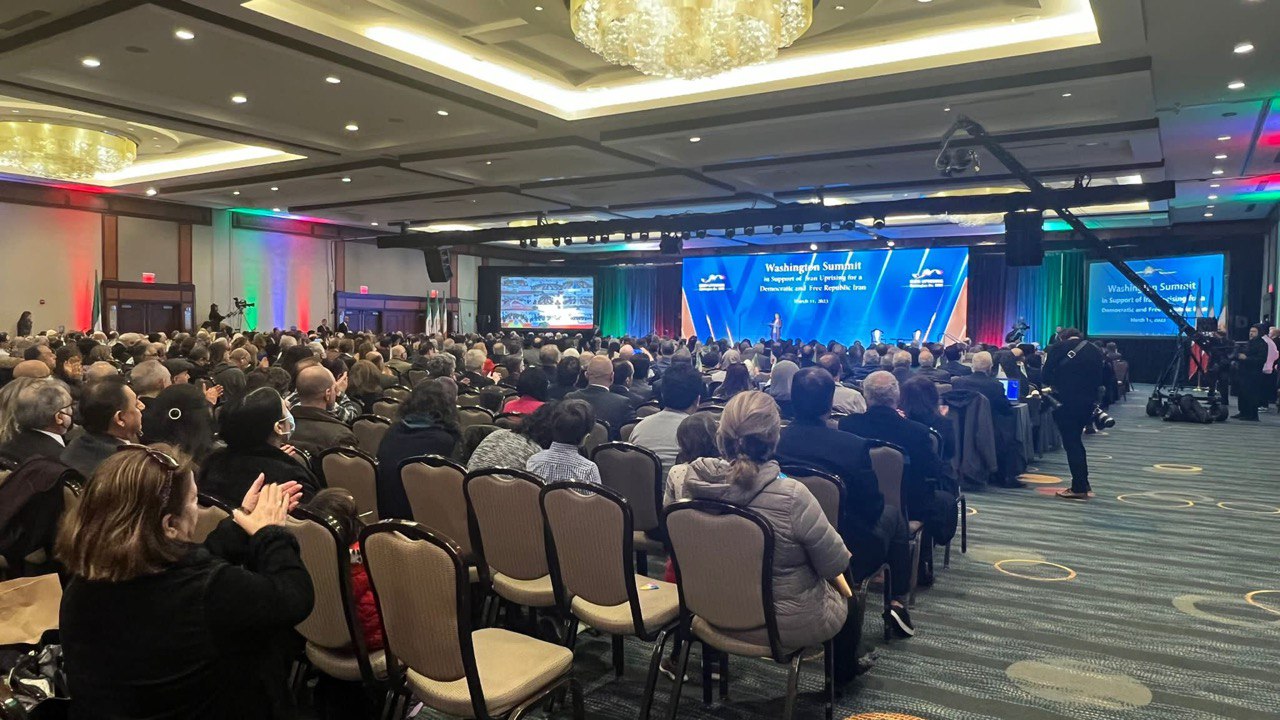
As the country’s nationwide uprising is about to enter its seventh month, the Organization of Iranian American Communities hosted a bipartisan summit in Washington on Saturday during which prominent dignitaries voiced their support for the Iranian people’s ongoing revolution and called for the international community to support the Iranian nation’s demands.
The speakers praised the recent bipartisan congressional majority behind House Resolution 100, announced on March 9, in support of a non-nuclear, secular, republic of Iran. Hundreds of Iranian American community leaders and members from across the U.S. attended the DC event in solidarity with the Iranian people and their ongoing protests against the mullahs’ theocracy. The conference was followed by a march in DC streets after which the participants gathered on the U.S. Capital Grounds to attend a photo exhibition honoring the victims of the mullahs’ brutalities against the Iranian people.
The keynote speaker of the event was Iranian opposition coalition NCRI President-elect Maryam Rajavi. Former U.S. Vice President Mike Pence, former NATO commander Gen. Wesley Clark, Gov. Gary Locke of Washington, Gov. Sam Brownback of Kansas, and Sen. Robert Torricelli were among the other speakers at the event that also hailed Mrs. Rajavi’s leadership of the Iranian Resistance movement and the MEK’s persistent struggle against the mullahs’ dictatorship, especially with the network of Resistance Units inside Iran.
The clerical regime will resort to any crime in effort to stop the uprising.
In the past three months, the regime has carried out a horrific crime by poisoning thousands of #IranianSchoolGirls nationwide through chemical attacks.
Despite this brutal https://t.co/Bx0Eq0hZHE… https://t.co/eE0ftGtJdx— Maryam Rajavi (@Maryam_Rajavi) March 11, 2023
“The clerical regime will resort to any crime in an effort to stop the uprising. In the past three months, the regime has carried out a horrific crime by poisoning thousands of Iranian school girls nationwide through chemical attacks. Despite this brutal suppression, the regime has failed to uproot the uprising, because this uprising has roots in the explosive state of Iran’s society, and MEK Resistance Units and the nationwide network of organized resistance inside the country play a significant role in the uprising,” the NCRI President-elect explained.
“The Iranian Resistance has called for the formation of the National Solidarity Front since 2002. This front has been proposed based on three principles:
-First, the overthrow of the regime in its entirety
-Second, the formation of a democratic republic
-Third, the separation of religion and state.
“The firsthand experience of the Iranian people has shown that monarchy in Iran has always been a manifestation of fascism. During the reign of the Shah, all freedom fighters were either imprisoned or executed, which enabled the mullahs to hijack the leadership of the revolution,” Mrs. Rajavi emphasized.
We are aware of the difficulties on the path ahead. But no obstacle can deter us from pursuing our objectives. The ruling religious fascism in Iran can and must be overthrown.
Today, the youth of Iran are shouting “we will fight, we will die, we will take https://t.co/7w18vf1Fz3… https://t.co/5ggA7XiXmo pic.twitter.com/63Yk7Kq1lF— Maryam Rajavi (@Maryam_Rajavi) March 11, 2023
Former Vice President Mike Pence voiced his support for the Iranian people’s uprising to establish a secular, democratic, and non-nuclear Iranian republic criticized the West’s appeasement policy vis-à-vis Tehran, called for the prosecution of regime President Ebrahim Raisi for his crimes against humanity and genocide, and emphasized there is “a well-organized, fully prepared, perfectly qualified, popularly supported alternative” in the NCRI against the mullahs’ regime.
Maryam Rajavi’s ten-point plan for the future of Iran will ensure freedom of expression freedom of assembly freedom of religion and the freedom of every Iranian to choose their elected leaders, Mr. Pence explained.
.@Mike_Pence: @Maryam_Rajavi's 10-point plan for the future of Iran will ensure freedom of expression freedom of assembly freedom of religion and the freedom of every Iranian to choose their elected leaders.#IranRevolutionhttps://t.co/QPZ6iFYQaA
— NCRI-FAC (@iran_policy) March 11, 2023
The regime should know that we’re not fooled by the fake reformers and regime puppets pretending to be moderates. People of Iran want real change and real change is exactly what MEK offers, the former U.S. Vice President highlighted, adding the regime wants to deceive the world into believing that the Iranians want to return to Shah’s dictatorship. But the world is not confused by their lies, he continued, underscoring that the Iranian people do not want to replace one dictator with another.
Former NATO chief Gen. Wesley Clark explained that the Iranian Revolution is already underway, step-by-step, with popular protests growing and determined. There is available a popular democratic secular program announced and offered by Mrs. Rajavi, he continued while explaining that the MEK is at the heart of Iran’s future and their decades of resistance, sacrifice, steadfast determination, courage, and persistence are unique in scale.
.@GeneralClark: The #JCPOA was canceled, and the United States has tried again to regain it. That's unsuccessful. I think it's essentially dead. And with it, I believe, is dying the policy of accommodating the ayatollahs' regime. #IranRevolutionhttps://t.co/XnuD9aMODt
— NCRI-FAC (@iran_policy) March 11, 2023
Ethnic minorities in Iran are among the most subjugated, dehumanized, and repressed groups in Iran, including under the time of the dictatorship of the Shah, said Gov. Gary Locke during his speech. He also emphasized that Tehran must be treated like the pariah state it is. The international community must side with the Iranian people in their historic and heroic struggle for freedom and democracy, Gov. Locke added.
Iran’s protests are not a sudden overnight phenomenon, yet another visible manifestation and result of more than 40 years of organized resistance to the regime, Gov. Locke underscored, going on to explain that during this time the MEK and its leadership have paid a huge price in blood.
Iran’s revolution is about bringing democracy and freedom to Iran, not returning to the dark and brutal day days of Shah’s dictatorial monarchy, Gov. Locke concluded.
.@GovGaryLocke: The #IranRevolution is about bringing democracy & freedom to Iran, not returning to the dark & brutal day days of Shah's dictatorial monarchy. Iranians have paid a heavy price in their resistance against 2 dictatorships.#No2ShahNo2Mullahshttps://t.co/pJy4HdWiy5
— NCRI-FAC (@iran_policy) March 11, 2023
The Iranian people can and will throw their rulers, said Gov. Sam Brownback, adding they are doing so now and that he prays for the success of the people of Iran to end this night of tyranny and to be free.
The Iranian people had a revolution, and it was stolen, explained Sen. Robert Torricelli. It will not be stolen again by anyone, he added, explaining this movement is moving forward and the Iranian people are not exchanging a theocracy for another kleptocracy.
It is Maryam Rajavi’s ten-point plan is the vision for a democratic Iran in which women will be respected with equal rights, the country will be non-nuclear, and will be at peace with its neighbors, he added.
.@bobtorricelli: Our vision is clear. It is Maryam Rajavi's ten-point plan. Iran will be democratic. Women will be respected with equal rights. Iran will be non-nuclear. It will be at peace with its neighbors.#IranRevolution #No2ShahNo2Mullahshttps://t.co/dvom527wXy
— NCRI-FAC (@iran_policy) March 11, 2023
The protests in Iran began following the death of Mahsa Amini. Mahsa (Zhina) Amini, a 22-year-old woman from the city of Saqqez in Kurdistan Province, western Iran, who traveled to Tehran with her family, was arrested on Tuesday, September 13, at the entry of Haqqani Highway by the regime’s so-called “Guidance Patrol” and transferred to the “Moral Security” agency.
She was brutally beaten by the morality police and died of her wounds in a Tehran hospital on September 16. The event triggered protests that quickly spread across Iran and rekindled the people’s desire to overthrow the regime.
In his remarks, @SeenaSaiedian explains slogans of “down with the oppressors, whether it is a Shah or a supreme leader” is heard everywhere and it reflects a uniform rejection of all forms of tyranny. #IranRevolution #No2ShahNo2Mullahs pic.twitter.com/S2m4wpfP6z
— OIAC: Organization of Iranian American Communities (@OrgIAC) March 12, 2023