

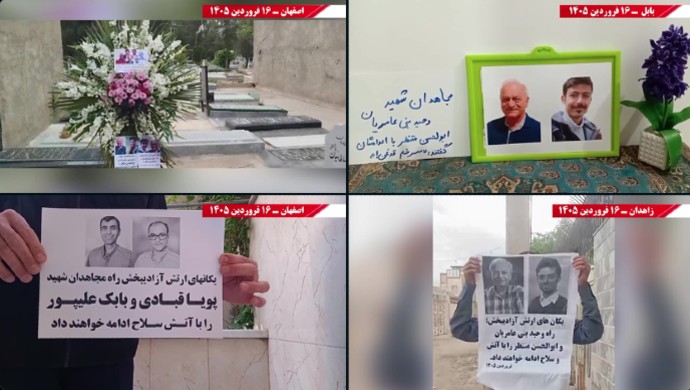

In a stunning display of bravery that shatters the Iranian regime’s illusion of control, the youth of Iran have taken to the streets to answer the mullahs’ latest wave of executions of PMOI/MEK members. On April 5, 2026, across major cities spanning from Tehran and Isfahan to Zahedan and Tabriz, PMOI Resistance Units launched a widespread mobilization.
In a defiant video from the streets, a female Resistance Unit member boldly shouted, “To the blood of Pouya and Babak, we will stand till the end.” Dozens of other activities featured posters and placards of recently executed PMOI members bearing powerful messages, such as, “No surrender!” and “We swear on the blood of our comrades that we will stand till the end.”
https://twitter.com/en_simayazadi/status/2040858820168077498
A desperate wave of executions
This nationwide defiance comes in response to a brutal campaign of state-sanctioned murder. Within a span of six days, the regime executed six PMOI political prisoners: Mohammad Taghavi and Akbar Daneshvarkar on March 30, Babak Alipour and Pouya Ghobadi on March 31, and Vahid Bani Amerian and Abolhassan Montazer on April 4. To justify the bloodshed, the regime’s IRGC-affiliated Tasnim News Agency branded the victims as “armed terrorists” facing charges of “baghi” (armed rebellion).
However, the reality of these martyrs exposes the regime’s lies. They were highly educated professionals and dedicated freedom fighters, including 34-year-old law graduate Babak Alipour, 33-year-old electrical engineer Pouya Ghobadi, 33-year-old management master’s graduate Vahid Bani Amerian, and 66-year-old architect Abolhassan Montazer.
April 5—Iran
Resistance Units commemorate PMOI members executed by the regime, vow to continue their path and the fight against the mullahs' regime. pic.twitter.com/Yk76jS2Tvf— People's Mojahedin Organization of Iran (PMOI/MEK) (@Mojahedineng) April 6, 2026
Following months of severe physical and psychological torture in Evin Prison’s Ward 209, they were subjected to a grossly flawed judicial process. Their death sentences were handed down by the notorious criminal judge Iman Afshari in Branch 26 of Tehran’s Revolutionary Court during sham hearings that lasted only minutes. The regime’s cruelty culminated on the night of March 29, when anti-riot guards violently raided Ghezel Hesar prison’s Ward 4, brutally beating the prisoners and severing all communications before sending them to the gallows.
Paralyzed by fear and uprisings
The timing of these consecutive hangings exposes a profoundly vulnerable establishment paralyzed by the fear of its own downfall. Between December 2025 and January 2026, massive nationwide uprisings brought the ruling establishment to its knees, forcing the state to maintain power only through the massacre of thousands of protesters.
Now, exploiting the chaos caused by the ongoing war, the clerics are quietly eliminating their most capable adversaries. The regime is desperately using the gallows to physically eliminate organized opposition and terrorize a restless society into submission.
Isfahan
"We will continue the path of PMOI martyrs Mohammad Taghavi and Akbar Dansehsvarkar until we overthrow the regime and free Iran" pic.twitter.com/FC33rurjj1— People's Mojahedin Organization of Iran (PMOI/MEK) (@Mojahedineng) April 6, 2026
If the regime’s ultimate goal was to intimidate the Iranian youth, it has monumentally miscalculated. The vibrant April 5 activities of the Resistance Units prove that the executions have completely backfired, only deepening the resolve of the resistance.
Far from retreating in fear, the youth are embracing the legacy of the fallen. In Zanjan, a Resistance Unit held a placard summarizing this reality: “The blood of executed Mojahedin shows the youth the path to overthrowing the regime.” In Sabzevar, the youth held up a photo of martyr Babak Alipour, echoing his own steadfast words: “The right thing to do is to remain steadfast and resist and not surrender to the executioners.”
An urgent call to the international community
Every martyr sent to the gallows only multiplies the determination of the Iranian people in their righteous cause to overthrow the regime. However, the threat of mass slaughter remains horrifyingly real. Other PMOI members and supporters face imminent execution on the same fabricated charges of “baghi,” and the regime’s tactic of cutting off communications chillingly mirrors the buildup to the 1988 massacre of political prisoners.
While global outrage has poured in from Amnesty International, UN experts, and lawmakers across the United States and Europe, verbal condemnations are no longer enough. The international community must take immediate, concrete, and punitive actions to hold the perpetrators accountable and halt this killing machine before another horrific massacre unfolds in Iran’s prisons.