

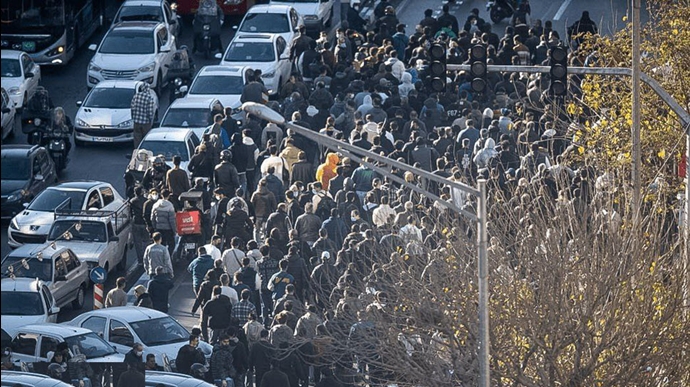

In a striking display of defiance that signals the deepening vulnerability of the Iranian regime, the Grand Bazaar of Tehran and major commercial centers across the capital have erupted into intense anti-government protests. What began on Sunday, December 28, as a strike against the catastrophic devaluation of the national currency has rapidly evolved into a political uprising targeting the highest echelons of the clerical establishment, including regime Supreme Leader Ali Khamenei.
The unrest, which entered its second day on Monday, December 29, 2025, has shattered the illusion of stability the regime has desperately tried to project more than a year into the presidency of Masoud Pezeshkian. With slogans shifting from economic grievances to explicit calls for regime change, the bazaaris—historically a barometer for major sociopolitical shifts in Iran—have signaled that the gap between the ruling theocracy and the Iranian people is now unbridgeable.
The spark: Currency collapse and hyperinflation
The immediate catalyst for this latest wave of unrest was a historic plunge in the value of the Iranian rial. By Sunday, the exchange rate for the US dollar had skyrocketed to over 1.45 million rials, a figure that has effectively paralyzed trade and commerce. This represents a staggering decline; just one month prior, the dollar traded at 1.14 million rials.
December 28—Tehran, Iran
Shopkeepers at Shoush Bazaar, plus traders in Aladdin Mall (6th floor) and Charsou Mall, staged protest rallies over the out-of-control dollar exchange rate and the economic chaos crushing their livelihoods.#IranProtests pic.twitter.com/SQS0lgrWjh— People's Mojahedin Organization of Iran (PMOI/MEK) (@Mojahedineng) December 28, 2025
The implications for the average Iranian are devastating. In the past year alone, food prices have surged by an average of over 66 percent. Even official government statistics, which routinely understate the severity of the crisis, admit that point-to-point inflation has surpassed 52 percent. Faced with hyperinflation and the inability to price goods or restock inventories, merchants in Tehran’s mobile phone and electronics hubs, specifically the Aladdin and Charsoo passages, initiated a strike that spread like wildfire.
From strike to street battles: A timeline of defiance
The uprising began in earnest on the afternoon of Sunday, December 28. Videos circulating on social media showed shopkeepers in the Aladdin complex closing their shutters and chanting, “Don’t be afraid, don’t be afraid, we are all together,” effectively turning the commercial corridors into protest venues. The strike quickly expanded to the Charsoo commercial complex across the street, the “Iron Market” in Shush, and the mobile phone district in Pakdasht. Merchants poured into the streets, marching toward the Hafez Bridge intersection, urging others to close their shops with chants of “Close them, close them” and “Support, support.”
December 28—Tehran, Iran
Shopkeepers, bazaar merchants, and residents rallied at Jomhuri Square over economic pressure and instability. They chanted: “Don’t be afraid—we’re all together,” and “Bazaar merchants may die, but won’t accept humiliation.”#IranProtests pic.twitter.com/EybIJEC4X4— People's Mojahedin Organization of Iran (PMOI/MEK) (@Mojahedineng) December 28, 2025
By Monday, December 29, the unrest had engulfed vast swathes of the capital. The strike spread to the “Light District” (Cheragh Bargh), the Gold Market, the Shoe Market (Bagh-e Sepahsalar), Lalehzar, Saadi, and the furniture markets of Yaftabad and Delavaran. The regime’s response was predictable brutal. In the Bagh-e Sepahsalar area and under the Hafez Bridge, security forces and special units loyal to Khamenei attacked the crowds with tear gas and batons. However, in a significant show of resilience, the youth and merchants fought back, forcing the repressive forces to retreat in several instances while chanting “Scoundrels, scoundrels.”
December 29—Tehran, Iran
Protests continue across the Tehran Grand Bazaar, including rallies in the Cheragh-Bargh. Merchants and residents condemn soaring prices, inflation, and crushing cost-of-living pressures, as more market sections join strikes and refuse to stay silent.… pic.twitter.com/DT9DM23Bx7— People's Mojahedin Organization of Iran (PMOI/MEK) (@Mojahedineng) December 29, 2025
Radicalization of slogans: Targeting the supreme leader
While economic desperation triggered the initial walkouts, the protests almost immediately took on a radical political character. The chants heard across Tehran on Monday left no doubt that the public holds the entire regime responsible for their misery. Slogans such as “Bazaaris will die but won’t accept humiliation,” “Death to the dictator,” and “Death to Khamenei” resonated through the streets of Ferdowsi, Jomhuri, and Lalehzar.
Crucially, the protesters drew a direct line between their poverty and the regime’s foreign policy adventurism. The chant “No Gaza, no Lebanon, my life for Iran” was heard once again, rejecting the regime’s funding of regional proxy groups at the expense of the Iranian people’s livelihoods. Furthermore, protesters specifically targeted the regime’s head with the chant, “This year is the year of blood, Seyyed Ali [Khamenei] is overthrown,” and dismissed the current president with “Pezeshkian have shame, let go of the country.”
December 29—Tehran, Iran
Protesters chant "Down with the dictator!" as the strikes in Tehran's bazaar enter second day.#IranProtests pic.twitter.com/8bZQh1fcse— People's Mojahedin Organization of Iran (PMOI/MEK) (@Mojahedineng) December 29, 2025
Regime admissions and the “hostage” economy
The intensity of the protests has forced even regime officials to admit to the systemic corruption and policy failures driving the collapse. Hossein Marashi, a former vice president of the regime, acknowledged that 40 percent of the country’s banking assets are “fictitious” and stated that for the past 20 years, Iran’s economy has been held “hostage to the nuclear issue.” He warned that the food crisis has the potential to drag hungry people into the streets.
Similarly, a member of the regime’s parliament, Aliyeh Kiasari, described the inflation as a fire fueled by “conflict of interest” among ruling elites who profit from the crisis. Even regime president Masoud Pezeshkian, facing the utter failure of his administration’s economic policies, confessed, “If problems aren’t solved, we can’t govern.” These admissions confirm what the Iranian Resistance has long maintained: the economic crisis is not due to external factors alone but is a result of the regime’s systematic looting and prioritization of nuclear and military ambitions over public welfare.
December 29—Tehran, Iran
Fresh images show a broad Tehran bazaar strike and protest against runaway inflation, backbreaking price hikes, the freefall of the rial, and deep economic instability. Merchants say dollar volatility and a bleak outlook have turned work into daily losses… pic.twitter.com/F5LVVLibaq— People's Mojahedin Organization of Iran (PMOI/MEK) (@Mojahedineng) December 29, 2025
The regime’s panic and the blame game
Terrified by the prospect of a widespread uprising reminiscent of previous nationwide protests, the regime has placed its security apparatus on high alert. The Islamic Revolutionary Guard Corps (IRGC) declared a 100 percent state of readiness for the “Sarallah” security headquarters in Tehran. Reinforcements from the repressive Basij, Ashura, and Fatehin battalions have been mobilized, and additional forces from the provinces of Mazandaran, Qom, and Semnan have been put on standby to be deployed to the capital.
In a move that reveals the regime’s fear of organized opposition, the IRGC-affiliated Fars News Agency attributed the radicalization of the protests to “small cells of 5 to 10 people.” Citing an intelligence official, the agency claimed these groups were following a specific “scenario” to convert economic grievances into political instability, explicitly blaming Mrs. Maryam Rajavi and the PMOI/MEK for directing the unrest. This acknowledgment inadvertently highlights the growing influence of the Resistance Units within the society.
December 29—Tehran, Iran
Security forces fired tear gas toward protesters at the Tehran Grand Bazaar as demonstrations continued amid anger over soaring prices, inflation, and worsening living conditions.#IranProtests pic.twitter.com/HCg024SgxE— People's Mojahedin Organization of Iran (PMOI/MEK) (@Mojahedineng) December 29, 2025
Nationwide expansion and the call for resistance
The uprising has rapidly spilled beyond the borders of Tehran. By Monday afternoon, protests were reported in major cities including Mashhad, Karaj, Kermanshah, Hamedan, and Qeshm. In Mashhad, protesters in Shohada and Saadi squares clashed with anti-riot forces, defending themselves with stones. In a symbol of the people’s fury, the vehicle of a cleric who insulted demonstrators by calling them “hypocrites” (monafeghin) was destroyed by the crowd.
Mrs. Maryam Rajavi, the President-elect of the National Council of Resistance of Iran (NCRI), praised the brave merchants and youth of Tehran. She emphasized that the skyrocketing currency rates, inflation, and systematic corruption have left the people with no choice but to revolt. “The protesters identified both the root of the problem, the velayat-e faqih regime, and the solution: resistance and uprising,” Mrs. Rajavi stated, calling on the nation’s youth to rise in solidarity with the bazaar.
The strike and protests by the honorable Tehran bazaar merchants expanded further for a second consecutive day, spreading across multiple markets and areas, including Beyn-ol-Haramayn, Chaharsouq, the Aluminum Building, Jafari Bazaar, Saray-e Melli, Lalehzar, Toopkhaneh,… pic.twitter.com/kO6cZhR0Bt
— Maryam Rajavi (@Maryam_Rajavi) December 29, 2025
As the slogans “Until the mullah is shrouded, this homeland won’t be a homeland” echo across Iran, it is clear that the bazaar uprising is not merely an economic strike; it is the latest chapter in the Iranian people’s ongoing revolution for freedom and democracy.