

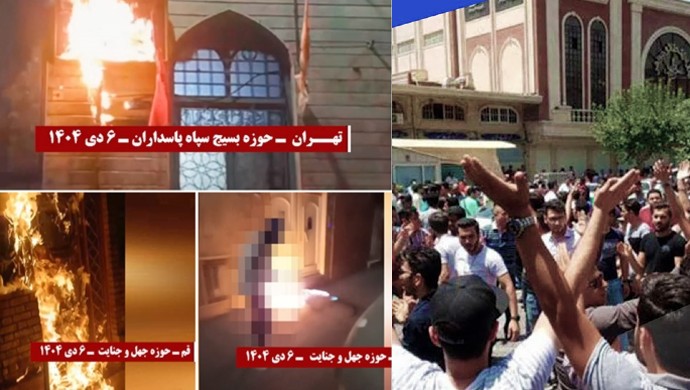

On the anniversary of Iran’s December 2017 uprising, where revolutionary upheavals from Mashhad to Tehran and Kermanshah, and from the north to the south of the country shook the ground under the feet of mullahs’ regime for more than 10 days with chants of “Death to Khamenei” and “Death to the dictator” across the occupied homeland, the rebellious youth carried out 15 fiery operations targeting the regime’s centers of suppression and crime in 11 cities.
By setting fire to Basij bases of the IRGC and centers of looting and suppression in Tehran, Qom, Zanjan, Isfahan, Mashhad, Yazd, Kerman, Qazvin, Hamedan, Dezful, and Izeh, the brave youth demonstrated that the volcano ignited during the December 2017 uprisings will not be extinguished until the regime in its entirety is overthrown.
The 15 operations by the rebellious youth on the anniversary of those great uprisings are as follows:
- Tehran: Setting fire to a center of fundamentalism, crime, and suppression of women
- Isfahan: Setting fire to a Basij base
- Mashhad: Setting fire to a center of fundamentalism and crime
- Qom: Setting fire to a center of fundamentalism and crime
- Hamedan: Setting fire to an IRGC Basij base
- Tehran: Setting fire to an IRGC Basij base
- Kerman: Setting fire to an IRGC Basij base
- Zanjan: Setting fire to the local headquarters of the regime’s corrupt Khomeini Committee
- Isfahan: Setting fire to a regime building
- Mashhad: Setting fire to the photos of regime founder Ruhollah Khomeini and supreme leader Ali Khamenei
- Yazd: Setting fire to a banner of Khamenei
- Kerman: Setting fire to a Basij unit tasked with suppressing students
- Qazvin: Setting fire to an IRGC Basij base
- Dezful: Setting fire to an IRGC Basij base
- Izeh: Setting fire to a monument of terror master Qassem Soleimani
The 2017 uprising, which began on December 28 (Dey 7) in Mashhad over economic grievances like the price of eggs, rapidly evolved into a political movement that spread across the country. Contrary to regime claims that it was a spontaneous event, the uprising was the result of accumulated dissatisfaction over four decades of suppression. According to the regime’s own officials, the protests spread to 160 cities, creating a dangerous situation for the regime.
It was during this uprising that the defining slogan, “Reformist, hardliner, the game is over,” became the chant of the nation, signaling a complete break with all factions of the theocracy. The regime’s Supreme Leader, Ali Khamenei, later admitted that the PMOI was the “third vertex” of a triangle that had organized and planned the protests for months, acknowledging the opposition’s leadership role in the unrest.
The uprising ignited such a fire across the homeland that Ali Rabiei, a former deputy of the Ministry of Intelligence, acknowledging the geographical extent and persistence of the uprisings, said: “The January protests were dangerous and sounded a siren that could spread further.”
During those days, Abdolreza Rahmani Fazli, the Interior Minister under regime president Hassan Rouhani, terrified, stated: “The January protests took place in 100 cities and turned violent in 40 cities. It was very different from 2009. It was not of the same nature. Because the level of accumulated dissatisfaction had risen and become general, wherever it found a possibility to emerge, it was expressed.”
During the uprising, protesters chanted revolutionary and fiery slogans that heralded a new era of foundational uprisings to overthrow the mullahs’ dictatorship. Slogans such as “Reformist, hardliner, the game is over,” “Woe to the day we become armed,” “So many years of crime, death to this rule,” and “Mullahs’ rule, we don’t want, we don’t want” were the cry of a generation that challenged the entirety of religious tyranny on the streets. The slogan “I will kill whoever killed my brother” symbolizes the determination of a generation that will not sit idly and let the regime continue with its crimes.
And today, the rebellious youth, with 15 fiery flames have lit the guiding light of “fire” and “uprising” to guide the masses to bring down the regime of execution and massacre.