

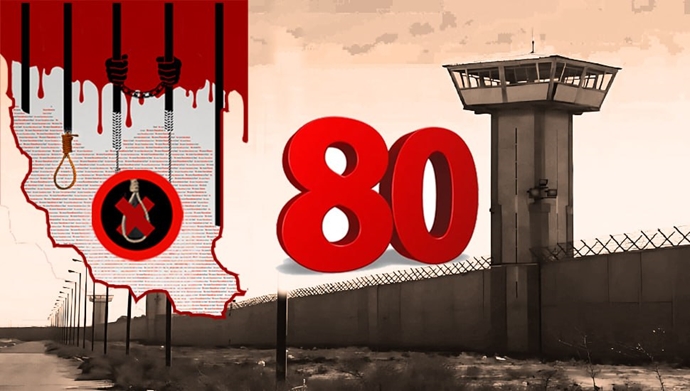

In a powerful display of coordinated defiance against the ruling theocracy, political prisoners in 48 of Iran’s most notorious prisons launched a mass hunger strike on Tuesday, August 5, marking the 80th consecutive week of the “No to Executions Tuesdays” campaign. Simultaneously, a wave of popular protests swept through dozens of cities across the country, with citizens taking to the streets in solidarity, demonstrating an unbreakable bond between the resistance in the dungeons and the uprising on the streets.
The unified action comes amid a horrifying surge in the regime’s use of capital punishment and medieval torture. In the week leading up to the protest, the authorities executed at least 30 prisoners, including two women, and carried out one hanging in public. In a particularly barbaric act, the regime amputated the fingers of three prisoners in Urmia Prison, a move condemned by Amnesty International as the work of a “cog in a torture machine” and by UN Special Rapporteur Mai Sato as “inhuman and degrading.”
The heart of the resistance: a message from the prisons
In their 80th weekly statement, released on August 5, the striking prisoners declared that the regime’s brutality is a calculated strategy to quell a society restless for freedom. “We believe that the goal of escalating executions, suppression, cutting off hands, and applying naked and incessant violence is nothing but to inject terror and fear and to silence society,” the statement read. The prisoners defiantly linked their struggle to Iran’s long quest for liberty, noting the day coincided with the 119th anniversary of the Constitutional Revolution.
The campaign has now expanded to 48 prisons, including Ghezel Hesar (Units 1, 3, and 4), Karaj Central Prison, Greater Tehran Prison, Evin Prison, and facilities in major cities like Mashhad, Isfahan, Shiraz, Tabriz, Ahvaz, and Sanandaj.
https://twitter.com/en_simayazadi/status/1952706243237224702
Regime’s brutal response: the Ghezel Hesar prison raid
The regime has responded to the prisoners’ organized resistance with extreme violence. On July 26, suppressive guards and security agents carried out a savage raid on political prisoners in Unit 4 of Ghezel Hesar Prison. They brutally beat key members of the campaign before transferring them to solitary confinement in the high-security Unit 3.
While some were returned after five days, the fate and whereabouts of five political prisoners remain unknown: Luqman Aminpour, Hamzeh Savari, Reza Salmanzadeh, Sepehr Emamjomeh, and Mostafa Ramezani. The condition of another prominent prisoner, Saeed Masouri, is described as “very worrying.” He is being held incommunicado in a solitary cell in Qezelhesar’s Special Unit 1 after the prison in Zahedan refused to accept his transfer. Despite the attack, the prisoners remain unbowed. “We… salute the resistance and steadfastness of our comrades on death row and in struggle,” they declared in their statement.
The people’s uprising: solidarity on the streets
The prisoners’ call for resistance was answered resoundingly by the Iranian people. Protests erupted in dozens of cities, including Tehran, Mashhad, Shiraz, Rasht, Sanandaj, Isfahan, Tabriz, and Kermanshah. Demonstrators carried placards and chanted slogans that directly challenged the regime’s authority:
- “The executioner government must be overthrown!”
- “Political prisoners must be freed!”
- “This is the final message: if you execute, there will be an uprising!”
At the forefront of these protests were the courageous families of political prisoners, who have become a symbol of the resistance. Mothers and fathers held signs reading “Do not execute our children” and “The right of Iran’s children is not execution.” Families of prisoners on death row, such as Vahid Baniamerian, Pouya Ghobadi, and Akbar Daneshvarkar, were seen leading demonstrations in several cities, demanding the immediate repeal of the unjust sentences. Their presence has transformed the campaign into a nationwide movement that has taken root deep within Iranian society.
August 5—Iran
Families of death row prisoners hold rallies in support of the "No to Executions Tuesdays" campaign in its 80th week.#IranProtests#نه_به_اعدام pic.twitter.com/MRlqZUTRjr— People's Mojahedin Organization of Iran (PMOI/MEK) (@Mojahedineng) August 5, 2025
A regime’s strategy unravels
The synchronized defiance from inside prisons and on the streets marks a significant strategic failure for the Iranian regime. Its primary tool of control—the gallows—is no longer instilling fear but is instead fueling an organized, nationwide movement for change. The fusion of the prisoners’ hunger strikes with popular street protests shows a new level of cohesion and determination among the Iranian people. Their clear and unified message is that they will not be silenced, and they will not stop until the regime’s machinery of torture and execution is dismantled and a free and democratic Iran is established.