

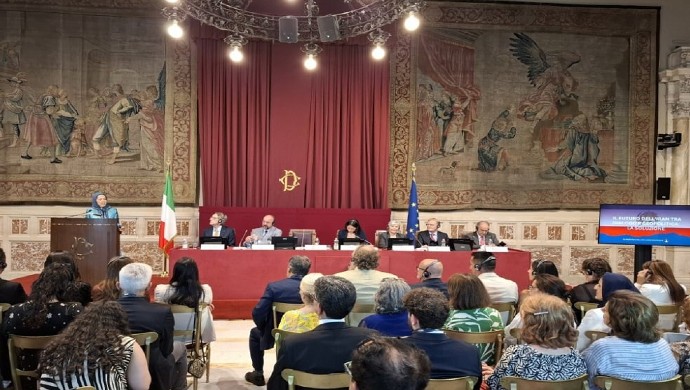

In a significant session at the Italian Parliament on July 30, 2025, a broad coalition of legislators, senators, and international dignitaries gathered to address the escalating crisis in Iran and explore a viable path toward a free and democratic future. Hosted in a chamber representing the heart of Italian democracy, the conference focused on the Iranian regime’s dire human rights record, its destabilizing regional role, and the democratic alternative presented by the Iranian Resistance.
The event, organized by Italian MP Naike Gruppioni, took place against a backdrop of heightened brutality by the clerical regime. The recent executions of political prisoners Behrouz Ehsani and Mehdi Hassani, both members of the People’s Mojahedin Organization of Iran (PMOI/MEK), cast a somber and urgent shadow over the proceedings, galvanizing calls for decisive international action.
Participants, including former European Council President Charles Michel and a strong delegation of Italian parliamentarians, voiced their support for the Ten-Point Plan for a future Iran proposed by Maryam Rajavi, the president-elect of the National Council of Resistance of Iran (NCRI). A key announcement during the session was that a majority in the Italian Senate had formally endorsed a declaration supporting Mrs. Rajavi’s plan, calling for the terrorist designation of the Islamic Revolutionary Guard Corps (IRGC) and affirming the legitimacy of the Iranian people’s struggle for freedom.
A roadmap for change by the Iranian people and their resistance
In her keynote address, Mrs. Rajavi thanked the Italian legislators for their focus on the “critical and urgent situation unfolding in Iran.” She began by honoring the recently executed PMOI members, Behrouz Ehsani and Mehdi Hassani, framing their deaths not as a sign of the regime’s strength, but of its desperation in the face of growing popular dissent. “Indeed, this regime—teetering on the edge of collapse—resorts to executions as a desperate response to the growing support among Iran’s youth for the PMOI,” she stated.
Speech at the Parliament of Italy
The Third Option: Change by the Iranian people and the Iranian Resistance
Just four days ago, the religious dictatorship in Iran committed yet another appalling crime: the execution of two members of the People's Mojahedin Organization of Iran,… pic.twitter.com/WFiGHYdvdS— Maryam Rajavi (@Maryam_Rajavi) July 30, 2025
Mrs. Rajavi underscored that the spirit of uprising is pervasive throughout Iran, turning even prisons into centers of defiance. She positioned the current moment as a historic turning point, arguing that the regime’s domestic repression and foreign warmongering are symptoms of its terminal decline. “This regime—in its entirety—is now standing at the edge of collapse. A decisive moment has emerged, one that holds the potential to reshape Iran and transform the broader region,” she declared.
Presenting a clear path forward, Mrs. Rajavi articulated the “Third Option,” a solution that rejects both foreign military intervention and appeasement of the religious dictatorship. Instead, it advocates for change led by the Iranian people and their organized resistance. She emphasized that the movement is self-reliant and seeks only political and moral solidarity, not material aid. “The Iranian people and the Iranian Resistance are not asking for money or weapons to bring down this regime,” she clarified. “They are simply demanding that no one stand with the regime.”
She firmly positioned this solution as the definitive break from Iran’s history of tyranny, ensuring a future free from the oppression of both the deposed monarchy and the current clerical rule. “The Third Option turns the page on the dark chapters of both the Shah and the mullahs and lays the foundation for a society built on freedom and democracy,” Mrs. Rajavi affirmed.
Achieving change in Iran is based on the Third Option:
Not foreign military intervention.
Not religious dictatorship or appeasement of it.
But regime change by the Iranian people and their organized resistance.
The Iranian people and the Iranian Resistance are not asking for… pic.twitter.com/KVO9Ic4X95— Maryam Rajavi (@Maryam_Rajavi) July 30, 2025
A unified condemnation of the regime’s human rights abuses
Speaker after speaker condemned the Iranian regime’s systematic use of the death penalty to crush dissent. Charles Michel, former President of the European Council, provided stark figures, stating, “Just last month, 81 prisoners were executed. That’s 130% more than in June last year. This is not just a cruel statistic; behind every number, it is a life unjustly taken.”
Italian Senator Giulio Terzi described the regime’s defining characteristic as “the daily use of the death penalty to suppress any form of dissent.” He expressed deep outrage at the recent executions of Ehsani and Hassani and recalled the 1988 massacre of 30,000 political prisoners, a “very dark page in the history of the world, which remains without justice to this day.” Senator Terzi also sharply criticized Western analysts who portray the regime’s new president as a moderate, calling it shameful to label “a person with whom one can negotiate” a man responsible for such horrors.
Senator Lucio Malan, President of the Majority Caucus, highlighted Iran’s grim status as a world leader in executions. “Unfortunately, Iran holds the sad record for the highest number of executions, certainly in proportion to its population, but perhaps even in absolute terms,” he noted. “It is an extremely sad issue: people are put to death on vague or false charges, and the repression is aimed at discouraging anyone who wants to fight for freedom.”
https://twitter.com/en_simayazadi/status/1950603900882493601
International backing for the ‘third option’ and a democratic alternative
The conference marked a strong consensus around the “Third Option” as the only viable policy on Iran. Charles Michel forcefully rejected both appeasement and foreign military intervention. “Appeasement does not work,” he stated, adding that “silence is complicity.” He endorsed the NCRI’s path, declaring, “There is indeed a third path—I’m tempted to say the only way, the only path promoted by the recognized opposition… regime change by the Iranian people and their organized and structured resistance.”
Linda Chavez, former White House Director of Public Liaison, echoed this sentiment. “Madame Rajavi talked about a third way… I’m going to differ with you a little bit… because I don’t think it is a third way. I think it is the only way,” she asserted, criticizing the U.S. administration’s statement of not seeking regime change as a “terrible statement.”
Italian legislators expressed similar support. MP Naike Gruppioni described Mrs. Rajavi’s Ten-Point Plan as “a dream for Iran: concrete, possible, and just, for a secular and free Iran.” Senator Lucio Malan referred to the plan as a “shared and reassuring program for everyone, [the program] of a modern and advanced nation, as the Iranian nation deserves to be.” This unified support underscored a growing international belief that a democratic, organized alternative to the current regime not only exists but is the key to a peaceful and stable future for Iran.
During today's conference at the Italian parliament, @chavezlinda told Simay Azadi's @Ehsaneghbale that the only solution to Iran’s tyranny is not to return to the monarchy or foreign invasion, nor appeasement but #IranThirdOption offered by Mrs. @Maryam_Rajavi pic.twitter.com/KtB6z4pjLx
— SIMAY AZADI TV (@en_simayazadi) July 30, 2025
Calls intensify to designate the IRGC as a terrorist entity
A central demand of the conference was the designation of the IRGC as a terrorist organization. The announcement that a majority of the Italian Senate supports this measure was a pivotal moment. Senator Giulio Terzi provided a powerful rationale, labeling Iran a “terrorist state.” He cited the foiled bombing of the NCRI’s 2018 rally in Villepinte, France, planned by a regime diplomat, and the assassination attempt on former European Parliament Vice President Alejo Vidal-Quadras in 2023, which Spanish courts have linked to Tehran.
Senator Terzi explained the regime’s modus operandi: “A regime that, through the financing, training, and supply of weapons to its proxy militias… sows terror. It sows it with Hezbollah, Hamas, the Palestinian Islamic Jihad, and the Houthis.” Mrs. Rajavi also directly linked the IRGC to the regime’s nuclear ambitions and regional aggression, framing the Resistance Units as the domestic force capable of countering it. The clear consensus was that blacklisting the IRGC is a necessary step to curb the regime’s global terrorism and support the Iranian people’s struggle.
==ALLA CAMERA CONVEGNO SU FUTURO DELL'IRAN "TRA DIALOGO E GEOPOLITICA"==
ROMA (ITALPRESS) – Behrouz Ehsani, 48 anni, e Mehdi Hassani, 70 anni, sono le ultime due vittime del regime iraniano, impiccati in segreto, il 27 luglio, nella prigione Ghezel Hesar di Karaj. Sull'ondata… pic.twitter.com/7SSxuPyqGD— Giulio Terzi (@GiulioTerzi) July 30, 2025
A clear rejection of all forms of dictatorship
The conference was unequivocal in its rejection of a return to the past, emphasizing that Iran’s future must be democratic and free from any form of tyranny, whether clerical or monarchical. Mrs. Rajavi’s “Third Option” explicitly aims to “turn the page on the dark chapters of both the Shah and the mullahs.”
This crucial point was reinforced by international speakers. Linda Chavez was direct in her dismissal of any alternative that does not empower the Iranian people. She praised the Iranian people who take to the streets and “proclaim no to Khamenei and no to a return of a monarchy in Iran, because that is not an answer.” The message from the speakers was clear: the only legitimate path forward is one that establishes a pluralistic, democratic republic based on the sovereignty of the Iranian people.
Solidarity with the Iranian people’s struggle for freedom
Throughout the event, speakers expressed deep admiration and solidarity with the Iranian people. MP Lorenzo Cesa shared a moving anecdote from his wife’s trip to Iran, where a family man told her, “I don’t know if I will see this country free, but I am sure that my children will live in democracy in the coming years, because this regime is destined to disappear.”
MP Emanuele Pozzolo framed the struggle in universal terms: “On one side, there are human beings who love life and freedom. On the other, unfortunately, there are human beings who live under the shroud of hatred and death… We stand with you, firmly and forever.”
https://twitter.com/EmanuelePozzolo/status/1950598319471820859
Simona Giaccardi, President of the Fossano City Council, praised Mrs. Rajavi as a symbol of hope for a generation that has known only oppression. “Her voice gives hope, and we are here to support her,” she said.
The conference in Rome was more than a political discussion; it was a powerful demonstration of international solidarity. The message was unambiguous: the world is watching, the policy of appeasement has failed, and there is growing support for the Iranian people and their organized resistance in their quest to establish a free, secular, and democratic republic.