

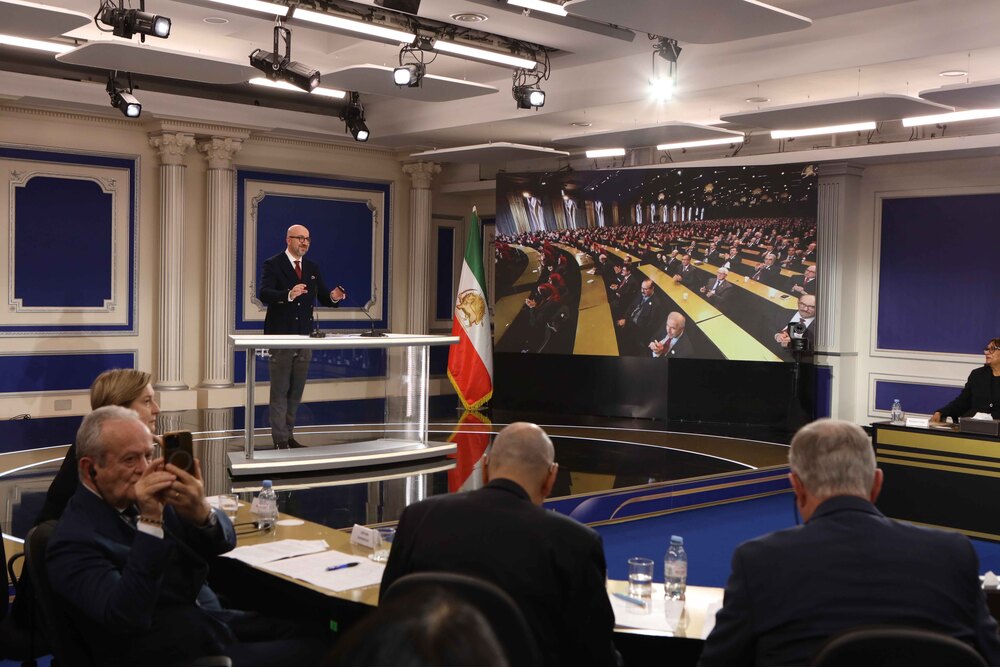

“The MEK and its Resistance Units on the ground are at the forefront of this struggle,” Charles Michel, former president of the European Council and former prime minister of Belgium, declared at an international conference in France on November 21, marking the seventh anniversary of Iran’s November 2019 uprising.
Addressing members of the Iranian Resistance, Michel added, “You are not spectators of history; you are making history!”
The conference, which brought together current and former parliamentarians, ministers, and political leaders from Europe and beyond, highlighted the role of organized opposition inside Iran in the struggle against dictatorship.
The speakers’ remarks came as Resistance Units affiliated with the People’s Mojahedin Organization of Iran (PMOI/MEK) continued their nationwide anniversary campaign, commemorating the November 2019 uprising and expressing their determination to achieve freedom and democracy.
A resistance that continues despite repression
Seven years after the November 2019 uprising, in which more than 1,500 protesters were killed, PMOI Resistance Units continue to commemorate the uprising through anti-regime activities across Iran.
The anniversary campaign has also included a series of operations against government-linked institutions and symbols of the regime. On November 14, Resistance Units reported carrying out 30 operations across Tehran and 16 other cities, followed by another 20 operations on November 16. These incidents were part of a broader nationwide campaign commemorating the seventh anniversary of the November 2019 uprising, taking place amid heightened security measures and surveillance.
On November 19, 2026, Resistance Units displayed placards and wrote graffiti in Tehran, Tabriz, Zahedan, Mahabad, Ahvaz, and other cities, honoring the victims of the uprising and reaffirming their commitment to political change. In Zahedan, Resistance Units held public placard campaigns on November 13 and 20, rejecting dictatorship and denouncing the regime’s repression.
These activities take place against the backdrop of an escalating campaign of executions and persecution of political opponents.
Dorien Rookmaker, former member of the European Parliament, addressed the Resistance Units and political prisoners, declaring, “Your courage inspires all who believe in a free, democratic, and prosperous Iran.”
“The more we see the regime being oppressive and aggressive, the more we know they fear you,” she added.
Lord Steve McCabe, member of the British House of Lords, also highlighted the significance of the recent Magnitsky Human Rights Award presented to death-row political prisoner Mohammad Javad Vafaei Sani, describing it as recognition of the sacrifices and determination of the Iranian people and their Resistance Units.
The strategic significance of organized resistance inside Iran
Beyond recognizing the sacrifices of Resistance Units, speakers at the conference examined the strategic importance of an organized opposition rooted inside Iranian society.
Hans-Ulrich Seidt, former German ambassador to Afghanistan and South Korea, presented the findings of a study titled Iran – the Internal Opposition as a Strategic Factor, which he co-authored with Carsten Müller, chair of the Judiciary Committee of the German Bundestag.
Seidt argued that neither decades of European diplomacy nor foreign military intervention had resolved the Iranian crisis. He emphasized the importance of organization in translating popular discontent into political change.
“What is necessary is an organized opposition,” Seidt said, stressing that such an opposition must have a presence inside the country.
Seidt also highlighted the experience accumulated by successive generations of PMOI members in their opposition to both the shah’s dictatorship and clerical rule, as well as the democratic program presented by the National Council of Resistance of Iran (NCRI).
The continued public activities of Resistance Units during the November uprising anniversary illustrate the domestic dimension of the opposition that Seidt emphasized in his analysis.
Two fundamentally different visions for Iran’s future
The conference also highlighted the contrast between a political movement rooted inside Iran and efforts to bring about political change through foreign military intervention.
Michel criticized Reza Pahlavi, the son of Iran’s deposed shah, for his advocacy of foreign military intervention, questioning the democratic credentials of a figure who continues to defend his father’s legacy.
“Foreign military intervention cannot deliver democracy,” Michel stressed, identifying democratic change led by the Iranian people themselves as the alternative to both appeasement and war.
Lars Rise, former member of the Norwegian Parliament, also addressed the distinction between the organized Iranian Resistance and the political alternative promoted by Pahlavi’s supporters.
“The real question now is: it’s not who opposes the regime, but who has the principles, the organization, and the capacity to replace it,” Rise said.
The rejection of both forms of dictatorship was also a recurring theme in the Resistance Units’ anniversary activities. Through their operations and activities, they expressed their opposition to both clerical rule and a return to monarchy, reflecting the democratic republican aspirations articulated at the conference.
Iran’s future belongs to its people
The international figures gathered in France emphasized that the role of the international community should be to support the Iranian people’s democratic aspirations, not to determine their political future.
As Lord McCabe explained, “The Resistance isn’t asking Western governments to fight its battle. It’s seeking political support for the Iranian people’s legitimate struggle for freedom, justice, and democracy.”
Seven years after the November 2019 uprising, the continued activities of Resistance Units and the steadfastness of political prisoners underscore the persistence of opposition inside Iran. Their struggle and their rejection of both clerical and monarchical dictatorship reflect a vision of political change based on popular sovereignty.
As John Bercow, former speaker of the British House of Commons, concluded:
“The future of Iran does not belong to a prince because of his birth. It does not belong to a cleric because of his title. And it does not belong to a politician because of his ambition. It belongs to the people of Iran themselves.”