

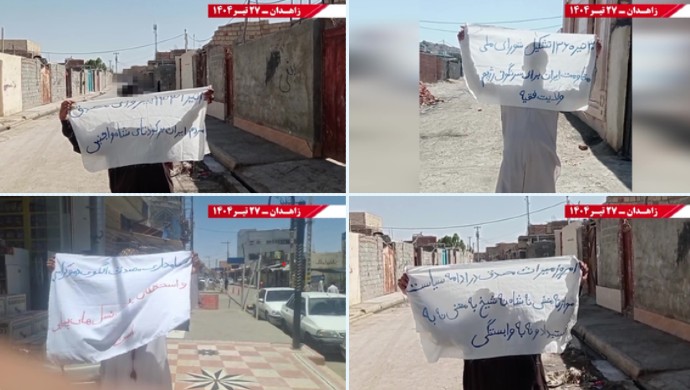

On the anniversary of the historic July 21, 1952, national uprising, PMOI Resistance Units in Zahedan have sent a powerful message of defiance against the ruling clerical dictatorship. This date commemorates a landmark event where the Iranian people took to the streets in massive numbers to successfully force the Shah to reinstate the popular and democratically-oriented Prime Minister Mohammad Mossadegh, marking a major victory for popular sovereignty against monarchic rule.
By staging public activities and displaying banners that link this legacy to the current struggle, the Resistance Units have reaffirmed the Iranian people’s four-decade-long quest to establish a democratic republic. These actions are not merely a commemoration of history, but a clear declaration that the fight for freedom and independence in Iran is a continuous, organized struggle that will not be deterred.
"July 21, 1952, marked the victory of Mossadegh and the people of Iran over the coup of Shah and his foreign masters" pic.twitter.com/UAZwaYQ4X4
— People's Mojahedin Organization of Iran (PMOI/MEK) (@Mojahedineng) July 19, 2025
A rejection of all forms of dictatorship
A central theme of the Resistance Units’ activities was the emphatic rejection of all forms of tyranny, whether from the deposed monarchy or the current religious regime. The banners drew a direct line from Mossadegh’s struggle against colonialism and the shah’s autocracy to the modern fight against the mullahs.
Slogans made it clear that the Iranian people seek a future free from any form of oppression. “Today, the legacy of Mossadegh is ‘no to shah, no to mullahs,’ which represents the rejection of tyranny and dependence (on foreign states),” one banner read. Another popular slogan echoed this sentiment across the country: “From Zahedan to Tehran, down with the oppressor, be it the shah or the mullahs.” This message underscores that the goal is not to replace one dictator with another, but to establish genuine popular sovereignty.
"Today, the legacy of Mossadegh is 'no to shah, no to mullahs,' which represents the rejection of tyranny and dependence (on foreign states)" pic.twitter.com/itekvv4SWZ
— People's Mojahedin Organization of Iran (PMOI/MEK) (@Mojahedineng) July 19, 2025
The Third Option: The only path forward for Iran
The activities in Zahedan powerfully advocated for the “Third Option,” the long-standing policy of the Iranian Resistance that rejects both foreign military intervention and appeasement of the current regime. Banners championed this path as the only legitimate solution to the crisis in Iran. One slogan stated clearly, “The Third Option: No to war, no to appeasement, yes to regime change by the people and Resistance.”
This policy places the responsibility and power for change squarely in the hands of the Iranian people and their organized Resistance movement. It is a declaration of self-reliance and a call for the world to support the Iranian people’s own aspirations, not to interfere or prop up their oppressors.
Defiance in the face of escalating repression
These acts of resistance are taking place amidst a backdrop of heightened repression by the regime. The slogans directly confronted the regime’s desperate measures to maintain control, including its recent campaign of mass arrests under the pretext of security following its 12-day war with Israel. “Khamenei is resorting to mass arrests to escape the fury of the people,” one banner declared.
"Khamenei will be overthrown, with or without atomic bombs" pic.twitter.com/HBNjzj08JL
— People's Mojahedin Organization of Iran (PMOI/MEK) (@Mojahedineng) July 19, 2025
The Resistance Units also showed their resolve in the face of the regime’s nuclear threats, which it views as an insurance policy for its survival. Another slogan boldly proclaimed, “Khamenei will be overthrown, with or without atomic bombs.” This demonstrates that neither internal crackdowns nor external posturing can crush the spirit of resistance.
An unbroken chain of struggle for a democratic republic
The events in Zahedan weave together the threads of Iran’s modern history into an unbroken narrative of struggle. They connect the 1952 uprising, the formation of the National Council of Resistance of Iran (NCRI) on the same anniversary in 1981 after the regime violently crushed all peaceful opposition, and the defiant activities of today’s Resistance Units.
This continuity proves the resilience and determination of a movement that has been fighting for decades. As the Resistance Units declared on their banners, “The Resistance of the people of Iran for liberation must be recognized.” Their message is a clear call to the international community to stand on the right side of history by recognizing the Iranian people’s right to overthrow their dictatorial rulers and establish the free, democratic, and sovereign republic they have long fought for.